
TL;DR:
- Social selling uses social media to build trust and relationships before direct outreach begins. Sales professionals who adopt this method generate more opportunities and are more likely to meet their quotas.
Social selling is defined as the practice of using social media platforms to identify prospects, build relationships, and create sales opportunities through trust rather than interruption. Sales professionals who adopt this approach generate 45% more opportunities and are 51% more likely to hit quota than those who rely on cold outreach alone. That gap is not a coincidence. Buyers now research vendors independently, engage with content before speaking to anyone in sales, and expect conversations that feel relevant from the first message. LinkedIn, in particular, has become the primary arena for B2B social selling, and agencies like The Lead Lab have built entire service models around making that engagement systematic and repeatable.
What is social selling and how does it work day to day?
Social selling is the structured use of social media to move prospects through the early stages of a buying journey before any direct sales conversation begins. It replaces cold interruptions with warm, credibility-driven contact. The mechanics are straightforward, but the discipline required is not.
The core daily activities break down into four repeatable steps:
- Prospect identification. Use LinkedIn’s search filters, Sales Navigator, or Twitter/X lists to find buyers who match your ideal customer profile. Look for signals like recent job changes, company announcements, or content they have published.
- Content sharing. Post insights, commentary, and case studies that demonstrate expertise. The goal is to appear in a prospect’s feed as a credible peer, not a vendor.
- Personalized engagement. Comment on prospects’ posts with genuine observations. Send connection requests with a specific reason tied to their work. Reference something real, not a template.
- Relationship nurturing. Follow up with relevant articles, congratulate milestones, and check in after key events. Consistency builds the familiarity that makes later outreach land.
Effective social selling requires roughly one dedicated hour per day. That time investment is what separates practitioners who build real pipeline from those who post occasionally and wonder why nothing converts.
Pro Tip: Set a daily 20-minute block for social listening. Use LinkedIn notifications and Twitter/X lists to track what your top 50 prospects are posting. React and comment before you ever send a direct message.

The shift from interruptive to trust-based selling is the defining feature of this approach. Social selling builds peer-to-peer relationships rather than vendor-to-buyer transactions. That dynamic change makes buyers more open to conversation when direct outreach eventually happens.
What are the key benefits of social selling for B2B professionals?
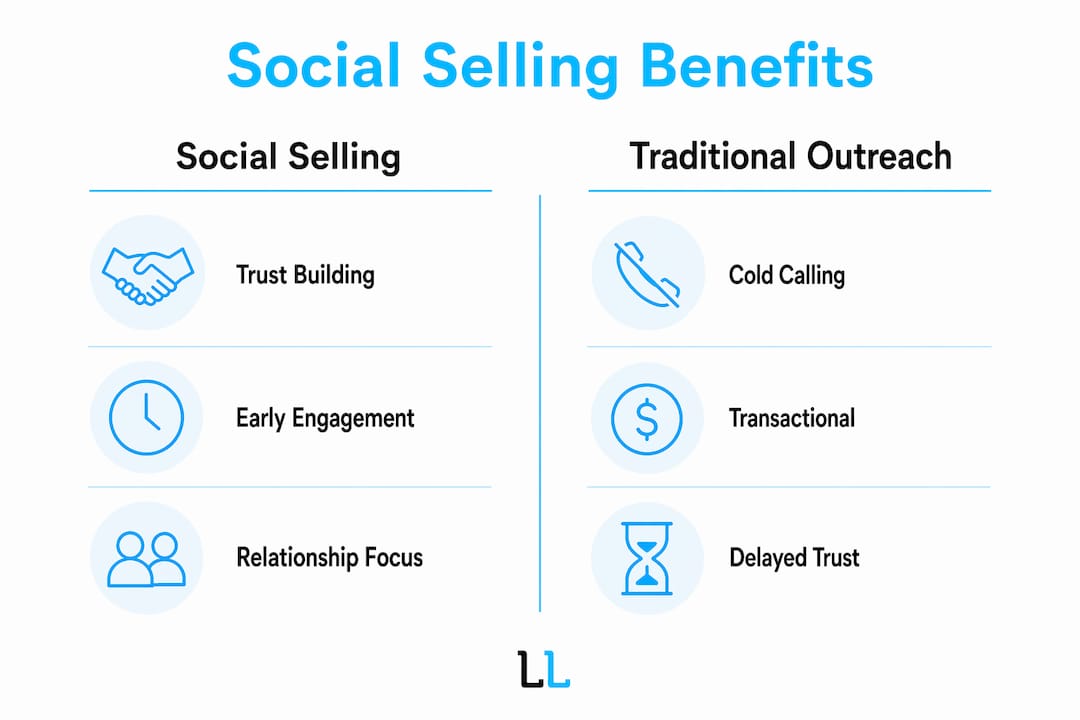
Social selling produces measurable results that traditional outreach cannot match at the top of the funnel. 78% of top-performing sales reps use social platforms to build pipeline faster, and 66% of those fill their pipelines successfully compared to fewer than 50% relying on traditional methods alone. The performance gap is consistent across industries.
The specific benefits for B2B professionals include:
- More qualified pipeline. Prospects who engage with your content before a call already understand your positioning. That shortens discovery conversations and improves close rates.
- Multi-stakeholder reach. B2B buying decisions involve 5–11 stakeholders across departments and can span 3–18 months. Social selling lets you build relationships with multiple decision-makers simultaneously, not just the one contact you found in a CRM.
- Faster trust establishment. Buyers who follow your content before a meeting arrive with context. You skip the credibility-building phase that consumes the first half of most cold sales calls.
- Brand credibility at the individual level. A well-maintained LinkedIn profile with consistent, expert content signals authority in a way that a company page alone cannot replicate.
The contrast with traditional methods is clearest in complex deals. Cold calling and email blasts work for transactional sales with short cycles. Social selling works for the kind of considered, multi-stakeholder purchases that define most B2B professional services.
| Dimension | Social selling | Traditional outreach |
|---|---|---|
| Trust-building phase | Before first contact | During the sales call |
| Stakeholder reach | Multiple, simultaneously | Usually one contact at a time |
| Pipeline fill rate | 66% success rate | Below 50% success rate |
| Best fit | Long-cycle, complex B2B deals | Short-cycle, transactional sales |
| Primary channel | LinkedIn, Twitter/X, Instagram | Phone, email, trade events |
Social selling and traditional selling serve different phases of the buyer journey. Social selling builds trust early. Traditional selling closes deals. The strongest B2B sales motions use both.
What social selling strategies deliver the best results?
The most effective social selling strategies rest on four pillars: a credible personal brand, a disciplined prospecting process, trigger-based engagement, and consistent relationship nurturing. Skipping any one of them produces inconsistent results.
Building a credible personal brand
Your LinkedIn profile is the first thing a prospect checks after you engage with their content. A profile that reads like a resume kills momentum. Rewrite your headline and summary to speak to the problems you solve for buyers, not the titles you have held. Add proof: case studies, recommendations, and published articles carry more weight than job descriptions.
Professional photography matters more than most sales professionals admit. A clear, current headshot signals that you take your professional presence seriously. Business photography guidance for professionals covers the practical steps to get this right without a large budget.
Using trigger-based engagement
Trigger-based engagement uses real-time prospect events, such as job changes, funding announcements, or published articles, to start timely, relevant conversations. A message referencing a prospect’s recent promotion lands differently than a generic outreach template. Set up LinkedIn alerts for your top accounts and act within 24–48 hours of a trigger event.
Pro Tip: When a prospect publishes a post that gets strong engagement, add a substantive comment within the first two hours. Early, thoughtful comments get seen by the prospect and their entire network.
Avoiding the broadcast trap
A frequent error in social selling is treating social platforms as broadcasting channels. Posting promotional content about your product on a personal profile is the fastest way to lose followers and credibility. Every piece of content you share should teach, provoke thought, or solve a specific problem your buyers face. Promotion belongs on company pages and paid channels, not your personal feed.
Integrating social selling activity with your CRM keeps the effort from becoming invisible to the rest of your team. Log connection requests, content interactions, and direct messages as touchpoints. That data shows which social activities actually move prospects into pipeline.
How can sales and marketing teams align to maximize social selling impact?
Sales and marketing alignment is the multiplier that makes social selling scale. Without it, sales reps create content in isolation, marketing runs campaigns that ignore individual rep activity, and buyers get a fragmented experience. With it, every touchpoint reinforces the same message.
Marketing creates awareness and brand presence at the company level. Social selling builds personal credibility at the individual rep level. The two work together: marketing warms the market, and social selling warms the specific relationship. A prospect who has seen your company’s thought leadership content is already primed when a rep engages with their post.
Practical alignment steps include:
- Content enablement. Marketing creates a library of articles, data points, and short-form posts that reps can share or adapt. Reps should not be writing from scratch every day.
- Shared ICP definition. Sales and marketing agree on the ideal customer profile, so social prospecting targets the same accounts that paid campaigns are reaching.
- Social listening integration. Tools that track prospect engagement with company content feed directly into sales workflows. A rep should know when a target account has visited the pricing page or engaged with a LinkedIn ad.
- Governance and coaching. Managers review social activity in the same cadence as call reviews. Reps who get coaching on their LinkedIn content improve faster than those left to figure it out alone.
The LinkedIn outreach tips that work best are almost always the product of sales and marketing working from the same playbook. When both teams share data and messaging, the buyer experience feels coherent rather than accidental.
Key takeaways
Social selling works because it builds trust with multiple stakeholders before direct outreach begins, producing higher pipeline fill rates and better quota attainment than traditional methods alone.
| Point | Details |
|---|---|
| Core definition | Social selling uses social media to build relationships and create sales opportunities before direct outreach. |
| Quota impact | Reps using social selling are 51% more likely to meet quota than those relying on traditional methods. |
| Multi-stakeholder reach | B2B deals involve 5–11 stakeholders, and social selling lets you engage all of them simultaneously. |
| Daily discipline | Effective social selling requires roughly one dedicated hour per day, not occasional activity. |
| Sales-marketing alignment | Marketing creates awareness; social selling builds personal credibility that makes direct outreach land. |
Social selling is a long game, and that is the point
I have watched sales teams adopt social selling with genuine enthusiasm, post for three weeks, see no immediate pipeline, and quietly abandon it. That pattern is the single biggest reason social selling underperforms for most organizations. It is not a tactic you run for a quarter. It is a discipline you build into how you work.
The reps I have seen get the most from social selling share one trait: they treat it like a professional development habit, not a lead generation hack. They post because they have something worth saying. They comment because they are genuinely curious about what their prospects are thinking. That authenticity is not a soft concept. It is the mechanism that makes the whole thing work. Dedicating 10–15% of weekly working hours to social engagement is what separates reps who build real relationships from those who collect connections.
The other thing I would push back on is the idea that social selling replaces traditional sales. It does not. Cold outreach still closes deals. Social selling makes that outreach far more likely to succeed by doing the trust work first. The best B2B sales professionals use both, and they know exactly which phase of the buyer journey each one serves.
If you are starting out, pick one platform, commit to one post per week, and spend 20 minutes a day engaging with your target accounts. Do that for 90 days before you judge the results. The LinkedIn messaging practices that convert are almost always the product of reps who have been showing up consistently for months, not days.
— Toby
How The Lead Lab supports your social selling efforts
Social selling works best when your outreach is targeted, your messaging is sharp, and your follow-up is consistent. Getting all three right at scale is where most teams struggle.
The Lead Lab specializes in done-for-you LinkedIn outreach campaigns built for professional services firms. From prospect targeting and message copywriting to response management and campaign analytics, every element is handled with a focus on qualified meetings, not just activity metrics. If you want to see what a well-built LinkedIn lead generation program looks like in practice, The Lead Lab’s client case studies show the results across a range of professional services sectors.
FAQ
What is social selling in simple terms?
Social selling is the practice of using social media platforms to build relationships with prospects before making a sales pitch. The goal is to create trust and familiarity that makes direct outreach more effective.
How is social selling different from social media marketing?
Social media marketing builds brand awareness at the company level through paid and organic content. Social selling is done by individual sales professionals to build personal credibility and engage specific prospects directly.
Which platform works best for B2B social selling?
LinkedIn is the primary platform for B2B social selling because it concentrates professional buyers, decision-makers, and industry conversations in one place. Twitter/X and Instagram play supporting roles depending on the industry.
How long does social selling take to produce results?
Social selling typically requires consistent daily activity over 60–90 days before meaningful pipeline appears. Reps who dedicate structured time weekly see stronger results than those who engage sporadically.
Does social selling replace cold outreach?
Social selling does not replace cold outreach. It builds the trust and familiarity that makes cold outreach significantly more likely to convert, particularly in long-cycle B2B deals with multiple stakeholders.