
TL;DR:
- Effective response management is a structured process that improves communication speed, accuracy, and accountability across an organization. Treating responses as strategic assets enables faster, more informed decisions and enhances customer trust and revenue growth. Implementing clear roles, templates, and continuous improvement practices turns response handling into a competitive advantage.
Response management is the systematic process of receiving, analyzing, crafting, and delivering communications that address customer inquiries, complaints, audit findings, and business requests in a consistent, timely, and accountable way. The industry term most professionals use is “response management,” though the strategic evolution of this practice now carries a more specific label: Strategic Response Management, or SRM. Understanding what is response management means recognizing it as far more than answering emails. The DMAIC framework (Define, Measure, Analyze, Improve, Control) gives organizations a proven structure to measure and continuously improve response quality and speed. The Lead Lab builds response management directly into its LinkedIn outreach campaigns, treating every reply as a data point and a revenue opportunity.
What is response management and why does it matter?
Response management is defined as the coordinated system an organization uses to handle all inbound communications with accuracy, speed, and accountability. This definition covers everything from customer service replies and audit findings to RFP submissions and sales follow-ups. The common thread is structure: who responds, what they say, and how fast they say it.
The business case is direct. Poor response management erodes customer trust, creates legal exposure, and leaves revenue on the table. A prospect who receives a vague or delayed reply will move to the next vendor. A management response in audits typically includes a resolution timeline of around 60 days, clearly defined corrective actions, and named accountability assignments. That same discipline applies to customer communications: define the action, name the owner, set the deadline.
Response management also functions as a quality signal. Customers judge a company’s competence by how it responds under pressure. A well-structured reply to a complaint communicates control. A scattered, delayed, or inconsistent reply communicates the opposite.
What are the core components of effective response management?
Every effective response management process follows four stages: receive, analyze, craft, and deliver. Each stage has distinct requirements.

Receive means capturing all inbound communications in one place. Siloed inboxes and disconnected channels create gaps. A centralized intake system, whether a CRM, helpdesk platform, or shared inbox, prevents messages from falling through.
Analyze means reading the communication for intent, urgency, tone, and required action before drafting a reply. Skipping this step produces generic responses that miss the point and frustrate the sender.
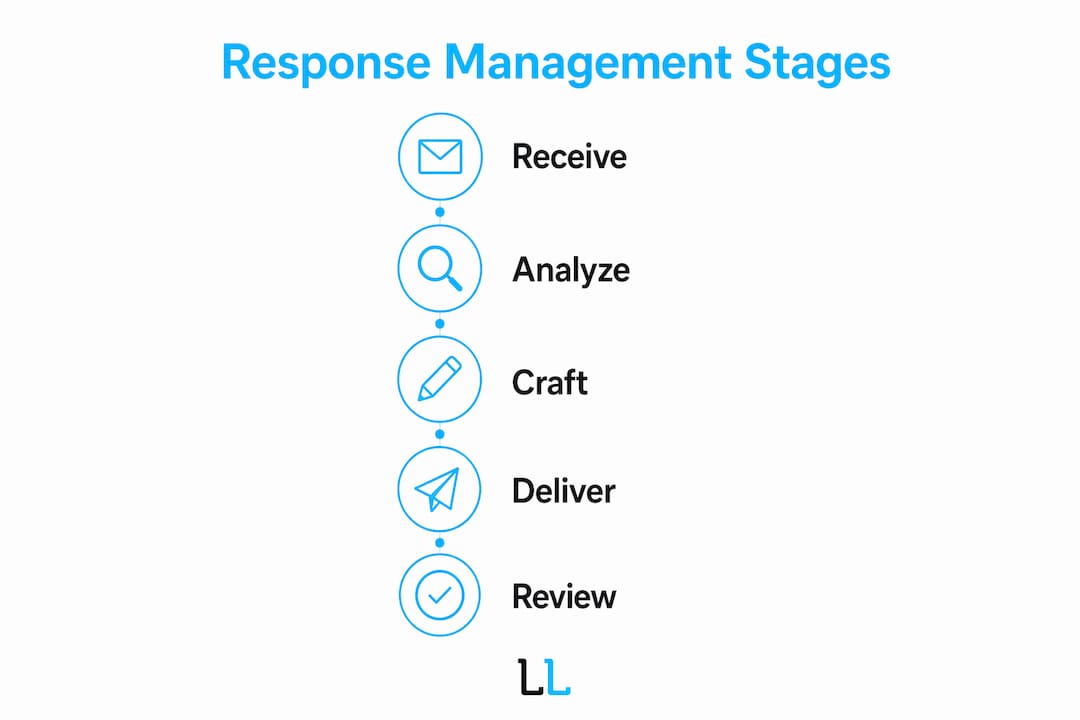
Craft is where tone, accuracy, and accountability come together. A management response differs from a corrective action plan by focusing on high-level acknowledgment and accountability rather than step-by-step remediation. The same principle applies in customer communications: acknowledge the issue, state the action, name the owner.
Deliver means sending the response through the right channel, at the right time, with the right follow-up trigger. Delivery without a follow-up system is incomplete.
Roles matter as much as process. Every response workflow needs a drafter, a reviewer, and an approver for high-stakes communications. Without clear ownership, responses either stall or go out unchecked.
Pro Tip: Set a maximum internal review time for each response category. Audit responses may warrant 48 hours of review. Routine customer inquiries should clear in under four hours. Defining these thresholds in writing prevents bottlenecks.
Tone calibration with active, direct language builds trust. Corporate jargon and passive voice erode customer confidence, especially in high-volume automated responses. Small misalignments in tone significantly impact customer perceptions and loyalty. Write in plain language, use the active voice, and address the sender’s specific concern before offering a solution.
How does Strategic Response Management transform business outcomes?
Strategic Response Management (SRM) is the practice of treating every response as an asset, not just a task. Where traditional response management focuses on answering correctly, SRM focuses on answering faster, learning from patterns, and using response data to drive business decisions.
SRM platforms create a centralized knowledge base that enables faster, more accurate business communication across the organization. AI-driven SRM tools democratize information, enabling quick responses across RFPs, security questionnaires, and ad hoc requests. That means a sales team in one region can draw on answers already approved by legal and compliance in another region, without starting from scratch.
The strategic benefits extend beyond speed:
- Revenue growth. Faster, more accurate RFP responses win more contracts. Organizations that treat response management as a strategic capability realize measurable gains in revenue and risk reduction.
- Market intelligence. Patterns across customer responses reveal which objections recur, which features customers request most, and which competitors they mention. That data informs product strategy and go/no-go decisions.
- Operational agility. A centralized knowledge base cuts the time teams spend searching for approved answers, freeing them to focus on higher-value work.
- Customer experience. Consistent, accurate responses across every channel build the kind of trust that drives repeat business and referrals.
Leading organizations approach response management as a knowledge engine that unlocks revenue and market intelligence. This shift from reactive to strategic is the defining difference between companies that treat communication as overhead and those that treat it as a competitive advantage.
Pro Tip: Before adopting an SRM platform, audit your existing response library. Identify your 20 most common inquiries and build approved answers for each. That foundation makes any AI-assisted tool dramatically more effective from day one.
What are the common challenges in implementing response management?
The most common failure in response management is a reactive mindset. Teams respond to whatever arrives loudest rather than following a structured intake and prioritization process. The result is inconsistent quality, missed deadlines, and frustrated customers.
Three other pitfalls appear consistently:
- Inconsistent tone. When multiple team members respond without shared guidelines, customers receive different experiences depending on who picks up the ticket. Canned responses are structured, pre-approved templates that maintain accuracy, tone, and reduce cognitive load in high-volume settings. They are not a shortcut. They are a quality control mechanism.
- Lack of accountability. Responses that require no named owner get delayed or ignored. Every response category needs an assigned role.
- Ungoverned AI use. Free-form AI-generated responses carry legal and reputational risk in sensitive interactions. Experts advise locking core response templates for sensitive topics and allowing AI only to personalize non-critical portions, preserving brand integrity.
The table below contrasts reactive and strategic approaches across four dimensions.
| Dimension | Reactive approach | Strategic approach |
|---|---|---|
| Intake | Ad hoc, siloed inboxes | Centralized, categorized intake system |
| Tone | Varies by individual | Governed by shared style guidelines |
| Accountability | Unclear ownership | Named roles with defined timelines |
| Learning | No feedback loop | Response data analyzed for patterns |
Pro Tip: Build a two-tier template library. Tier one covers locked, legally reviewed language for complaints, refunds, and compliance topics. Tier two covers flexible, AI-personalizable language for general inquiries and follow-ups. This structure gives you speed without sacrificing control.
For teams managing client communication workflows, documenting these tiers in a shared playbook reduces onboarding time and keeps quality consistent as the team scales.
How do you implement response management step by step?
A practical implementation follows five steps, grounded in the DMAIC model and audit response best practices.
- Define your response categories. List every type of inbound communication your organization receives: customer complaints, sales inquiries, audit findings, RFPs, and internal requests. Assign a priority level and a target response time to each category.
- Assign roles and ownership. Name a drafter, reviewer, and approver for each category. Document these assignments in a shared process guide. Without named owners, accountability collapses.
- Build your template library. Draft approved responses for your 20 most common inquiries. Include tone guidelines, required disclosures, and escalation triggers. Review templates with legal and compliance before publishing.
- Measure response quality and speed. Track first response time, resolution time, and customer satisfaction scores for each category. Use these metrics to identify which categories need improvement.
- Refine continuously. Schedule a monthly review of response metrics and template performance. Update templates when products, policies, or customer needs change. This step is where the DMAIC “Control” phase lives.
The Lead Lab applies this exact structure to LinkedIn outreach campaigns, treating each prospect reply as a categorized inbound communication with a defined response workflow. Teams that follow this lead response management process convert more conversations into qualified meetings because they respond faster and more accurately than competitors who handle replies ad hoc.
Integrating response management with your CRM closes the loop between communication and revenue. Every response becomes a record. Every record becomes a data point. Every data point informs the next campaign, the next product decision, or the next hiring plan.
For teams focused on high-touch customer service, the implementation roadmap above applies directly. The difference between a good response and a great one is often the structure behind it, not the individual writing it.
Key Takeaways
Effective response management requires a centralized intake system, named accountability, tone governance, and a continuous improvement loop to convert communications into business outcomes.
| Point | Details |
|---|---|
| Define response categories | List every inbound communication type and assign a priority level and target response time. |
| Assign clear ownership | Name a drafter, reviewer, and approver for each category to prevent delays and inconsistency. |
| Use a tiered template library | Lock legally sensitive language and allow AI to personalize only non-critical portions. |
| Adopt Strategic Response Management | Treat response data as a knowledge asset to drive revenue, market intelligence, and faster decisions. |
| Measure and refine continuously | Track first response time and resolution time monthly, then update templates and workflows accordingly. |
Why response management is the most underrated business system
Most managers I work with treat response management as a support function. They staff it reactively, measure it loosely, and revisit it only when something goes wrong. That framing costs them more than they realize.
The organizations I have seen grow fastest treat every inbound communication as a signal. A customer complaint tells you where your product breaks. A prospect’s objection tells you where your positioning fails. An audit finding tells you where your controls are weak. None of that intelligence reaches decision-makers if the response process is just about closing tickets.
The shift to Strategic Response Management is not about buying a platform. It is about deciding that your responses are worth governing. That means writing down who owns what, setting time standards, and reviewing performance data monthly. Most teams skip those steps because they feel administrative. They are actually the difference between a communication function that costs money and one that generates it.
AI makes this easier, but it does not replace the governance layer. I have seen teams deploy AI-assisted response tools and immediately lose brand consistency because no one locked the core templates. The technology is only as good as the structure behind it. Build the structure first. Then add the technology.
The follow-up discipline that separates top-performing sales teams from average ones applies equally to response management. Speed matters. Accuracy matters more. Consistency across both is what builds the trust that converts prospects into clients and clients into advocates.
— Toby
How The Lead Lab approaches response management for clients
Response management is a core part of every campaign The Lead Lab runs for professional services firms. When a prospect replies to a LinkedIn outreach message, that reply enters a structured workflow: categorized, prioritized, and handled with approved language that reflects the client’s brand.
The Lead Lab’s done-for-you campaigns include message copywriting, prospect targeting, and full response management so clients never miss a qualified conversation. The result is a consistent pipeline of meetings booked without the client managing individual replies. If you want to see how this works in practice, the client portfolio includes case studies from professional services firms that scaled their outreach without scaling their headcount. For a full picture of available services, visit The Lead Lab.
FAQ
What is the response management definition?
Response management is the systematic process of receiving, analyzing, crafting, and delivering communications to address inquiries, complaints, or findings in a consistent and timely way. It applies across customer service, audit compliance, sales, and RFP workflows.
What is crisis response management?
Crisis response management is a specialized branch of response management focused on coordinating communications during high-stakes events such as product failures, public complaints, or regulatory investigations. It prioritizes speed, accuracy, and a unified message across all channels.
What are the key response management best practices?
The most effective practices include centralizing inbound communications, assigning named owners to each response category, building a tiered template library, and measuring first response time and resolution time monthly.
How does AI fit into response management tools?
AI works best in response management when it personalizes non-critical portions of pre-approved templates. Free-form AI responses carry legal and reputational risk in sensitive interactions, so locking core language and letting AI handle personalization is the recommended approach.
How does response management support lead generation?
Every prospect reply is an inbound communication that requires a structured response. Teams that apply response management principles to sales conversations, including defined timelines, approved language, and named ownership, convert more replies into qualified meetings than teams that handle replies ad hoc.