TL;DR:
- Outbound marketing involves proactively engaging targeted prospects through personalized multi-channel outreach to generate qualified leads. It emphasizes precision targeting using ICP and intent data, building coordinated sequences that foster conversations rather than immediate deals. Combining outbound with inbound strategies optimizes pipeline growth, with measurement focused on pipeline outcomes rather than activity volume.
Outbound marketing is defined as the practice of proactively initiating contact with targeted prospects through personalized, multi-channel communication to generate qualified leads and drive revenue. Unlike waiting for buyers to find you, outbound puts your message in front of the right people at the right time. The discipline has evolved far beyond cold calls and mass email blasts. In 2026, precision targeting replaces spray-and-pray volume, and AI-assisted sequences across LinkedIn, email, and phone have become the standard operating model for B2B revenue teams.
What is outbound marketing and how does it work in 2026?
Outbound marketing works by identifying high-fit accounts, building a targeted contact list, and running coordinated multi-channel sequences designed to start a conversation. The goal is not to close a deal in the first message. The goal is to earn a meeting with someone who genuinely needs what you offer.
Modern campaigns follow a structured process:
- Define your Ideal Customer Profile (ICP). Identify the firmographic and behavioral traits of your best customers: company size, industry, job title, tech stack, and growth signals.
- Layer in intent data. Use signals like recent funding rounds, leadership changes, or job postings to prioritize accounts showing active buying intent. Intent data and activity triggers improve outreach timing and relevance significantly.
- Build a multi-channel sequence. Combine LinkedIn connection requests, personalized emails, and phone calls across a 2–4 week window. High-performing sequences use 6–8 touchpoints to build familiarity before asking for a meeting.
- Personalize at scale with AI. AI tools assist with prospect research, message drafting, and lead routing. AI-assisted outbound now delivers conversion rates in the 2–4% range, far above what generic outreach achieves.
- Route and respond fast. When a prospect replies, speed matters. Automated lead routing gets the right sales rep on the conversation within minutes, not days.
- Measure and refine. Track reply rates, meetings booked, and pipeline generated. Adjust messaging and targeting based on what the data shows.
Pro Tip: Align your outbound message with the landing page you send prospects to. Sending traffic to a generic homepage after a highly specific outreach message is one of the most common conversion killers in B2B campaigns.
The shift from broad volume tactics to targeted account-based marketing (ABM) defines modern outbound. ABM focuses resources on a defined set of accounts most likely to convert, rather than blasting thousands of contacts and hoping for responses.

Outbound vs. inbound marketing: differences and synergies
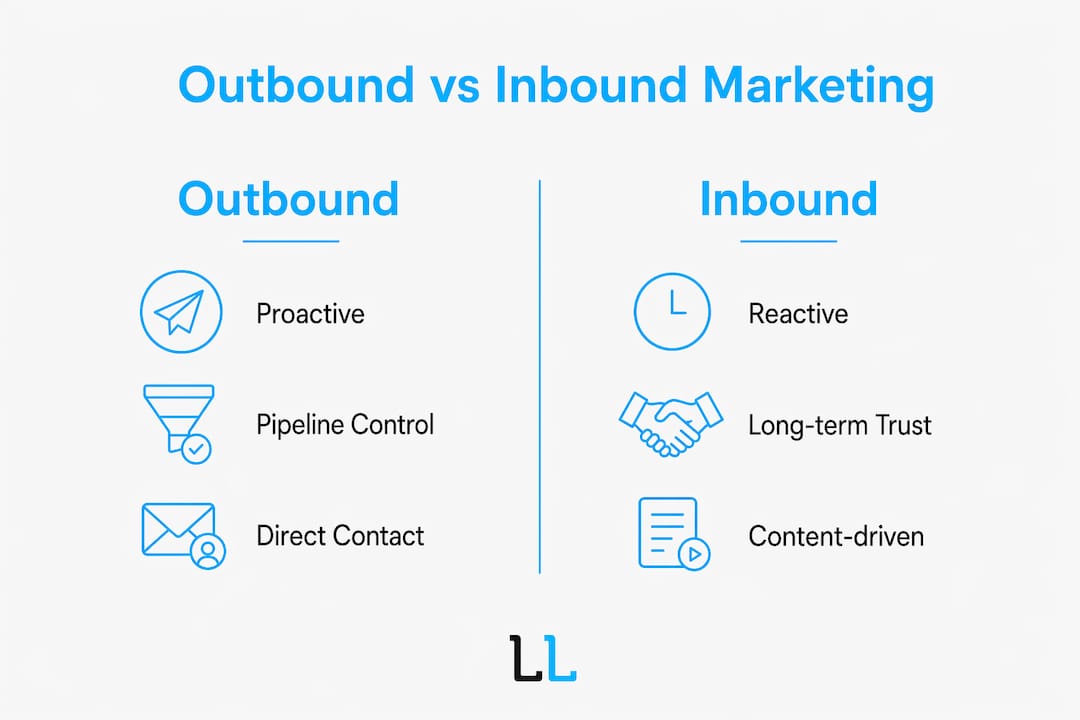
Outbound marketing is proactive push communication. Inbound marketing is reactive pull communication. Both serve the same ultimate goal of filling the pipeline, but they operate on fundamentally different timelines and mechanics.
Outbound gives revenue teams direct control over who they contact and when. Pipeline control is the defining advantage: you decide which accounts to pursue, rather than waiting for the right buyer to stumble across your content. This predictability is critical for B2B firms with specific revenue targets and defined sales cycles.
Inbound builds long-term trust through content, SEO, and thought leadership. It attracts buyers who are already searching for a solution. The limitation is timing. You cannot control when a prospect decides to search, and inbound alone rarely fills a pipeline fast enough for growth-stage companies.
Combining outbound and inbound widens the sales funnel and accelerates pipeline velocity. Inbound captures ready buyers. Outbound captures the much larger pool of buyers who fit your ICP but have not yet started searching.
| Dimension | Outbound Marketing | Inbound Marketing |
|---|---|---|
| Initiation | Brand contacts the prospect | Prospect finds the brand |
| Speed to pipeline | Fast, weeks to first meeting | Slow, months to organic traction |
| Audience targeting | Precise, based on ICP and intent data | Broad, based on search behavior |
| Message control | High, tailored per segment | Lower, content serves many audiences |
| Cost structure | Higher upfront per contact | Lower per lead at scale over time |
| Best use case | New market entry, specific account targeting | Brand awareness, long-term lead nurturing |
| Complementary role | Starts conversations with cold prospects | Warms and converts already-interested buyers |
The most effective B2B marketing programs in 2026 run both systems in parallel. Outbound opens doors. Inbound keeps them open.
Examples of outbound marketing tactics that work in b2b
Outbound marketing techniques range from direct one-to-one outreach to broader channel-based campaigns. The tactics that work best in B2B share one trait: they are specific, not generic.
Here are the most effective examples of outbound marketing for professional services and B2B firms:
- Cold email outreach. A well-researched cold email references a specific pain point, a relevant trigger event, and a clear value proposition. Generic emails that open with “I wanted to reach out” get ignored. Emails that reference a prospect’s recent product launch or hiring surge get replies. See prospecting email examples that consistently generate B2B responses.
- LinkedIn outreach. LinkedIn is the highest-signal channel for B2B outbound. A connection request followed by a short, relevant message performs far better than a cold call to a gatekeeper. Avoid the common mistakes that kill response rates by reviewing LinkedIn outreach pitfalls before launching any campaign.
- Phone calls within sequences. Cold calling as a standalone tactic has low returns. As the third or fourth touchpoint in a sequence, after a LinkedIn connection and two emails, a phone call dramatically increases reply rates. The prospect recognizes your name.
- Event sponsorship and speaking. Industry conferences and webinars put your brand in front of pre-qualified audiences. The follow-up outreach after an event, referencing the shared context, converts at higher rates than cold outreach.
- Behavioral trigger campaigns. When a prospect visits your pricing page or downloads a white paper, that signal triggers an outbound sequence. This is outbound prospecting at its most precise: you know the prospect is already interested.
Pro Tip: Message-market fit matters as much as targeting. The best list in the world will not save a message that does not speak directly to the prospect’s current problem. Test two or three message angles before scaling any sequence.
A typical high-performing B2B outbound sequence runs over three weeks. Week one: LinkedIn connection request and a brief introductory message. Week two: a personalized email with a specific value hook. Week three: a follow-up email plus a phone call. This multi-channel outreach approach builds familiarity across touchpoints without overwhelming the prospect.
How do you measure outbound marketing effectiveness?
Outbound marketing performance is measured by pipeline outcomes, not activity volume. The number of emails sent is a vanity metric. The metrics that matter are reply rate, meetings booked, opportunities created, and revenue generated.
Closed-loop attribution connects each outreach touchpoint to downstream revenue. This means tracking which channel, message, and sequence step drove the first reply, the meeting, and the closed deal. Without closed-loop data, you cannot tell whether LinkedIn or email is driving results, and you cannot optimize intelligently.
| Metric | What It Measures | Why It Matters |
|---|---|---|
| Reply rate | Percentage of prospects who respond | Indicates message relevance and targeting quality |
| Meeting conversion rate | Replies that convert to booked meetings | Measures sales development effectiveness |
| Pipeline generated | Total deal value from outbound contacts | Connects outbound activity to revenue impact |
| Sequence completion rate | Prospects who receive all touchpoints | Reveals drop-off points in the sequence |
| Cost per meeting | Total spend divided by meetings booked | Benchmarks efficiency across campaigns |
Use this data to refine your ICP and messaging continuously. If reply rates are high but meeting conversion is low, the message is attracting the wrong type of interest. If reply rates are low across all segments, the targeting or the message angle needs to change. Optimizing outreach campaigns based on live data is what separates teams that scale from teams that plateau.
Multi-touch attribution across LinkedIn, email, and phone also reveals which channel combination drives the fastest pipeline. Most B2B teams find that no single channel outperforms a coordinated sequence. The combination is the strategy.
Key takeaways
Outbound marketing works because it gives revenue teams direct control over pipeline by targeting high-fit accounts with personalized, multi-channel sequences that generate predictable meetings and opportunities.
| Point | Details |
|---|---|
| Proactive by design | Outbound initiates contact with targeted prospects rather than waiting for inbound interest. |
| Multi-channel sequences win | Combining LinkedIn, email, and phone across 6–8 touchpoints drives higher reply rates than single-channel outreach. |
| ICP and intent data are the foundation | Targeting accounts that match your ideal customer profile and show buying signals maximizes efficiency. |
| Outbound and inbound are complementary | Outbound opens cold conversations; inbound nurtures and converts already-interested buyers. |
| Pipeline metrics beat activity metrics | Reply rate, meetings booked, and revenue generated are the only numbers that matter for optimization. |
Why outbound is a system, not a set of tactics
Most teams that struggle with outbound are treating it as a collection of isolated activities. They send a batch of cold emails, get low replies, and conclude that outbound does not work. That conclusion is wrong. The problem is the absence of a system.
Successful outbound programs integrate personalized messaging, coordinated sequences, and tight sales-marketing alignment. Marketing defines the ICP and builds the message framework. Sales executes the sequences and feeds back what objections they hear. That feedback loop is what improves conversion over time.
The teams I have seen generate the most consistent pipeline from outbound share one habit: they treat every campaign as a test. They run two message angles simultaneously, measure reply rates at 50 sends each, and kill the underperformer fast. This is not complicated. Most teams just do not do it.
I also think the outbound versus inbound debate is a distraction. The question is never which one to use. The question is how to run both in a way that each makes the other more effective. Outbound opens doors that inbound content then keeps warm. Inbound content gives outbound reps something credible to reference in their sequences.
The one thing I would tell any B2B marketer starting an outbound program in 2026: do not scale before you have message-market fit. Sending 5,000 emails with the wrong message is not a volume problem. It is a waste of a perfectly good list.
— Toby
How the lead lab can accelerate your outbound results
Running a high-performing outbound program requires more than a good list and a template. It requires precise targeting, tested messaging, and a sequence structure that builds trust across every touchpoint.
The Lead Lab specializes in done-for-you LinkedIn outreach and lead generation for professional services firms. From ICP definition and prospect targeting to message copywriting and response management, every element of the campaign is handled by specialists who run these programs daily. The client portfolio shows the range of industries and firm types that have generated qualified meetings through The Lead Lab’s outbound campaigns. If you want a predictable pipeline without building the system from scratch, explore The Lead Lab’s services and book a discovery call today.
FAQ
What is outbound marketing in simple terms?
Outbound marketing is when a business proactively reaches out to potential customers rather than waiting for them to make contact. Common methods include cold email, LinkedIn outreach, phone calls, and event sponsorship.
What is outbound prospecting?
Outbound prospecting is the process of identifying and directly contacting potential buyers who match your ideal customer profile. It is the front end of outbound marketing, focused on finding and qualifying leads before passing them to sales.
How does outbound marketing differ from inbound marketing?
Outbound marketing initiates contact with prospects; inbound marketing attracts prospects who are already searching. Outbound delivers faster pipeline results, while inbound builds long-term brand authority and organic lead flow.
What are the main benefits of outbound marketing for b2b firms?
The primary benefit is pipeline control: outbound lets you decide which accounts to target and when, independent of inbound traffic fluctuations. This predictability is critical for firms with defined revenue targets and specific account lists.
How many touchpoints does an effective outbound sequence need?
High-performing outbound sequences use 6–8 touchpoints across LinkedIn, email, and phone over a 2–4 week period. This cadence builds familiarity with the prospect before requesting a meeting, which increases reply and conversion rates.