
TL;DR:
- Multi-channel marketing uses independent platforms like social media and email to reach customers without sharing data or coordinating messages. It builds brand presence across multiple touchpoints but differs from omnichannel by lacking customer journey integration. Starting with focused channels and using regular performance reviews helps businesses effectively implement multi-channel strategies.
Multi-channel marketing is defined as the practice of reaching customers across multiple independent platforms, including social media, email, websites, paid search, and physical stores, with each channel operating as its own separate ecosystem. Unlike integrated approaches, these channels do not share customer data or coordinate messaging in real time. Businesses that understand this structure can build brand presence across every platform where their audience spends time, without waiting for a full technology overhaul. This guide breaks down how multi-channel marketing works, where it differs from omnichannel, and how to build a strategy that actually performs.
What is multi-channel marketing and how does it work?
Multi-channel marketing is the use of several distinct channels to communicate with customers, where each channel operates independently with its own team, budget, and performance metrics. A business might run a LinkedIn campaign, send a monthly email newsletter, and place Google Search ads, all at the same time, but none of those efforts inform the others. Customer behavior on one channel does not influence what they see on another.

This structure is not a flaw. Channel independence is often a deliberate strategy that lets businesses scale their marketing reach gradually before investing in complex integrations. A professional services firm, for example, can launch a LinkedIn outreach program and a direct mail campaign simultaneously without needing a unified customer data platform to connect them.
The core goal is presence. The more channels you occupy, the more touchpoints you create with potential customers, and the more likely your brand is to be recognized when a buying decision is made.
How does multi-channel marketing differ from omnichannel?
The distinction between multi-channel and omnichannel marketing is one of the most misunderstood concepts in modern marketing strategy. Both use multiple channels, but the relationship between those channels is fundamentally different.
In multi-channel marketing, channels do not share customer context like browsing history or abandoned cart data. A customer who clicks an email link and then visits your website is treated as a new, unconnected visitor. Each channel tells its own story.
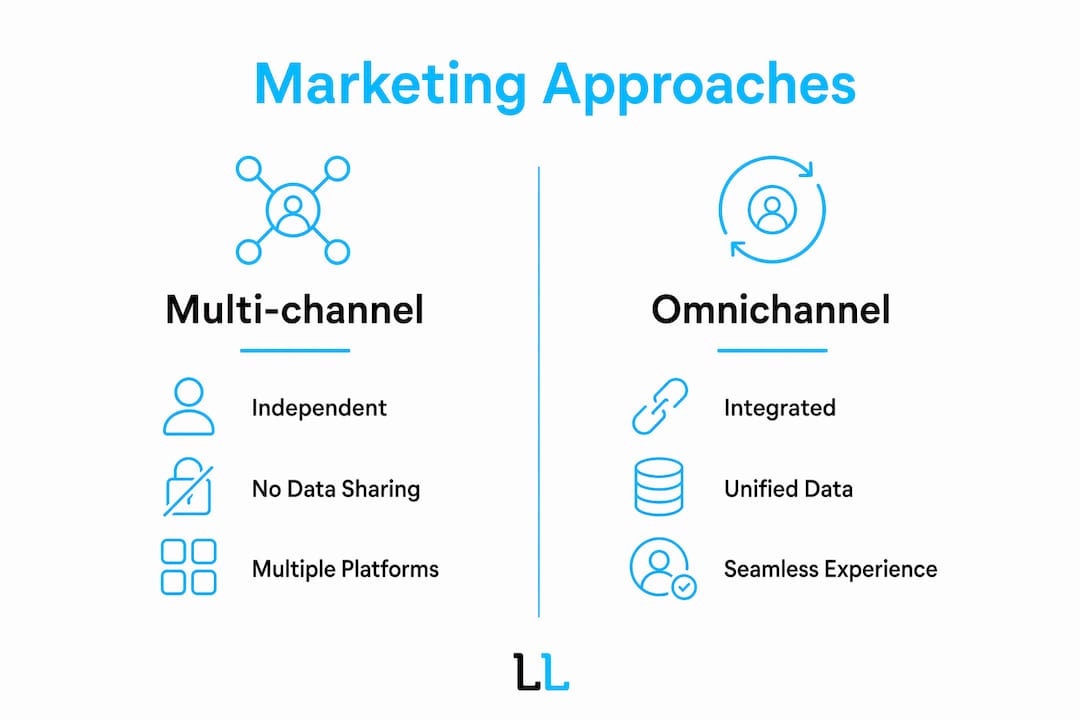
Omnichannel marketing, by contrast, integrates all channels under a unified data model. A customer who browses a product on mobile, abandons it, and then sees a retargeted ad on Instagram is experiencing omnichannel coordination. The channels talk to each other, and the customer journey feels continuous.
| Feature | Multi-channel | Omnichannel |
|---|---|---|
| Data sharing between channels | None or minimal | Fully integrated |
| Customer journey continuity | Fragmented | Unified |
| Technology requirement | Lower | Higher |
| Best suited for | Growing businesses | Mature, data-rich organizations |
| Channel coordination | Independent | Coordinated in real time |
The practical implication is this: omnichannel delivers a better customer experience, but it requires significant investment in customer data platforms and integration infrastructure. Multi-channel is the more accessible starting point for most businesses.
Pro Tip: If you are not yet ready for omnichannel, start with consistent brand messaging across your independent channels. Uniform tone and visuals reduce the fragmentation customers feel, even without data integration.
What are common multi-channel marketing examples?
The most widely used channels in a multi-channel marketing strategy include social media, email, websites, mobile apps, brick-and-mortar stores, paid search, and direct mail. Each channel attracts a different segment of your audience and serves a different purpose in the buying cycle.
Here is how different industries apply these channels in practice:
- Professional services firms use LinkedIn for outreach and thought leadership, email for nurturing prospects, and a content-rich website for inbound discovery.
- Retailers combine paid search ads, social media promotions, email campaigns, and in-store experiences, each managed by separate teams with separate KPIs.
- B2B technology companies often pair webinars and whitepapers with LinkedIn ads and cold email sequences, running each as a standalone program.
- Local service businesses mix Google Business Profile optimization, direct mail to nearby zip codes, and Facebook ads, each tracked independently.
The key insight is that channel selection should follow your audience, not industry convention. A consulting firm whose clients spend time on LinkedIn has no reason to invest heavily in TikTok, regardless of its general popularity. Knowing where your buyers spend their time is the first filter for any channel decision.
Cross-channel marketing, a related concept, refers to campaigns that use multiple channels to deliver a single coordinated message, sitting between pure multi-channel and full omnichannel integration. Understanding what cross-channel marketing means helps clarify where your current strategy sits on that spectrum.
What are the benefits of multi-channel marketing?
Multi-channel marketing delivers four concrete advantages that make it the right starting point for most businesses.
- Expanded reach. Meeting customers on their preferred platforms increases the probability of brand exposure. A prospect who ignores email may respond to a LinkedIn message or a paid search result.
- Operational simplicity. Managing channels independently removes the need for an expensive unified technology stack. Smaller teams can run effective programs without enterprise-level infrastructure.
- Risk reduction. Diversified channel presence protects businesses from algorithm changes, platform cost increases, or sudden drops in a single channel’s performance. Relying on one platform is a single point of failure.
- Channel-level testing. Independent channels make it easier to test messaging, offers, and creative without cross-contaminating results. You can pause or scale any single channel without disrupting the others.
“Performance marketers treat multi-channel marketing as an essential defensive strategy in 2026. Platform volatility is real, costs are rising, and businesses that depend on a single channel are one algorithm update away from a serious revenue problem.”
The ability to test and optimize channel by channel is particularly valuable for professional services firms, where buyer behavior varies significantly by seniority, industry, and deal size. Prospect segmentation combined with channel-specific campaigns produces far better results than a single broad approach.
How to implement a successful multi-channel marketing strategy
A working multi-channel strategy starts with focus, not breadth. Trying to be everywhere at once produces mediocre results on every channel. The right approach is to identify 2–3 core channels where your audience is most active and build those out before adding more.
Step 1: Choose channels based on audience data. Look at where your existing customers came from. If 60% of your closed deals started with a LinkedIn conversation, that channel deserves the most attention. Let data drive channel selection, not assumptions.
Step 2: Apply the 70/20/10 budget rule. The 70/20/10 budget allocation framework directs 70% of your budget to proven channels, 20% to channels you are actively scaling, and 10% to experiments. This prevents over-investment in unproven channels while keeping room for growth.
Step 3: Set channel-specific KPIs. Each channel needs its own success metrics. Email campaigns track open rates, click-through rates, and conversions. LinkedIn outreach tracks connection acceptance rates, reply rates, and meetings booked. Paid search tracks cost per click and cost per acquisition. Mixing metrics across channels produces misleading conclusions.
Step 4: Run monthly budget reviews using marginal ROAS. Marginal ROAS measures the return from the last dollar spent on a channel, not the average return across all spend. When marginal ROAS drops below your target threshold, that channel is saturating. Reallocate that budget to a channel with higher marginal returns.
- Review channel performance monthly, not quarterly.
- Track customer acquisition cost (CAC) alongside ROAS to catch hidden inefficiencies.
- Set a minimum performance floor for each channel. If a channel consistently misses it, pause and reassess before adding more spend.
Step 5: Maintain consistent messaging. Consistent brand voice across channels increases recognition even when channels do not share data. Use the same core value proposition, visual identity, and tone across every touchpoint. The message adapts in format, but the substance stays the same.
Pro Tip: Automate your campaign performance tracking with a shared dashboard that pulls channel-level data into one view. You will spot budget inefficiencies weeks faster than reviewing each channel in isolation.
Key Takeaways
A successful multi-channel marketing strategy requires channel focus, consistent messaging, and monthly performance reviews guided by marginal ROAS and CAC, not just average returns.
| Point | Details |
|---|---|
| Define your channels clearly | Each channel operates independently with its own team, budget, and metrics. |
| Start with 2–3 core channels | Focus beats breadth; build proven channels before expanding to new ones. |
| Use the 70/20/10 budget rule | Allocate 70% to proven channels, 20% to scaling, and 10% to experiments. |
| Track marginal ROAS monthly | Average ROAS hides saturation; marginal ROAS reveals when to reallocate. |
| Keep messaging consistent | Uniform brand voice reduces fragmentation even without data integration. |
Why multi-channel marketing is non-negotiable in 2026
I have worked with enough professional services firms to know that most of them are one platform change away from a serious pipeline problem. They built their entire lead generation on a single channel, usually LinkedIn or email, and when costs rose or reach dropped, they had nothing to fall back on.
Multi-channel marketing is not about doing more. It is about not being exposed. The businesses I see growing consistently in 2026 are the ones that treat channel diversification the same way a CFO treats financial diversification. You do not put everything in one asset class, and you do not put everything in one channel.
The operational simplicity argument is real, especially for small and medium businesses. You do not need a customer data platform on day one. You need a LinkedIn program that books meetings, an email sequence that nurtures those leads, and a website that converts the ones who do their own research. Three channels, three sets of metrics, one consistent message.
The mistake I see most often is treating multi-channel as a destination rather than a starting point. The goal is eventually to move toward more integration, where your channels inform each other and the customer experience becomes more continuous. But you cannot integrate what you have not yet built. Start with independent channels, measure them rigorously, and add integration as your data and technology mature.
— Toby
How The Lead Lab helps you build a channel strategy that performs
Multi-channel marketing works best when channel selection, messaging, and performance measurement are treated as a system, not a checklist.
The Lead Lab specializes in building B2B outreach programs for professional services firms that need results from their marketing investment, not just activity. From LinkedIn outreach campaigns to prospect targeting and response management, The Lead Lab’s done-for-you campaigns are built around the channels where your buyers actually spend time. If you want to see what a focused, measurable multi-channel approach looks like in practice, the portfolio at The Lead Lab shows exactly how these strategies perform across different industries and firm sizes.
FAQ
What is multi-channel marketing in simple terms?
Multi-channel marketing is the practice of reaching customers through several independent channels, such as email, social media, and paid search, each operating separately with its own goals and metrics.
How is multi-channel marketing different from omnichannel?
Multi-channel channels operate independently without sharing customer data, while omnichannel integrates all channels into a unified experience that tracks and responds to customer behavior across every touchpoint.
What channels are most common in a multi-channel strategy?
The most common channels include social media, email, websites, paid search, mobile apps, direct mail, and physical stores, selected based on where the target audience is most active.
What is the 70/20/10 rule in multi-channel marketing?
The 70/20/10 rule allocates 70% of the marketing budget to proven channels, 20% to channels being scaled, and 10% to experimental channels, preventing over-investment in unproven tactics.
How do you measure multi-channel marketing performance?
Track channel-specific KPIs such as CAC, conversion rate, and marginal ROAS for each channel separately, and run monthly budget reviews to reallocate spend away from saturating channels.