
TL;DR:
- Building diverse, mutually valuable professional networks from before a crisis enhances long-term career growth. Consistent engagement, genuine curiosity, and strategic cross-industry connections foster trust and unlock opportunities. Prioritizing relationship quality over quantity ensures a support system that accelerates promotions and salary development.
Professional networks are collections of career-related connections that provide mutual access to opportunities, knowledge, and support across your working life. Most professionals treat networking as a last resort when they need a job. The ones who advance fastest treat it as infrastructure. LinkedIn alone has established itself as the largest professional networking platform in the world, and organizations like Chambers of Commerce have formalized the practice for decades. The research is direct: neglecting your network creates a compounding disadvantage in salary growth and promotion speed that gets harder to reverse the longer you wait.
What are professional networks, and what types exist?
Professional networks, sometimes called career networks or professional relationship systems, are structured or informal groups of people connected through work, industry, or shared professional goals. They are not the same as social networks, though platforms like LinkedIn blur that line. The defining feature is mutual professional value: each connection either offers or receives something career-relevant, whether that is a referral, a piece of advice, or a collaboration opportunity.
Effective professional networking organizes into three distinct categories:
- Operational networks are the people you work with day-to-day. Colleagues, direct reports, managers, and vendors fall here. These connections keep your current role functioning.
- Personal networks are built around shared interests, alumni ties, or professional associations. They exist outside your immediate employer and provide perspective beyond your current organization.
- Strategic networks are the most powerful and most neglected. These are senior figures, cross-industry leaders, and connectors who can open doors you did not know existed.
Within those three categories, five key connection types define the nodes of a strong network: mentors who guide your trajectory, protégés who keep you current and build your reputation as a developer of talent, hub connectors who introduce you to people you would never reach alone, peer squads who provide honest feedback and emotional support, and external industry leaders who signal your credibility to the broader market.
The formal versus informal distinction matters practically. Formal networks include professional associations like the American Marketing Association, industry conferences, and alumni groups from institutions like Harvard Business School. Informal networks are built through coffee conversations, shared Slack communities, and LinkedIn exchanges. Both serve different functions, and the most effective professionals maintain both.

| Network type | Primary function | Example |
|---|---|---|
| Operational | Day-to-day task support | Team members, vendors |
| Personal | Perspective and emotional support | Alumni groups, interest communities |
| Strategic | Opportunity access and influence | Senior leaders, cross-industry connectors |
| Formal | Structured relationship building | Professional associations, conferences |
| Informal | Organic trust development | LinkedIn conversations, peer meetups |
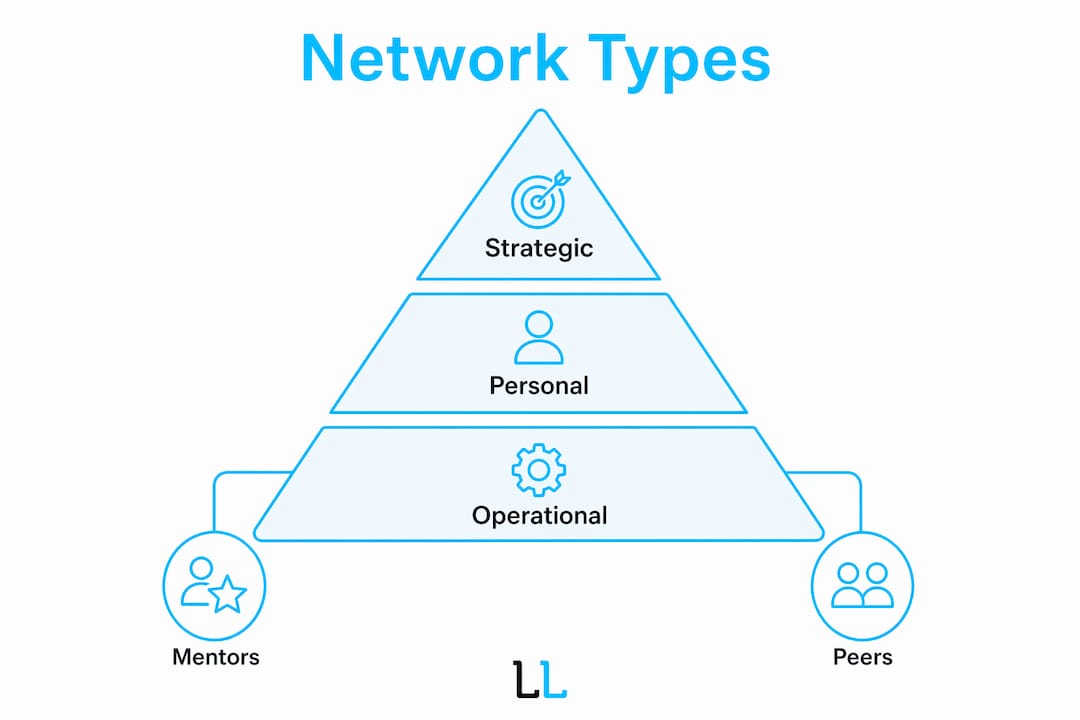
Pro Tip: Map your existing contacts against these five types. Most professionals discover they have a dense operational network and almost no strategic one. That gap is where your next opportunity is hiding.
Why are professional networks important for career growth?
The importance of professional networks goes well beyond finding your next job. Dedicating 80% of job search time to networking correlates directly with higher salary outcomes and faster career progression. That figure reframes how most people allocate their effort. Sending applications into an applicant tracking system is not a strategy. Building relationships with people who can advocate for you before a role is posted is.
The benefits extend into your daily working life, not just career transitions. Networking enhances career satisfaction and optimism while acting as a psychological buffer against burnout. Professionals with strong networks report higher confidence in navigating workplace challenges because they have people to consult, not just problems to solve alone.
Diversity within your network produces a specific and measurable advantage. Building diverse networks counters homophily, the natural human tendency to connect only with people who look, think, and work like you. Homophily feels comfortable but produces echo chambers. A network that spans industries, functions, and career stages exposes you to ideas and opportunities that a uniform network simply cannot generate.
Pro Tip: When you reach out to a new contact, ask for their advice rather than a favor. Research from Harvard Business School shows that seeking advice signals competence and encourages knowledge sharing, making the other person more likely to engage and remember you positively.
Both internal and external networking contribute to career outcomes. Internal and external networking together drive salary growth, promotion speed, and job satisfaction in ways that neither achieves alone. Professionals who only network inside their company plateau. Those who only network externally miss the internal advocates who actually make promotion decisions.
How to build a professional network that actually works
Building a professional network is a long-term system, not a one-time event. The most common mistake is treating it transactionally: reaching out only when you need something, then disappearing. Effective networking prioritizes mutual value and repeated engagement over time. The relationship has to exist before you need it.
Here are the core steps to build and maintain a network that delivers real career results:
- Audit your current network. List your contacts by the five types described above. Identify gaps, particularly in strategic and cross-industry connections.
- Set a contact cadence. Maintain monthly contact with advocates and reach out to broader contacts at least once per quarter. Consistency is what separates a living network from a dormant contact list.
- Use LinkedIn with intention. Connect after real interactions, not cold mass requests. Engage with posts through substantive comments, not just likes. Share content that demonstrates your expertise. The LinkedIn outreach strategies that work are built on relevance and personalization, not volume.
- Attend industry events with a specific goal. Walking into a conference without a target is how you end up collecting business cards you never follow up on. Identify two or three people you want to meet before you arrive.
- Participate in virtual communities. Slack groups, LinkedIn communities, and industry forums like those run by the Society for Human Resource Management or the Project Management Institute offer ongoing access to peers and leaders without geographic limits.
- Follow up within 48 hours. A brief, specific message referencing your conversation is what converts a meeting into a relationship. Most people skip this step. That is why most networks stay shallow.
- Prioritize quality over quantity. Twenty engaged contacts who know your work beat 500 passive connections.
- Give before you ask. Share an article, make an introduction, or offer a perspective before requesting anything.
- Diversify deliberately. If everyone in your network has the same job title, you have a peer group, not a network.
Pro Tip: When you help someone in your network without being asked, you create what behavioral economists call a reciprocity trigger. The other person feels a genuine desire to return the value, and your relationship deepens without any awkward ask.
Common misconceptions about professional networking
The biggest misconception about professional networking is that it is the same as prospecting or sales. Networking is not prospecting. Prospecting targets strangers with a specific offer. Networking builds relationships that may eventually create business opportunities, but that is a byproduct, not the goal. Professionals who approach every new contact as a potential transaction destroy trust before it forms.
Here are the most persistent myths and the realities behind them:
- Myth: Networking is only for job seekers. Reality: The professionals who benefit most from their networks are the ones who built them long before they needed them.
- Myth: You need an impressive elevator pitch. Reality: Over-polished pitches signal self-interest. Genuine curiosity about the other person’s work is more memorable and more effective.
- Myth: More connections equal a stronger network. Reality: A large, shallow network provides almost no real support. Depth and diversity matter far more than volume.
- Myth: Networking is manipulative. Reality: Networking builds visibility and trust over time. When done with genuine intent, it creates value for both parties.
“The goal of networking is not to collect contacts. It is to build relationships where both people are genuinely better off for knowing each other.”
The homophily problem deserves specific attention. Most professionals naturally gravitate toward people who share their background, industry, or worldview. This feels efficient but produces a network that cannot surprise you. Diverse networks across industries prevent echo chambers and generate the kind of cross-pollination that produces real innovation and unexpected opportunity.
Key takeaways
Professional networks are the single most reliable infrastructure for long-term career advancement, and building them requires consistent, diverse, and genuinely mutual relationship investment.
| Point | Details |
|---|---|
| Three network types | Operational, personal, and strategic networks each serve distinct career functions. |
| Diversity beats volume | Networks spanning industries and functions outperform large, uniform contact lists. |
| Consistency is the mechanism | Monthly contact with advocates and quarterly outreach to others keeps a network alive. |
| Networking is not prospecting | Relationships built on mutual value produce opportunities; transactional approaches destroy trust. |
| Start before you need it | The professionals who benefit most built their networks before a career transition forced them to. |
Why most networking advice misses the point
I have watched professionals spend years collecting LinkedIn connections and conference badges while their actual network stayed paper-thin. The number on their profile grew. The number of people who would genuinely go to bat for them stayed at three or four.
The advice to “just put yourself out there” skips the part that actually matters: what you do after the first conversation. Authenticity is not a personality trait in networking. It is a practice. It means following up with something specific, remembering what someone told you six months ago, and reaching out when you have nothing to gain. That is what makes you memorable.
I have also seen the diversity argument treated as a box-checking exercise. The real reason to connect across industries and functions is not optics. It is that your next best idea, your next best hire, or your next best client is almost certainly sitting in a network you have not built yet. The professionals I have seen advance fastest are not the most extroverted. They are the most consistent and the most genuinely curious about people whose work looks nothing like their own.
Patience is not optional here. A network that delivers real career results takes years to build and minutes to damage. Treat every contact as a long-term relationship, not a transaction, and the compounding effect will show up in ways you cannot predict but will absolutely recognize.
— Toby
How The Lead Lab helps you turn your network into results
Understanding professional networks is the foundation. Converting those relationships into qualified business opportunities is where most professionals stall. The Lead Lab specializes in LinkedIn outreach and lead generation for professional services firms, helping you move from passive connection to active pipeline. Whether you need a LinkedIn prospecting framework that respects the relationship-first principles covered in this article, or a done-for-you outreach campaign that targets the right decision-makers at scale, The Lead Lab builds the system around your goals. Explore what a personalized outreach strategy looks like for your firm at The Lead Lab.
FAQ
What are professional networks in simple terms?
Professional networks are groups of career-related contacts, including colleagues, mentors, industry peers, and leaders, who provide mutual access to opportunities, knowledge, and support. They exist both online, through platforms like LinkedIn, and offline through industry events and associations.
How many types of professional networks are there?
Professional networks organize into three main categories: operational, personal, and strategic. Each serves a different function, from day-to-day work support to long-term career advancement and opportunity access.
How much time should I spend on networking?
Dedicating 80% of job search time to networking correlates with higher salary outcomes and faster career progression. Outside of active job searches, consistent monthly or quarterly outreach to key contacts is sufficient to maintain a strong network.
Is LinkedIn the best platform for professional networking?
LinkedIn is the largest and most widely used professional networking platform globally, making it the default starting point for digital networking. It works best when used with intention, through personalized outreach, substantive engagement, and content that demonstrates real expertise.
What is the difference between networking and prospecting?
Networking builds long-term, mutually beneficial relationships without an immediate transactional goal. Prospecting targets specific individuals with a defined offer. Treating networking as prospecting is the most common reason professional relationships fail to develop.
Recommended
- Why segment prospects: boost professional service leads efficiently – The Lead Lab
- Innovative outreach campaign ideas to supercharge LinkedIn leads – The Lead Lab
- What is lead nurturing? Strategies for professional services – The Lead Lab
- How automation transforms B2B marketing for professional services – The Lead Lab