
TL;DR:
- Referrals, hosted roundtables, and outbound email are the top non-LinkedIn channels for professional services lead generation. Combining warm and cold channels and testing multiple options over 90 days ensures effective pipeline growth strategies. Outsourced outreach services like The Lead Lab provide predictable appointments when internal capacity is limited.
For US professional services firms, the highest-performing non-LinkedIn channels are structured referral programs, targeted outbound email, SEO and content, hosted roundtables, and paid search targeting comparison queries. When internal capacity is the bottleneck, a done-for-you outsourced outreach service like The Lead Lab delivers the same appointment-setting outcomes without building the function in-house.
Quick channel verdict by primary goal:
- Lead quality: Referrals and hosted roundtables
- Speed to first meeting: Targeted outbound email or outsourced outreach
- Volume at scale: SEO/content and paid search (longer horizon)
- Predictable appointments without internal effort: Done-for-you outreach (The Lead Lab)
LinkedIn remains the dominant B2B social lead source in 2026: 89% of B2B marketers use it and it drives approximately 80% of all social-media B2B leads. Any alternative must outperform on quality and cost, not just presence.
Table of Contents
- What are the best LinkedIn alternatives for B2B lead generation?
- How do you choose the right channel or provider?
- Why combining warm and cold channels keeps your pipeline from going quiet
- How to run a 90-day test on two or three alternative channels
- The Lead Lab: a done-for-you alternative to running LinkedIn in-house
- Key Takeaways
- What we see actually working for professional services right now
What are the best LinkedIn alternatives for B2B lead generation?
The table below maps each channel against the metrics that matter most to sales directors and marketing leaders evaluating a switch or supplement.
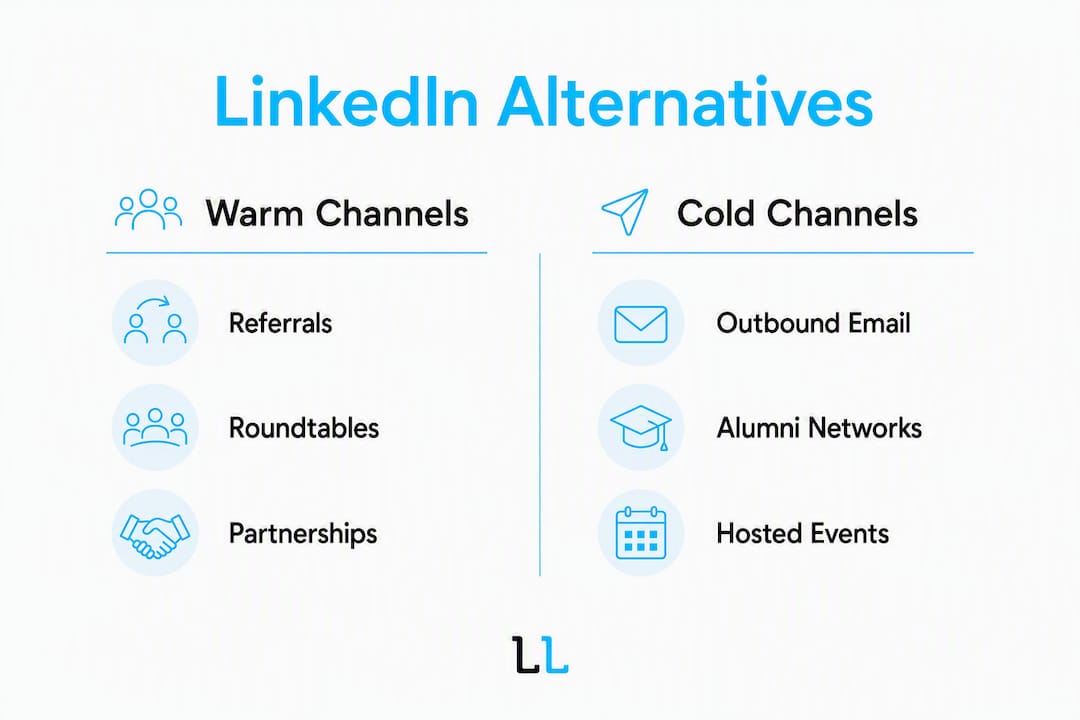
| Channel | Best for | Typical cost (ballpark) | Speed to first qualified meeting | Scalability | Lead quality/intent | Internal effort | ROI measurement |
|---|---|---|---|---|---|---|---|
| Referral & partnerships | Highest-quality, fastest-closing leads | Low (program setup) | 1–4 weeks | Limited by network size | Very high | Moderate (program management) | Referral conversion rate, CPL |
| Targeted outbound email | Speed and control | $200/month tooling + time | 2–6 weeks | Moderate | Medium-high (personalized) | High (copy, sequencing, data) | Reply rate, meetings booked, CPM |
| SEO & content | Long-term volume and inbound intent | Low per lead over time | 6–12 months | High | High (active searchers) | High (ongoing production) | Organic traffic, lead volume, CPL |
| Webinars & roundtables | High-intent, relationship-led pipeline | Moderate (hosting costs) | 4 weeks | Moderate | Very high — many marketers rate webinars best for quality | High (logistics, promotion) | Attendee-to-meeting rate, CPL |
| Paid search | Active-demand capture, comparison buyers | Medium-high (ad spend) | 1–3 weeks | High (budget-dependent) | High (evaluation stage) | High (ad management) | CPC, CPL, pipeline value |
| Done-for-you outreach | Predictable appointments, no internal build | Monthly retainer | 2–4 weeks | High (vendor-managed) | High (targeted ICP lists) | Low (vendor handles execution) | Appointments per month, CPM |
Core trade-offs to remember:
- Referrals close faster and cheaper, but you cannot manufacture them at will without a structured program.
- Outbound email works best at a focused list of 20–50 dream accounts with highly personalized messaging, not mass spray-and-pray.
- SEO compounds over time but requires 6–18 months before it reliably fills a pipeline.
- Webinars produce the highest-quality leads of any channel for many professional services firms, but the logistics cost is real.
- Paid search captures buyers already comparing options — comparison and alternative queries are underused by most professional services firms and represent a genuine gap to exploit.
How do you choose the right channel or provider?
Start with six decision criteria before you evaluate a single vendor or channel:
- Goal alignment — Are you solving for speed (outbound, paid search), quality (referrals, roundtables), or volume over time (SEO)?
- Funnel stage fit — Cold channels fill the top; warm channels accelerate mid-funnel. Match the channel to where your pipeline is actually thin.
- Measurable KPIs — If you cannot define a success threshold before you start (reply rate, meetings booked, cost per meeting), you cannot evaluate results fairly.
- Budget and timeline — SEO requires 12+ months; outbound can show results in weeks. Align expectations before committing spend.
- Internal capacity — A systems view matters here: audience definition, messaging, follow-up, qualification, and reporting all need owners. If those seats are empty, outsourcing is not a shortcut — it is the right call.
- Buyer persona reach — Channel priority varies by vertical: local SEO and paid search suit healthcare and accounting; content and webinars suit consulting and law.
Provider due-diligence checklist:
- What are the specific deliverables and timelines (appointments per month, reporting cadence)?
- How do they define and build the target list — ICP criteria, data sources, verification?
- Can they share sample metrics from comparable clients (reply rate, appointment rate, cost per meeting)?
- Do they provide references or published case studies with named outcomes?
- Who owns the data, contact lists, and CRM records at contract end?
- What are the SLAs for response management and campaign adjustments?
- What is the onboarding timeline before the first outreach goes live?
Red flags that should disqualify a provider immediately: no measurable commitments, vague targeting methodology, refusal to share references, unverifiable data sources, or a contract that locks you in for 12 months before you see a single result.
Pro Tip: Ask every provider for a sample message sequence and a sample prospect list before signing. The quality of those two artifacts tells you more about their actual capability than any sales deck.

Why combining warm and cold channels keeps your pipeline from going quiet
Top professional services firms run warm and cold layers in parallel — not as a hedge, but because each layer covers the other’s weakness.
Warm channels (referrals, alumni networks, strategic partnerships, hosted roundtables) close faster and at lower cost per lead. Referrals convert 20–30% higher than most outbound channels, and roundtable attendees arrive pre-qualified by the invitation itself. The problem: warm channels are relationship-constrained. You cannot double referral volume by working harder next quarter.
Cold channels (targeted outbound email, paid search, SEO) fill the pipeline during slow periods and reach buyers outside your existing network. They take longer to warm up and require more infrastructure, but they scale on budget rather than on relationships.
Suggested mix by firm profile:
- Boutique firm (under 10 people): Referral-first, supplemented by one cold channel (outbound email or paid search). Keep the outbound list tight — 20–50 accounts maximum.
- Growth firm (10–50 people): Balanced mix. Run a structured referral program, one or two roundtables per quarter, and a parallel outbound or paid search campaign. Use multi-channel outreach to sequence touchpoints.
- Scaling firm (50+ people): Full-stack. Add SEO and content as a long-horizon layer alongside active cold outbound and a formal partner program.
Pro Tip: Activate warm channels first — a referral program or a roundtable series takes four to six weeks to set up and produces results faster than any cold channel. Use that early pipeline to fund the patience that SEO and content require.
How to run a 90-day test on two or three alternative channels
- Weeks 1–2 (Setup): Define your ICP, build segmented prospect lists, write two to three message variants per channel, configure your CRM routing, and set your success thresholds before a single message goes out. Proper segmentation at this stage determines whether the test is readable.
- Weeks 3–6 (Outreach and content runs): Launch outbound sequences, publish two to three pieces of targeted content, and send roundtable invitations to a curated list. Keep outbound lists focused — 20–50 high-fit accounts per channel.
- Weeks 7–10 (Follow-up and qualification): Run follow-up sequences, qualify inbound responses against your ICP criteria, and book discovery calls. Track every touchpoint in your CRM.
- Weeks 11–12 (Review and Go/No-Go): Pull the metrics table below. Any channel hitting the target thresholds gets a 90-day scale budget. Any channel below threshold gets cut or redesigned before more spend goes in.
Metrics to track and target thresholds:
| Metric | What it measures | Target threshold (viable channel) |
|---|---|---|
| Reach | Prospects contacted per channel | 50+ per channel per month |
| Reply/response rate | Engagement with outreach | 5%+ for outbound email |
| Meetings booked | Pipeline activity | 2–4 per month per channel |
| Cost per meeting (CPM) | Efficiency | Below your average deal value ÷ 10 |
| Pipeline velocity | Speed from contact to opportunity | Under 30 days for warm; longer for cold |
Execution checklist:
- Audience segmentation complete before launch
- Two to three message variants ready for A/B testing
- Follow-up sequence mapped (minimum three touches)
- Qualification criteria documented and shared with whoever takes the call
- CRM routing confirmed so no lead falls through
The Lead Lab: a done-for-you alternative to running LinkedIn in-house
If the 90-day playbook above sounds right but the internal bandwidth is not there, that is exactly where The Lead Lab fits.
The Lead Lab handles the full outreach function: ICP targeting and list building, personalized message copywriting, automated outreach, response management, lead enrichment (mobile numbers and verified emails), and appointment setting — with qualified calendar meetings delivered directly to your team. You get the outcomes of a LinkedIn-style outreach campaign without hiring, training, or managing the function yourself.
Service tiers move from a starter package (focused prospecting and appointment setting for firms testing the channel) through growth and scale tiers that add verified LinkedIn account rental, deeper lead enrichment, and higher monthly meeting volumes. Onboarding typically runs two to three weeks before the first outreach goes live, and clients receive campaign analytics and reporting on a regular cadence throughout.
For professional services firms that want predictable appointments and transparent reporting without a long internal build, The Lead Lab’s done-for-you campaigns are worth a direct conversation. You can also review client outcomes and case studies before committing to a call.
Key Takeaways
Non-LinkedIn channels work best when you match the channel to your primary goal — quality, speed, or volume — and run warm and cold layers together rather than betting on one.
| Point | Details |
|---|---|
| Match channel to goal | Referrals and roundtables for quality; outbound email for speed; SEO for long-term volume. |
| Run warm and cold in parallel | Warm channels close faster; cold channels keep the pipeline full when relationships run dry. |
| Test before you scale | Run a 90-day experiment with defined thresholds; cut channels that miss the cost-per-meeting target. |
| Webinars outperform on quality | 73% of marketers say webinars produce their best quality leads; 89% agree webinars outperform other channels for qualified leads. |
| The Lead Lab for outsourced outreach | When internal capacity is the constraint, The Lead Lab delivers targeted prospecting and qualified appointments without the internal build. |
What we see actually working for professional services right now
The pattern that keeps showing up: firms that treat referrals as a system rather than a happy accident close deals faster and at lower cost than any other channel. That means a formal ask process, a partner list that gets reviewed quarterly, and a roundtable or dinner series that gives referral sources something worth passing along. It is not glamorous, but the conversion numbers are hard to argue with.
On the cold side, the firms getting real traction from outbound email lead generation are not the ones sending the most messages. They are running tight lists, writing messaging that speaks to a specific buyer’s situation, and following up three to five times before moving on. Volume is not the lever — precision is.
Roundtables deserve more credit than they get. A well-curated 10-person dinner or virtual session with a sharp agenda consistently produces two to four qualified conversations per event. The cost per lead from webinars and roundtables is cited around $72 on average, and the relationship quality is in a different category entirely.
The firms that struggle are usually chasing a single channel fix. The ones that grow build a small stack — one warm channel, one cold channel, clear metrics — and iterate from there. That is the same logic behind the 90-day test plan above, and it is the same logic The Lead Lab applies to every campaign it runs.