
TL;DR:
- Timeline commitments turn project schedules into enforceable agreements that foster accountability and stakeholder trust. They focus teams, reduce delays, and improve reliability by setting clear deadlines and milestones. Effective tracking with a commitment register and range-based dates adapts to AI and agile workflows, ensuring project integrity.
Timeline commitments are defined as binding promises that transform a project schedule into an enforceable agreement between teams, leaders, and stakeholders. The role of timeline commitments goes far beyond setting a due date. They create a shared contract that aligns everyone around the same objectives, and only 9% of employees feel fully aligned with company goals. That gap is exactly where timeline commitments do their most important work. Without them, project plans remain intentions. With them, they become obligations that drive real accountability.
How do timeline commitments enhance accountability and focus?
Timeline commitments sharpen focus by creating a boundary that forces prioritization. When a deadline is binding, teams stop asking “what could we add?” and start asking “what must we finish?” That shift is not cosmetic. It changes how people allocate time, energy, and attention every single day.

Parkinson’s Law states that work expands to fill the time available for its completion. Applied deliberately, this principle means that setting a firm deadline compresses effort into a productive window. Teams that operate without binding deadlines tend to polish endlessly, revisit decisions, and delay delivery. A fixed commitment cuts that cycle short.
Milestones are the mechanism that makes this work in practice. The most effective project teams treat milestones as binary checkpoints, not celebrations. A milestone is either hit or missed. That binary quality forces an honest conversation about whether the project is on track, weeks before a final deadline becomes a crisis.
Research on deadline-driven behavior confirms that human action spikes abruptly near the end of a timeline window. This means that without structured intermediate commitments, most of the productive work happens too late for course correction. Milestones spread that urgency across the full project arc.
- Binding deadlines reduce perfectionism by forcing teams to define “good enough” before work begins.
- Milestone checkpoints create early warning signals rather than end-of-project surprises.
- Shared ownership of timelines increases individual accountability across the team.
- Visible progress tracking keeps momentum high and reduces the risk of silent delays.
Pro Tip: Involve team members directly in building the timeline. When people set their own deadlines, they treat those dates as personal commitments rather than external mandates. Ownership produces reliability.
What risks and challenges come with timeline commitments?
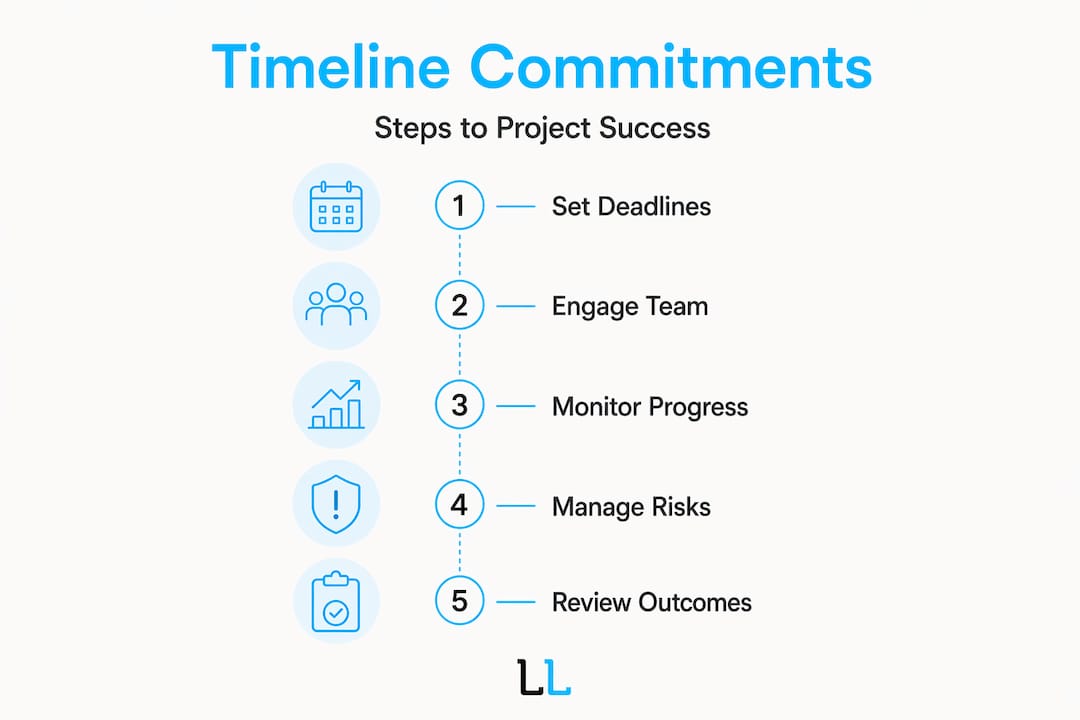
Timeline commitments carry real risks when they are set without discipline or enforced without judgment. The most common failure mode is treating a deadline as a “wishline,” a date that everyone hopes to hit but no one is truly accountable for missing.
Research on audit quality published in january 2026 found that auditors completing work at or beyond filing deadlines produce lower quality output. This finding applies broadly. When deadline pressure becomes extreme, teams cut corners, skip reviews, and ship work that damages credibility. The commitment itself becomes the problem when it is set unrealistically.
Overcommitting is the most common source of this pressure. Leaders who say yes to every stakeholder request without protecting existing commitments create a cascading failure. One overloaded sprint bleeds into the next, and the entire project timeline loses credibility. Broken timelines damage brand reputation and erode the social license that professional services firms depend on.
The solution is not softer deadlines. It is better commitment discipline.
- Re-baseline transparently. When a timeline must shift, communicate the reason, the new date, and the corrective action. Silence destroys trust faster than a missed deadline.
- Protect existing commitments before accepting new ones. Saying no to a conflicting priority is a leadership act, not a failure.
- Assign clear owners to every commitment. A deadline without a named owner is not a commitment. It is a suggestion.
- Audit commitment integrity regularly. Review which promises are at risk before they become overdue.
Pro Tip: Apply the 5 C’s of Accountability framework: Clarity, Commitment, Competence, Communication, and Consequences. Leaders who use this structure convert timeline commitments from preferences into binding contracts.
How are timeline commitments evolving with AI and agile methods?
The traditional model of timeline commitments assumed a fixed scope and a fixed date. That model is under pressure in 2026. AI-assisted development introduces variability that makes single-point delivery dates unreliable, and agile methodologies have already shifted many teams toward iterative delivery cycles.
AI-assisted development introduces variability in delivery speed that makes fixed-date commitments increasingly difficult to defend. A feature that takes one developer two weeks might take an AI-augmented team two days, or two months, depending on the complexity of the integration. That unpredictability demands a different commitment model.
Range-based commitments with explicit confidence levels are the emerging standard. Instead of committing to “delivery by March 15,” a team commits to “70% confidence of delivery between March 10 and March 25.” This approach gives stakeholders honest information rather than false precision. It also creates space for transparent updates without triggering a trust crisis every time a date shifts.
| Commitment approach | Scope flexibility | Stakeholder clarity | Risk profile |
|---|---|---|---|
| Traditional fixed-date | Low | High (false precision) | High when missed |
| Agile fixed-date, flexible scope | High | Medium | Moderate |
| Range-based with confidence level | Medium | High (honest range) | Low when communicated |
Agile projects handle this by separating the delivery date from the feature scope. A sprint ends on a fixed date regardless of what is complete. What ships is whatever is ready. This model protects the commitment to the timeline while building in flexibility on the deliverable. For business leaders managing stakeholder expectations, the key is communicating which element is fixed and which is flexible before the project begins.
What tools and strategies track timeline commitments effectively?
Tracking timeline commitments requires more than a spreadsheet. The most effective teams use a centralized commitment register that assigns an owner, a due date, a risk level, and a current status to every promise made inside or outside the project.
Automated commitment agents scan communications across email, chat, and project tools to identify promises and compare them against the project roadmap in real time. These systems flag discrepancies before they become missed deadlines. A commitment made in a Monday morning call that never makes it into the project plan is exactly the kind of gap these tools catch.
The practical steps for building a commitment tracking system are straightforward.
- Create a commitment register. List every promise with an owner, a due date, and a risk category.
- Categorize by risk. Use four categories: on track, at risk, overdue, and no roadmap item.
- Assign a single owner to each commitment. Shared ownership produces no ownership.
- Review the register weekly in a standing team meeting. Make the status visible to everyone.
- Connect commitments to roadmap items. Any promise without a corresponding roadmap entry is a red flag.
- Automate scanning where possible. Automation in project tracking reduces the manual burden and catches commitments that fall through the cracks.
The “no roadmap item” category deserves special attention. A commitment that exists in a conversation but not in the project plan is invisible to the team and dangerous to the stakeholder relationship. Surfacing these commitments early is one of the highest-value activities a project manager can perform.
Consistent timeline commitments build trust over time. Every commitment honored adds to a track record that makes future promises credible. Every broken commitment without explanation subtracts from it. The register is not just a tracking tool. It is a trust ledger.
Key Takeaways
Timeline commitments are binding project obligations that drive accountability, protect stakeholder trust, and determine whether a project plan becomes a real delivery or just a schedule.
| Point | Details |
|---|---|
| Commitments create accountability | Binding deadlines force prioritization and reduce the perfectionism that delays delivery. |
| Milestones are diagnostic tools | Treat every milestone as a binary checkpoint to catch problems early, not as a celebration. |
| Overcommitting destroys credibility | Protect existing commitments before accepting new ones to preserve team and stakeholder trust. |
| AI demands range-based commitments | Replace fixed-date promises with confidence-range commitments to give stakeholders honest expectations. |
| Tracking requires a formal register | Assign an owner, due date, and risk level to every commitment and review it weekly. |
Why I think most leaders underestimate commitment discipline
Most project management conversations focus on planning tools, sprint velocity, and resource allocation. The commitment itself gets treated as an output of planning rather than a discipline in its own right. That is a mistake I have seen derail otherwise well-run projects repeatedly.
The courage to say no is the most underrated skill in project leadership. When a stakeholder asks for a new deliverable and the honest answer is “that will push our current commitment back by three weeks,” most leaders hedge. They say “we’ll see what we can do.” That hedge is where wishlines are born. The 5 C’s of Accountability framework exists precisely because saying no clearly and early is harder than it sounds.
AI is making this more complex, not simpler. Range-based commitments are the right answer intellectually, but they require a level of stakeholder maturity that many organizations have not yet developed. Telling a sponsor “we are 70% confident we will deliver by March 25” sounds like hedging to someone used to fixed dates. Building that maturity takes consistent communication and a track record of honest updates. You have to earn the right to give a range.
The organizations that get this right treat commitment fidelity as a brand attribute, not just a project metric. When your firm consistently delivers on its promises, clients stop questioning your timelines. That reputation is worth more than any individual project outcome. It is the foundation of scalable growth in professional services.
— Toby
How The Lead Lab supports your commitment to delivery
Timeline accountability does not stop at the project level. For professional services firms, every client interaction carries an implicit commitment, and tracking those promises across campaigns, outreach sequences, and follow-up cycles requires the same discipline as any internal project.
The Lead Lab builds outreach campaigns with committed timelines, clear milestones, and transparent reporting built in from day one. Every campaign includes defined delivery windows, response tracking, and regular updates so you always know where your pipeline stands. If you want to see how structured commitment tracking applies to B2B lead generation, visit The Lead Lab to explore the approach. The portfolio at The Lead Lab’s case studies shows exactly what consistent delivery looks like in practice.
FAQ
What is the role of timeline commitments in project management?
Timeline commitments are binding promises that convert a project schedule into an enforceable agreement. They align teams around shared goals, drive accountability, and protect stakeholder trust throughout the project lifecycle.
Why do deadlines improve team productivity?
Parkinson’s Law explains that work expands to fill available time. Binding deadlines compress that expansion and force teams to define “good enough,” which reduces procrastination and perfectionism.
What happens when timeline commitments are broken?
Broken timelines damage brand reputation and erode stakeholder confidence. Transparent communication about the cause and a revised date recovers more trust than silence or vague reassurances.
How should teams handle AI-driven timeline uncertainty?
Range-based commitments with explicit confidence levels replace fixed-date promises. A statement like “70% confidence of delivery between two dates” gives stakeholders honest information and reduces the trust damage when a single date slips.
How do you track timeline commitments across a project?
A centralized commitment register assigns an owner, due date, and risk category to every promise. Weekly reviews and automated scanning tools catch commitments that exist in conversations but never make it into the project plan.