
TL;DR:
- Most B2B marketers misinterpret their challenges, believing they have a data problem rather than an insight problem.
- Effective campaigns depend on interpreting relevant signals, aligning data types with specific objectives, and enforcing governance.
Most B2B marketers think they have a data problem. They don’t. They have an insight problem. The role of data in B2B campaigns is widely misunderstood: having more data doesn’t make your campaigns smarter. It often makes them slower. B2B marketers are drowning in data but consistently struggle to extract anything actionable from it. This article breaks down what data actually does in a B2B campaign, where most teams go wrong, and how to build a data strategy that produces real pipeline, not just prettier dashboards.
Table of Contents
- Key takeaways
- The role of data in B2B campaigns starts here
- How data transforms targeting, ABM, and content
- Common pitfalls that kill data-driven campaigns
- Best practices for maximizing data impact
- My honest take on where data goes wrong
- How Theleadlab turns data into pipeline
- FAQ
Key takeaways
| Point | Details |
|---|---|
| Data volume isn’t the goal | Having more data without clear interpretation frameworks leads to slower decisions and wasted budget. |
| Intent data requires validation | Predictive intent data only improves targeting when integrated into verified CRM workflows, not used raw. |
| ABM relies on clean account data | Account-Based Marketing campaigns fail without accurate, governed data on the accounts you’re pursuing. |
| Insight drives action, not reports | Automated reports rarely produce decisions. Teams need dedicated processes to turn signals into next steps. |
| Governance is non-negotiable | Standardizing account hierarchies and tracking policies is foundational to scaling any B2B campaign. |
The role of data in B2B campaigns starts here
Data-driven B2B marketing isn’t about collecting everything. It’s about knowing which signals actually correlate with revenue. And to do that well, you first need to understand the types of data in play and what each one is genuinely useful for.
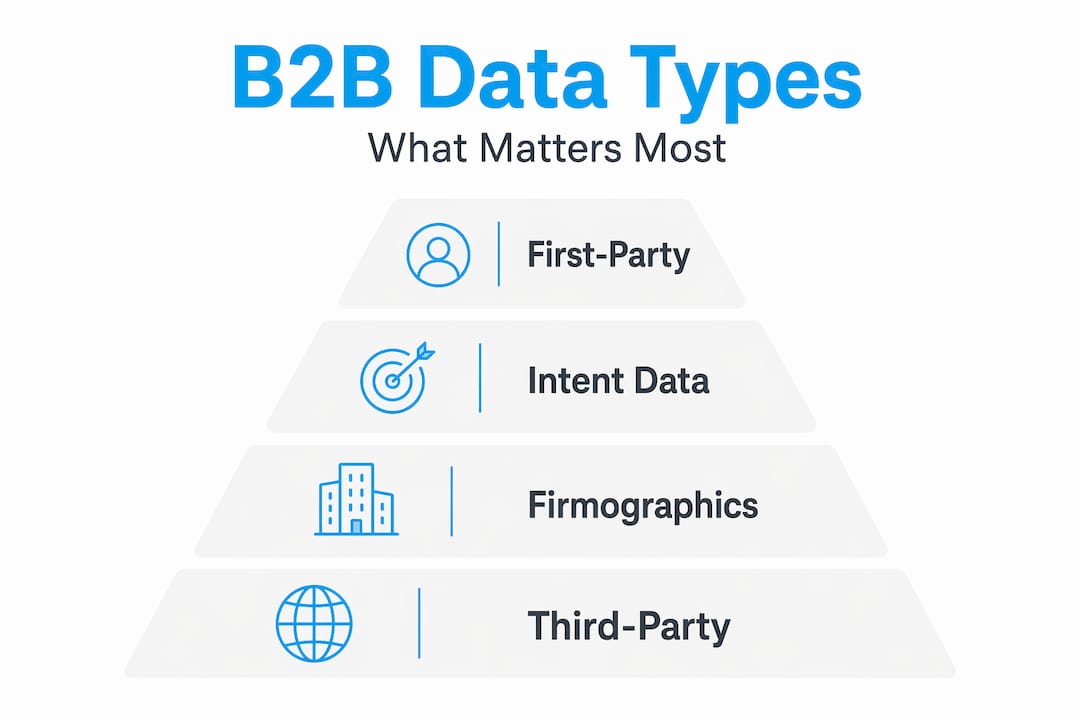
The four categories that matter
- First-party data is what your organization collects directly: CRM records, website behavior, email engagement, past purchase history. This is your highest-quality data because you own it and control it.
- Third-party data is purchased or licensed from external providers. It widens your reach but often degrades quickly. Firmographic data from third parties, for example, can be 20 to 30 percent out of date within a year.
- Intent data tracks behavioral signals across the web to identify accounts actively researching topics relevant to your solution. When an account is consuming content about enterprise procurement software, that’s a buying signal.
- Predictive data uses machine learning models to score accounts based on their likelihood to buy, combining historical patterns with real-time signals.
Each category supports a different stage of the buyer journey. First-party data is best for retention and upsell. Intent data is best for top-of-funnel prioritization. Predictive data helps sales focus on accounts most likely to convert in the near term.
The impact of data in B2B is most visible when teams match the right data type to the right campaign objective. Using third-party firmographics to personalize mid-funnel content, for instance, rarely works because the data isn’t specific enough. Using first-party behavioral signals to trigger nurture sequences does work, because the data reflects actual engagement.
Data governance, including standardizing account hierarchies and enforcing consistent tracking policies, is what separates teams that scale campaigns reliably from those that rebuild their data stack every 18 months. Without it, every campaign you run is operating on a leaky foundation.
How data transforms targeting, ABM, and content
The practical applications of B2B campaigns using analytics are where strategy becomes revenue. Three areas show the clearest return.
Account-based marketing
Traditional outbound treats every account equally. ABM does the opposite. Focusing on high-value accounts using precise account data reduces wasted resources and sharpens conversion rates by concentrating effort where buying signals are strongest.

ABM relies on tiered account lists built from a mix of first-party engagement data and firmographic filters. Tier 1 accounts get fully personalized campaigns. Tier 2 gets personalized messaging within templated programs. Tier 3 gets programmatic, lightly personalized touches. The data determines which tier each account falls into and when to escalate.
Predictive intent data for timing
Timing is one of the most underrated variables in B2B outreach. Predictive intent data ranks accounts by buying readiness using machine learning, which means your sales team can focus their week on the 12 accounts most likely to engage rather than the 200 accounts on a static list.
This is how data influences B2B results in ways that feel almost unfair to competitors still working from last quarter’s contact list. One account that’s actively researching your category right now is worth more than 50 accounts that loosely match your ICP but aren’t in a buying cycle.
Pro Tip: Set up intent data alerts inside your CRM so that when a tier 1 account spikes in relevant research topics, a sales task is auto-created within 24 hours. Speed to engagement matters enormously when a prospect is mid-research.
Content personalization at scale
Original research content produces a 25% lift in top-ranking keywords for B2B sites, and it serves double duty. It generates the data you need for personalization while simultaneously building authority that attracts inbound traffic.
| Tactic | Traditional approach | Data-informed approach |
|---|---|---|
| Audience targeting | Broad industry verticals | Firmographic and behavioral filters |
| Content delivery | Same asset to all contacts | Personalized by stage, role, and account |
| Outreach timing | Fixed send schedules | Intent signal triggers |
| Account prioritization | Revenue potential only | Intent score plus engagement history |
| Campaign measurement | Open rates, clicks | Pipeline contribution and velocity |
The shift from left to right in that table is exactly what data strategies for B2B are designed to accomplish.
Common pitfalls that kill data-driven campaigns
Understanding what goes wrong is just as important as knowing what to do. These are the obstacles that consistently prevent teams from realizing the true impact of data in B2B.
- Data overload without frameworks. Automated reports lacking actionable takeaways are the norm, not the exception. If your team is reviewing dashboards without a process for converting what they see into a next action, the data is generating cost and no value.
- Poor integration between tools. Most B2B marketing stacks include a CRM, a marketing automation platform, an ABM tool, and at least one intent data provider. When these systems don’t talk to each other cleanly, intent data integration fails and you lose the real-time responsiveness that makes it valuable.
- Treating intent data as gospel. Without validation and workflow integration, intent data becomes an expensive guessing game. An account researching a topic doesn’t mean a decision-maker there is ready to buy. Context matters. You need additional signals before escalating to a high-touch outreach play.
- Attribution gaps created by long sales cycles. A B2B deal that closes in month nine was influenced by a blog post from month two, a webinar in month four, and a LinkedIn sequence in month seven. Last-click attribution misses most of that story. Without multi-touch attribution modeling, your team will systematically defund the campaigns that actually work.
- Organizational silos blocking data activation. Sales has CRM data. Marketing has campaign data. Product has usage data. When these teams don’t share data with a common taxonomy, campaigns can’t be coordinated and measurement becomes impossible.
Pro Tip: Before purchasing any new data tool or intent platform, audit your existing data flows. If your CRM records are incomplete or inconsistently formatted, adding more data sources will multiply the problem, not solve it. Start with prospect segmentation as a forcing function to clean what you have.
Best practices for maximizing data impact
Getting data to actually move the needle in your B2B campaigns requires a structured approach. Here’s what works.
- Establish data governance before scaling. Agree on a single source of truth for account and contact records. Standardize how accounts are named, hierarchied, and tagged across systems. This is the unsexy work that makes everything else possible.
- Integrate CRM, MAP, and ABM platforms. Integrating CRM and outreach tools is the infrastructure that allows intent signals to trigger real-time, personalized responses automatically, not as a manual process.
- Build insight workflows, not just reports. Every data review meeting should end with a decision: which accounts to escalate, which content to promote, which channels to shift budget toward. If the meeting ends without a decision, restructure the meeting.
- Use predictive analytics for prioritization, not just reporting. Predictive intent data filters noise and times outreach when accounts are genuinely in a buying window. Use it to rank your weekly outreach targets, not just to build annual ICP profiles.
- Align sales and marketing on shared data definitions. A “qualified lead” means different things to every team. Document exactly what behavioral and firmographic signals constitute a sales-ready account and build your data triggers around that agreed definition.
- Run multi-channel campaigns triggered by data signals. When an account hits a certain intent score threshold, trigger a coordinated sequence: a LinkedIn connection request, a personalized email, and a sales call attempt within the same week. Strategic LinkedIn messaging paired with intent data dramatically outperforms either channel alone.
- Measure and refine on a 30-day cycle. Data strategies for B2B degrade fast. What worked in Q1 may not work in Q3 as market conditions shift. Build a monthly review cycle where you re-score your ICP, review campaign attribution, and adjust targeting criteria based on what’s actually converting.
| Metric | What it measures | Why it matters |
|---|---|---|
| Intent score velocity | How fast an account’s research activity is accelerating | Predicts buying window opening |
| Pipeline influenced | Revenue touched by a campaign before close | True campaign ROI beyond click-through |
| MQL to SQL conversion rate | Quality of marketing-qualified leads | Signals ICP and data accuracy |
| Time to engage | Speed from signal to first outreach | Impacts win rates in competitive deals |
Analytics-driven marketing consistently delivers better ROI, but only when the underlying data infrastructure supports the measurement model you’re using to evaluate success.
My honest take on where data goes wrong
I’ve spent years watching marketing teams invest heavily in data tools and come away with slower campaigns, not faster ones. The pattern is always the same. The organization buys a platform, generates more dashboards, and then waits for the dashboards to make decisions for them. They never do.
In my experience, the gap between data availability and meaningful insight is almost entirely a culture problem, not a technology problem. The teams that win with data-driven B2B marketing have one thing in common: they’ve decided in advance what decision each data source is supposed to inform. They don’t look at intent signals and ask “what does this mean?” They already know. When an account crosses a certain score threshold, the response is automatic.
What surprises most people is that the teams generating the best results often use less data than their competitors. They’ve targeted ideal clients precisely and ruthlessly ignored everything that doesn’t inform that decision. Quality over volume is not a cliché here. It’s the actual operating model.
The uncomfortable truth about data strategies for B2B is that clean, integrated, minimal data beats large, siloed, unvalidated data sets every single time. The work of getting your data right is less exciting than buying a new tool. But it’s the work that actually compounds.
— Toby
How Theleadlab turns data into pipeline
Most B2B teams know data should be driving their campaigns. Getting the infrastructure, the targeting logic, and the outreach execution working together is where it breaks down. Theleadlab is built for exactly that gap. We run done-for-you B2B campaigns using LinkedIn outreach that combines precise account targeting, intent-informed sequencing, and personalized messaging designed for professional services firms. From prospect selection through to response management, every step is data-backed.
If you want to see how this works for firms like yours, our client case studies show real campaigns with real results. No generic playbooks. No vanity metrics. Just a documented approach to converting data into qualified meetings.
FAQ
What is the role of data in B2B campaigns?
Data defines who you target, when you reach out, what message you send, and how you measure success. Without structured data, B2B campaigns rely on guesswork instead of buyer signals.
What types of data matter most in B2B marketing?
First-party data and predictive intent data deliver the highest ROI. First-party data reflects real engagement with your brand, while intent data shows which accounts are actively researching solutions in your category right now.
How does intent data improve B2B campaign performance?
Intent data ranks accounts by buying readiness so your team can prioritize outreach at the right moment. It only works effectively when validated and integrated directly into your CRM and marketing automation workflows.
Why do so many data-driven B2B campaigns underperform?
Most failures trace back to data that isn’t integrated, isn’t governed consistently, or isn’t connected to a clear decision-making process. More data without a framework for acting on it creates noise, not results.
How often should B2B teams review their data strategy?
A 30-day review cycle is the practical minimum. Buyer behavior, market conditions, and ICP definitions shift quickly. Monthly calibration keeps your targeting criteria and attribution models aligned with what’s actually converting.