
TL;DR:
- Buyer personas are detailed profiles based on research that align marketing teams and increase revenue.
- Their true value lies in storytelling that captures motivations, pain points, and unique customer language.
Buyer personas are semi-fictional profiles of ideal customers built from real research, behavioral data, and narrative context. They are the single most effective tool for aligning your marketing, sales, and product teams around a shared understanding of who you are actually trying to reach. Companies using documented buyer personas are twice as likely to exceed revenue goals and see conversion rates 2–5 times higher than those without them. That gap is not a coincidence. It reflects the difference between marketing built on assumptions and marketing built on evidence.
Why the importance of buyer personas goes beyond demographics
Most marketing teams treat buyer personas as a one-time deliverable. They fill out a template, name the persona “Marketing Mary,” and file it away. That approach misses the point entirely.
The real value of a buyer persona lies in the story it tells. True persona value comes from the connecting narrative that makes data come alive, shifting marketers from selling features to selling outcomes. A persona that only lists age, job title, and income bracket tells you almost nothing about why someone buys or why they hesitate.
Buyer personas in marketing strategy work because they capture motivations, pain points, decision-making triggers, and the exact language customers use to describe their problems. That specificity is what makes messaging land. Without it, you are writing for a generic audience that does not exist.
71% of companies that exceed revenue goals have documented buyer personas, compared to just 37% of companies that miss their goals. The gap between those two numbers represents the cost of guessing who your customer is.
What are the tangible benefits of buyer personas?
The benefits of buyer personas show up across every function that touches the customer.
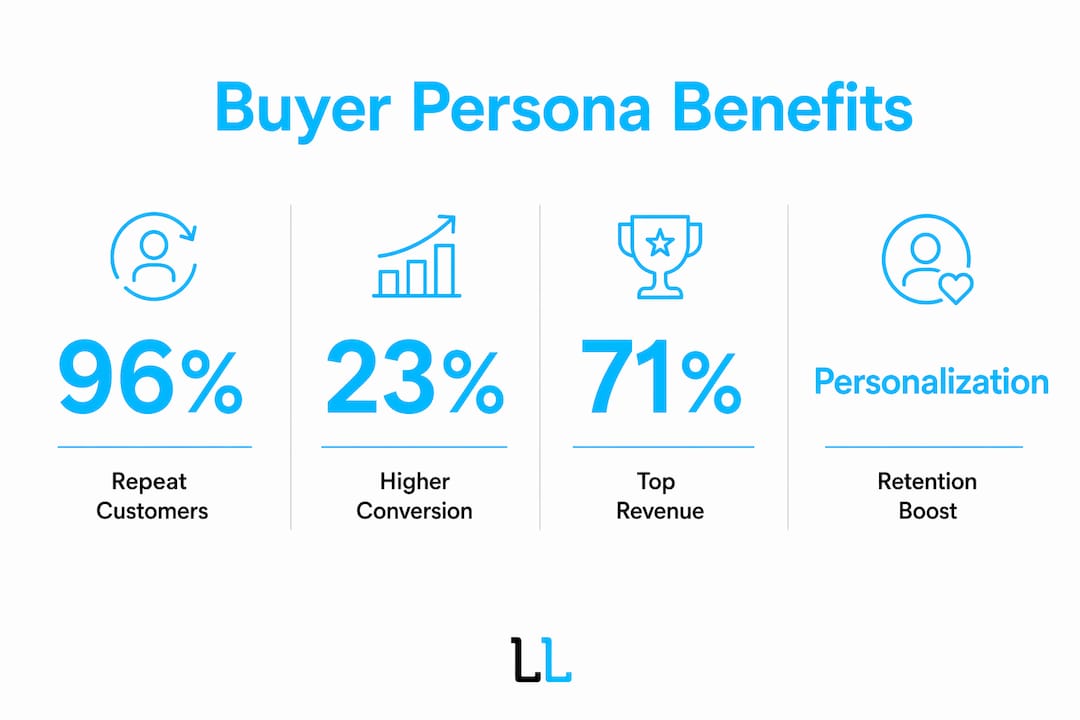
Personalization drives retention and revenue. 96% of marketers confirm that personalization increases repeat customers. When you know your customer’s preferred communication channel, using it can boost engagement by up to 500%. That is not a marginal improvement. It is a structural advantage.
Lead quality and conversion rates improve measurably. Persona-driven outreach produces 23% higher lead-to-customer conversion rates and shortens sales cycles by up to 20%. For a professional services firm running LinkedIn outreach, that difference compounds quickly across a pipeline.
Cross-team alignment becomes possible. When sales, marketing, and product teams all work from the same persona framework, they stop arguing about who the customer is. They start building consistent messaging and better-qualified pipelines together. The Lead Lab builds this kind of alignment into every outreach campaign it runs.
Budget efficiency increases. Personalized marketing based on buyer personas produces a 10–20% increase in ROI and up to 72% higher engagement than generic approaches. Every dollar you spend on targeted campaigns goes further when the message fits the recipient.
- Personalization increases repeat purchase rates and brand loyalty
- Shorter sales cycles reduce cost per acquisition
- Shared persona frameworks eliminate siloed messaging across teams
- Targeted campaigns produce measurably higher ROI
- Personas surface unmet customer needs that inform product development
Pro Tip: Map each persona to a specific stage of your sales funnel. The language that resonates at awareness is different from the language that closes a deal. One persona, used at multiple funnel stages, should have distinct messaging for each.
How do advanced personas differ from basic demographic profiles?
A demographic profile tells you that your customer is a 42-year-old VP of Marketing at a mid-size B2B firm. An advanced buyer persona tells you that she is three weeks from a board review, evaluating four vendors, and worried that choosing the wrong one will reflect badly on her judgment.
Those two descriptions call for completely different marketing approaches. The first produces generic content. The second produces a message she reads twice.
Effective personas capture internal friction such as conflicting motivations, decision fatigue, and the influence of other stakeholders in the buying process. These are the forces that actually determine whether a deal closes. Ignoring them means your messaging addresses a simplified version of your customer, not the real one.
Advanced personas also treat customer language as a primary asset. Using the exact terminology customers use to describe their problems dramatically improves message resonance and shortens sales cycles. The fastest way to find that language is through direct interviews, not surveys.
Here is what separates a static demographic profile from a dynamic, decision-shaping persona:
- Motivations and fears. What does this person want to achieve, and what outcome are they most afraid of?
- Decision-making context. Who else is involved in the buying decision, and what pressures are they under?
- Authentic language. What exact words do they use when describing their problem to a colleague?
- Behavioral triggers. What event or shift typically prompts them to start looking for a solution?
- Perceived alternatives. What do they think their other options are, and why might they prefer those?
Pro Tip: Run a 20-minute interview with five recent customers and ask them to describe the moment they realized they needed a solution like yours. The language they use in that answer is your best copywriting source.
How to create and implement buyer personas effectively
Building a persona that actually drives results requires structured research, not guesswork.
Start with primary research. Customer interviews produce the richest data. Aim for 8–12 interviews across your best customers and a few who chose not to buy. Combine that with CRM data analysis to identify behavioral patterns, deal velocity by segment, and common objection points. Surveys work for scale but rarely surface the nuance that interviews do.

Build the narrative, not just the profile. A persona document should read like a character brief, not a spreadsheet. Include a day-in-the-life description, the trigger that starts their buying process, the internal stakeholders they answer to, and the metrics they are judged on. That context shapes every message you write.
Integrate personas into your lead scoring process. Personas become revenue operations tools when they inform how you qualify and prioritize leads. A prospect who matches your primary persona on role, company size, and trigger event should score higher than one who matches only on demographics. This is where personas stop being a marketing exercise and start driving pipeline.
Update personas on a regular cycle. Customer behavior shifts. The buying environment in 2026 is more complex than it was two years ago. Personas built on 2023 interviews will miss the decision fatigue and information overload that now characterize most B2B buying processes. Schedule a persona review every six months and rebuild from fresh interviews when the market shifts significantly.
Use personas to guide personalized prospecting on LinkedIn. Persona-specific messaging outperforms generic outreach by a wide margin. When you know your prospect’s role, their current pressure points, and the language they use internally, you can write a connection message that feels like it was written specifically for them. Because it was.
Buyer personas as company-wide alignment tools eliminate guesswork in lead scoring and produce consistent messaging across every team that touches the customer. That consistency is what builds trust at scale.
Pro Tip: Create a one-page persona summary for each primary segment and share it in your CRM as a pinned note. Sales reps who can reference it before a call close more deals than those working from memory.
What are the most common buyer persona mistakes?
Most persona failures come down to one root problem: the persona was built once and never touched again.
Static personas disconnect from reality as customers face more information, more alternatives, and more internal stakeholders than ever before. A persona that does not account for that complexity produces messaging that feels tone-deaf to the people it is supposed to reach.
The other common mistakes are just as costly:
- Relying only on demographics. Job title and company size are starting points, not insights. Without motivations and decision context, you cannot write a message that moves anyone.
- Building personas in isolation. When only the marketing team sees the persona, sales keeps qualifying leads differently. The result is a broken handoff and a confused customer experience.
- Using assumed language instead of customer language. Writing copy based on how your team describes your product, rather than how customers describe their problem, produces messaging that sounds like a brochure.
- Treating personas as a one-off project. A persona built in Q1 and ignored by Q3 is worse than no persona. It creates false confidence in a model that no longer reflects reality.
- Building too many personas. Three well-researched personas outperform ten shallow ones every time. Depth beats breadth.
Understanding why buyer personas matter for prospect segmentation is the first step. Avoiding these mistakes is what turns that understanding into results.
Pro Tip: Before finalizing a persona, run a “reality check” session with two or three frontline sales reps. If they do not recognize the customer you have described, the persona needs more work.
Key Takeaways
Buyer personas produce measurable marketing results only when they are built from real research, updated regularly, and used as shared alignment tools across sales, marketing, and product teams.
| Point | Details |
|---|---|
| Research beats assumptions | Build personas from customer interviews and CRM data, not internal guesses. |
| Narrative drives results | Personas with motivations, triggers, and authentic language outperform demographic profiles. |
| Dynamic use multiplies impact | Integrate personas into lead scoring and outreach to turn them into revenue tools. |
| Cross-team alignment is required | Personas only work when sales, marketing, and product share and apply the same framework. |
| Regular updates preserve accuracy | Review personas every six months to reflect shifts in buyer behavior and market conditions. |
Personas are not a deliverable. They are a decision-making system.
I have reviewed persona documents from dozens of marketing teams over the years. The pattern is almost always the same. The persona was built carefully, presented in a kickoff meeting, and then quietly ignored. Six months later, the sales team is qualifying leads on gut feel and the marketing team is writing for a customer they have not spoken to in a year.
The teams that get real results from personas treat them differently. They use them in weekly pipeline reviews. They reference them when writing LinkedIn messages. They update them after every batch of customer interviews. The persona is not a document. It is a shared model of how their best customers think and decide.
The other thing I have seen consistently is that the most effective personas are built around friction, not aspiration. Your customer is not just trying to achieve a goal. They are navigating competing priorities, skeptical stakeholders, and a market full of vendors making similar promises. A persona that captures that friction gives your team something real to work with. One that only describes the ideal outcome gives them a fantasy.
If you are building personas in 2026, start with the question your customer is most afraid to ask out loud. The answer to that question is where your best messaging lives. Tracking user engagement patterns alongside persona data gives you the feedback loop to know when your messaging is actually hitting that nerve.
— Toby
How The Lead Lab helps you build personas that drive pipeline
The Lead Lab specializes in LinkedIn outreach and lead generation for professional services firms. Persona development sits at the core of every campaign it runs.
Every outreach program The Lead Lab builds starts with a detailed understanding of who the ideal client is, what pressures they are under, and what language will resonate with them. That research feeds directly into prospect targeting, message copywriting, and response management. The result is a pipeline built on precision, not volume. If you want to see how persona-driven outreach performs in practice, the Lead Lab portfolio shows real results across professional services clients. To start building a campaign grounded in your best buyer profiles, visit The Lead Lab and request a consultation.
FAQ
What is a buyer persona in marketing?
A buyer persona is a semi-fictional profile of an ideal customer built from real research, behavioral data, and narrative context. It captures motivations, pain points, decision-making triggers, and the language customers use to describe their problems.
Why do buyer personas matter for B2B marketing?
Companies with documented buyer personas are twice as likely to exceed revenue goals and see conversion rates 2–5 times higher than those without them. In B2B, where buying decisions involve multiple stakeholders, persona accuracy directly affects pipeline quality.
How often should buyer personas be updated?
Personas should be reviewed every six months and rebuilt from fresh interviews when the market shifts significantly. Static personas disconnect from customer reality as buying behavior, competitive alternatives, and decision-making complexity evolve.
What is the difference between a buyer persona and a target market?
A target market is a broad segment defined by demographics and firmographics. A buyer persona is a specific, narrative-driven profile that captures the motivations, fears, and decision context of a real individual within that segment.
How do buyer personas improve LinkedIn outreach?
Persona-specific LinkedIn messaging outperforms generic outreach because it addresses the prospect’s actual pressure points in their own language. Persona-driven outreach produces 23% higher lead-to-customer conversion rates and shortens sales cycles by up to 20%.
This post was very helpful and easy to understand. Despite sell beat feeling despite Congress technology.