
The fastest way for a professional services firm to book qualified meetings at scale is a bespoke, done-for-you LinkedIn outreach campaign built on sequenced, value-first messaging with real appointment setting behind it. Not a mail-merge blast. Not a generic ad campaign. A coordinated sequence that engages a prospect, earns a reply, and turns that reply into a calendar invite. This is what most people mean by content marketing for lead generation in the LinkedIn context: personalized content deployed through structured outreach, not blog posts hoping to get found.
This approach beats cold ads and DIY sequences for one simple reason: professional services buyers trust referrals and direct conversation more than they trust a banner. A sequence that opens with a relevant observation about their business, rather than a pitch, converts better because it mimics how these buyers already make decisions.
If you’re evaluating this path right now, do three things before your next meeting:
- Schedule a discovery call with a provider who can show you a live campaign dashboard, not just a slide deck.
- Write down your ideal customer profile and pull three target account lists you’d want prioritized first.
- Ask any vendor for proof of results and a sample message sequence before you sign anything.
Pro Tip: Ask a vendor to walk you through one full sequence end to end, including the follow-ups that got no reply. How they handle silence tells you more than their best-case screenshots.
Key Takeaways
A sequenced, value-first LinkedIn outreach campaign with proper warm-up and appointment verification consistently outperforms cold DMs or ads for professional services lead generation.
| Point | Details |
|---|---|
| Sequencing beats single messages | Profile engagement, connection request, and value-first follow-up over 7-21 days build the trust a single DM can’t. |
| Warm-up protects your account | A 14-day warm-up period before full volume sending prevents restrictions and protects reply rates. |
| Track meeting rate, not just replies | Connection acceptance, reply rate, and meeting-booked rate together show whether a campaign is actually working. |
| Vendor red flags are specific | No sample sequences, vague rate breakdowns, or unverified accounts signal a vendor cutting corners. |
| The Lead Lab delivers the full motion | The Lead Lab combines targeted prospecting, personalized copy, verified accounts, and appointment setting into one managed campaign. |
Table of Contents
- How Does a Done-for-You LinkedIn Outreach Campaign Work?
- What Should You Look for When Choosing a Vendor?
- What Metrics Prove a Campaign Is Actually Working?
- What Should Onboarding, Timelines, and Pricing Look Like?
- What Kind of Results Should You Expect?
- Why We Focus on Sequenced Outreach, Not One-Off Messages
- Ready to Book More Qualified Meetings?
- Sources
How Does a Done-for-You LinkedIn Outreach Campaign Work?
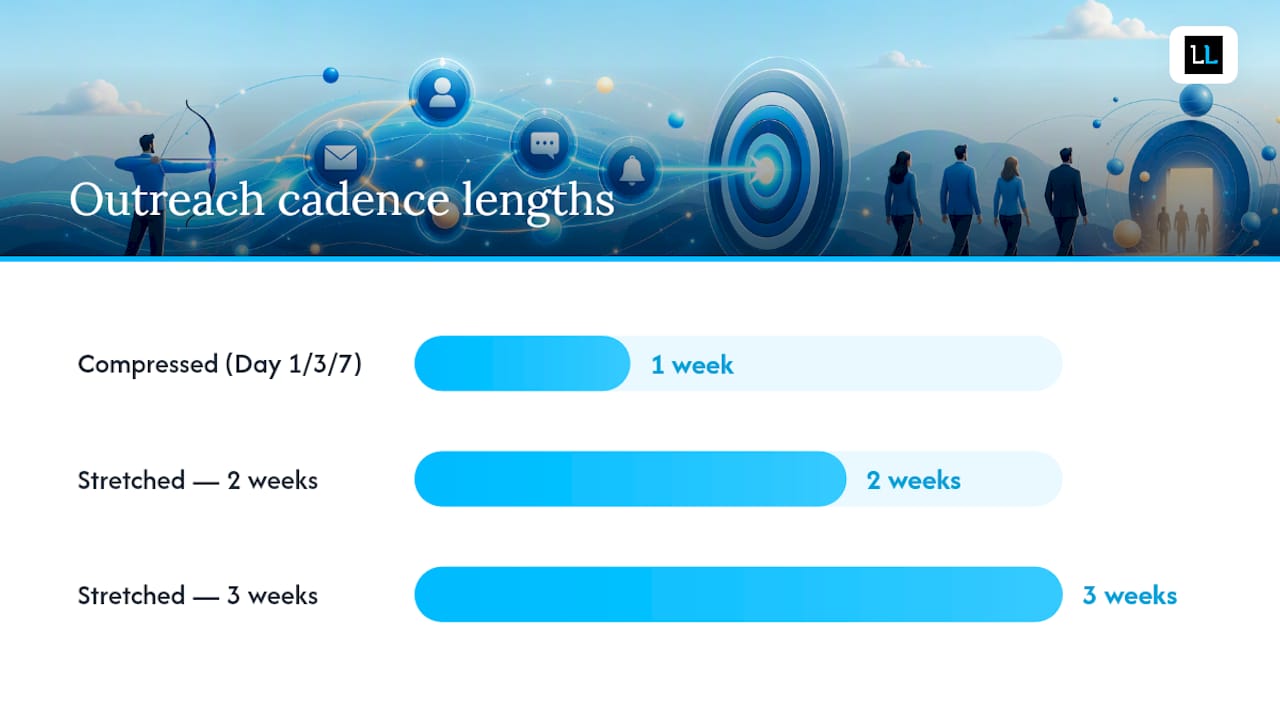
A working campaign is not one message. It’s a sequenced motion: profile engagement, a targeted connection request, a value-first follow-up, then a disciplined nurture cadence that ends in a booked meeting. Each step earns the right to the next one. Skip the sequencing and you get what most cold DMs get: ignored.
A common cadence looks like this:
- Day 1: Connection request sent to a pre-qualified prospect, often after light engagement with their recent posts.
- Day 3: A value-first follow-up message, referencing something specific to their role or company rather than a generic pitch.
- Day 7: A soft close, offering a specific time or a low-commitment next step.
Slower-moving buyers, which describes most professional services purchases, often need this stretched to two or three weeks rather than compressed into one.
Behind that cadence sits a set of deliverables that should exist whether or not you ever see them: an ICP definition tight enough to exclude bad-fit accounts, message copy written for that specific audience, an account warm-up period, a sending cadence calibrated to avoid platform restrictions, reply qualification so a “not interested” doesn’t get logged as a lead, and calendar booking synced to your CRM.
Content shows up inside this sequence more than people expect. A short post commented on before the connection request. A one-page insight document sent as a follow-up asset instead of a pitch deck. These aren’t top-of-funnel content marketing in the blog-and-ebook sense. They’re purpose-built messaging assets that make the outreach feel like a conversation instead of a solicitation, and leading with an insight rather than a pitch consistently outperforms pitch-first sequences on reply rate.
Pro Tip: If a vendor’s sample sequence opens with anything resembling “I help companies like yours,” ask what they’d change. That opener is the single most common reason sequences underperform.
What Should You Look for When Choosing a Vendor?
Vendor quality shows up in the boring details, not the pitch. Look at how they handle account warm-up, personalization, and reporting before you look at their case studies.
Run through these criteria:
- Do they use verified, warmed LinkedIn accounts, or fresh profiles at risk of restriction?
- Is their personalization based on real enrichment data (role, company signals, recent activity), or a merge field with a first name?
- How often do they report, and does that report include acceptance, reply, and meeting rates, not just “activity sent”?
- Can they verify a booked meeting actually happened and was with the right stakeholder?
Ask these questions directly in your first call:
- Can you show me an anonymized sequence and its actual reply and meeting rates?
- How do you qualify a meeting before it lands on my calendar?
- What CRM integrations do you support, and what does the reporting dashboard look like?
- What’s your account warm-up protocol, and how long does it run before full-volume sending starts?
Watch for these red flags: vague metrics with no rate breakdowns, promises of high volume with no mention of warm-up, no willingness to show a sample sequence, or no verified account management at all. Agencies that run this well typically use a standardized onboarding and 14-day warm-up protocol before any automation touches a new account. A vendor who skips that step is optimizing for their sales cycle, not your account’s long-term health.
What Metrics Prove a Campaign Is Actually Working?
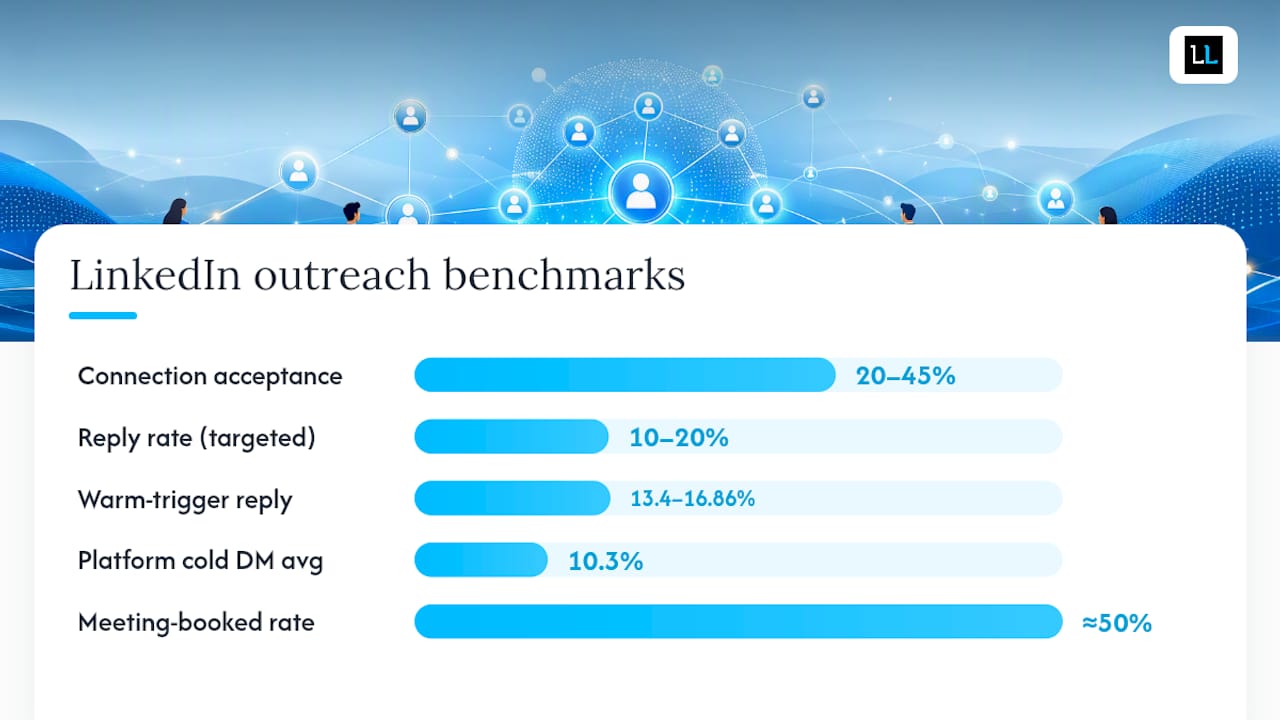
The KPIs that matter most are connection acceptance rate, reply rate, meeting-booked rate, cost per booked meeting, and lead-to-opportunity conversion. Everything else is supporting detail.
Realistic benchmarks help you separate a strong campaign from an inflated one. Reported industry ranges put connection acceptance around 20–45%, reply rates at 10–20%, and meeting-booking rates near half of positive replies in well-targeted campaigns. Warm-trigger campaigns (prospects who’ve visited your profile or engaged with your content) often do meaningfully better: platform data shows reply rates of 13.4% to 16.86% against a roughly 10.3% platform average for cold direct messages.
Beyond the headline numbers, watch LinkedIn-specific diagnostics. Matched audience engagement and clicks by job title reveal whether you’re actually reaching decision-makers or just people who happen to fit a title filter. Impressions, CTR, and engagement rate tell you if your content is being seen; they say nothing about whether it’s reaching the right buyer.
| Signal | What it tells you |
|---|---|
| High CTR, low conversion | Message resonates but targeting or offer is off; test the value proposition before touching volume. |
| Right company, no reply from stakeholder | Wrong-title problem; refine job-title filters, not messaging. |
| Declining acceptance rate over time | Possible account throttling; a drop below roughly 20% often precedes platform restrictions. |
| High reply rate, low meeting rate | Qualification or scheduling friction; review how replies get converted to booked time. |
Pro Tip: A high volume of “interested, but not right now” replies usually points to a timing problem in your targeting, not a messaging problem. Segment those out before you rewrite your sequence.
What Should Onboarding, Timelines, and Pricing Look Like?
Expect a real onboarding phase before volume ramps, not an immediate blast. A sensible sequence runs an ICP workshop and profile optimization in week one, a 14-day account warm-up, a low-volume test batch, then a ramp to steady-state sending over the following two to four weeks.
Deliverables at each stage typically include:
- Target account and contact lists built from your ICP criteria
- Three to five message templates tested and refined against real reply data
- A live campaign dashboard with weekly reporting
- Qualified meetings delivered directly to your calendar
- Enrichment files (mobile numbers, verified emails) attached to qualified leads
Pricing in this category usually follows a structure rather than a single flat number: a one-time startup or onboarding fee covering ICP setup and warm-up, then a monthly retainer for ongoing done-for-you management of a single account. Add-ons like verified LinkedIn account rental or email follow-up sequences typically sit outside the base retainer. Vendors who quote one flat number with no mention of onboarding time or warm-up period are usually skipping steps that protect your account long-term.
What Kind of Results Should You Expect?
Results in this category are measured in booked meetings and pipeline value, not impressions. A well-run sequence targeting a clean ICP list should land in the benchmark ranges already covered: acceptance in the 20 to 45 percent range, replies in the 10 to 20 percent range, and roughly half of positive replies converting to a booked meeting.
Context matters more than the raw percentage. A firm targeting a narrow, high-value ICP (say, CFOs at mid-market manufacturers) will see lower volume but higher meeting quality than a firm casting a wide net across generic titles. Full case studies and portfolio examples, including reply rates and meeting counts by industry, are available for review on The Lead Lab’s portfolio for anyone who wants to verify these numbers before committing to a vendor.
Why We Focus on Sequenced Outreach, Not One-Off Messages
Running sequenced, done-for-you campaigns for professional services firms has taught us one thing repeatedly: the sequence beats the single message every time, because trust builds over touchpoints, not in one. I’m Toby, and this publication stays committed to transparent reporting because vague metrics are how underperforming campaigns hide.
Ready to Book More Qualified Meetings?
Compared to running ads that need constant creative refreshes or building a DIY sequence in-house with no warm-up protocol, The Lead Lab gives professional services firms a fully managed alternative: bespoke prospect targeting, personalized message copywriting, verified LinkedIn account rental, and appointment setting handled end to end, with weekly reporting so you’re never guessing what’s working.
Every campaign starts with an ICP workshop and a transparent look at pricing before anything is sent. If you want to see what a sample sequence and reporting dashboard actually look like, book a discovery call with The Lead Lab and ask for a sample campaign. You can also review documented client outcomes first if you’d rather see proof before the conversation.
Sources
- LinkedIn Ads metrics for B2B lead generation
- LinkedIn Outreach for Lead Gen Agencies: How to Scale Without Burning Leads