
TL;DR:
- A buyer persona is a data-driven, semi-fictional profile of the ideal customer that guides marketing and sales efforts. Companies that develop and regularly update personas see improved alignment, personalization, and revenue growth. Integrating personas into every customer interaction ensures targeted messaging, efficient resource use, and better overall results.
A buyer persona is a semi-fictional, data-driven profile of your ideal customer, built from real research to represent the motivations, behaviors, and challenges that drive their purchasing decisions. With 71% of companies that exceed revenue goals using documented buyer personas to align sales and marketing, this is not a nice-to-have exercise. It is the foundation of every message, campaign, and sales conversation that actually lands. HubSpot, ZoomInfo, and Brandwatch all treat persona development as a core marketing discipline, and for good reason. Understanding your customer’s “why” goes far deeper than knowing their job title.
What is a buyer persona and why does it matter?
A buyer persona, sometimes called a marketing persona or customer avatar, is a structured profile that captures who your ideal customer is at a human level. It goes beyond age and industry to include their goals, daily frustrations, decision-making triggers, and preferred communication channels. The term “buyer persona” is the widely recognized industry label, though you will also see it called an audience persona or customer persona in different contexts.
The definition matters because it shapes how you use the tool. Personas must be synthesized into coherent narratives about human motivations, pressures, and daily realities. A list of demographic checkboxes is not a persona. A story about “Marcus, the overwhelmed VP of Sales at a 50-person consulting firm who needs to hit quota without adding headcount” is a persona. That distinction determines whether your marketing resonates or disappears.
Companies that invest in understanding buyer personas see measurable returns. 96% of marketers report that personalization increases repeat customers. Personalization at that scale is only possible when you know exactly who you are speaking to and what they care about most.
Why buyer personas drive real marketing and sales results
Documented buyer personas create alignment between sales and marketing teams that is otherwise difficult to achieve. When both teams operate from the same profile of who they are targeting, messaging stays consistent from the first LinkedIn touchpoint through to the closing call. That consistency builds trust with prospects faster.
“Personas enable sharper sales conversations and better product decisions.” — Brandwatch
Personas also eliminate wasted spend. Without a clear profile of your ideal customer, paid campaigns, content production, and outreach efforts get distributed too broadly. You end up paying to reach people who will never buy. A well-defined persona tells you which channels your buyers actually use, which pain points resonate, and which objections to address before they are raised.
The impact extends beyond acquisition. Companies with documented personas generate more relevant content and improve paid campaign targeting significantly. More relevant content builds brand authority with the right audience, which compounds over time into stronger pipeline and higher retention. For professional services firms in particular, where trust is the primary purchase driver, this compounding effect is substantial.
Personas also sharpen your prospect segmentation strategy, making it easier to prioritize outreach efforts toward the contacts most likely to convert.
How buyer personas differ from ICPs and negative personas
Three related concepts cause consistent confusion: the buyer persona, the ideal customer profile (ICP), and the negative persona. Each serves a distinct purpose, and using them interchangeably leads to targeting errors.
Ideal customer profiles operate at the company level. An ICP defines the type of organization most likely to buy from you, covering firmographics like company size, industry, revenue range, and technology stack. A buyer persona operates at the individual level. It profiles the specific decision-maker or influencer within that company, capturing their role, motivations, communication preferences, and objections.
In B2B sales, you typically need both. The ICP tells you which companies to target. The buyer persona tells you who to contact within those companies and what to say to them. A professional services firm might define its ICP as “consulting firms with 20 to 200 employees in financial services” and then build separate personas for the Managing Director who approves budget and the Marketing Manager who researches vendors.
Negative buyer personas represent the people you should actively exclude from your pipeline. These are prospects who drain resources, churn quickly, or simply never convert regardless of effort. Defining who you do not want is as strategically valuable as defining who you do.
| Profile type | Level | Primary use |
|---|---|---|
| Buyer persona | Individual | Messaging, content, sales conversations |
| Ideal customer profile | Company | Targeting, prospecting, account selection |
| Negative persona | Individual | Pipeline filtering, ad exclusions |
Pro Tip: Build at least one negative persona before launching any outreach campaign. Excluding low-fit prospects from your LinkedIn targeting alone can reduce wasted outreach by a significant margin and improve reply rates from the contacts who actually matter.
How to create a buyer persona that actually works
Effective buyer personas require aggregating real-world data from CRM records, sales conversations, win/loss analysis, and behavioral analytics. The biggest mistake marketers make is building personas from internal assumptions rather than external evidence. Here is a practical process for getting it right.

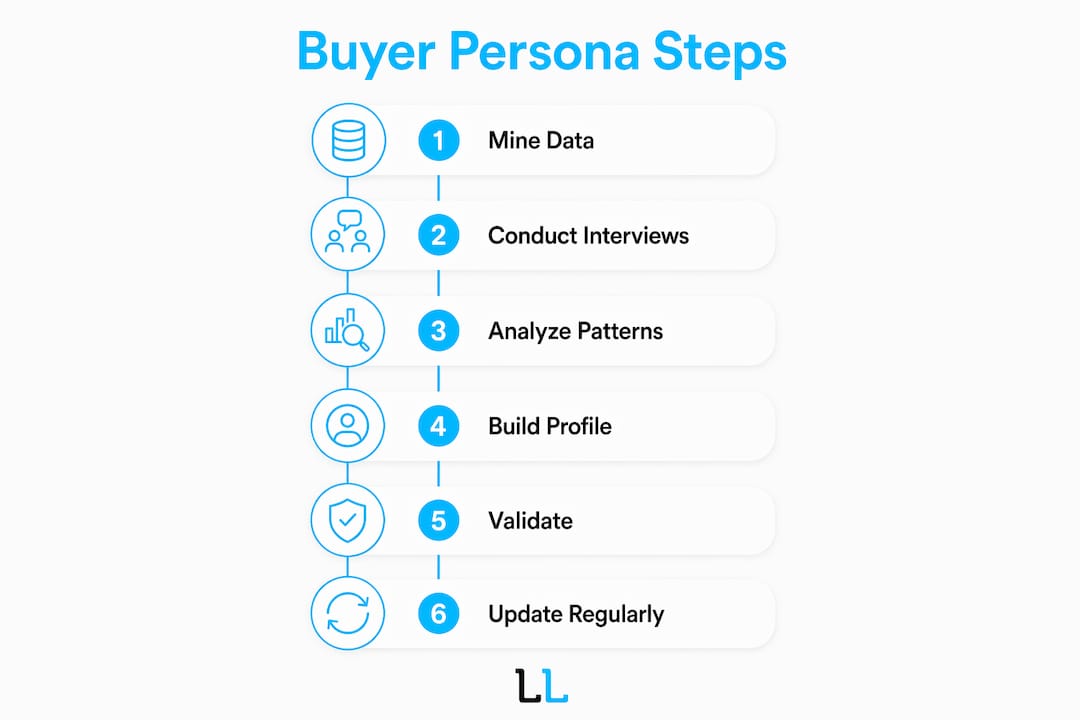
Step 1: Mine your existing CRM and sales data. Pull records of your best customers and look for patterns. Which industries, roles, and company sizes appear most often? What was the average sales cycle? Which objections came up repeatedly? Your CRM is the fastest source of validated persona data you already own.
Step 2: Conduct qualitative interviews. Talk directly to five to ten current customers and five to ten prospects who did not convert. Ask about their daily responsibilities, the problems they were trying to solve, how they evaluated options, and what almost stopped them from buying. These conversations surface the language and motivations that no analytics dashboard will show you.
Step 3: Analyze and segment the patterns. Group your findings by role and seniority. Look for shared pain points, goals, and decision-making behaviors. If two distinct profiles emerge, build two personas rather than averaging them into one generic profile that fits nobody well.
Step 4: Build the full persona profile. Best persona profiles include a descriptive name, demographics, professional goals, core pain points, decision criteria, preferred channels, and real quotes from customer interviews. HubSpot’s Make My Persona tool provides a structured template that walks you through each component. The goal is a profile vivid enough that your sales team can picture the person before picking up the phone.
Step 5: Validate with your sales team. Share the draft persona with the people who speak to prospects every day. They will immediately tell you whether the profile matches reality or whether a critical detail is missing. B2B personas must include objection-handling insights that sales teams can use directly in conversations. A persona that marketing loves but sales ignores has failed.
Step 6: Update regularly. Quarterly or biannual persona reviews are the standard for keeping profiles current. Customer behavior shifts, markets evolve, and a persona built in 2023 may no longer reflect the buyer you are actually meeting in 2026. Schedule the review into your marketing calendar rather than treating it as a one-time project.
Pro Tip: Avoid building more than three to four personas at launch. More than that and your team will struggle to internalize them. Start with the one or two profiles that represent 80% of your revenue and expand from there.
For a deeper look at building profiles from real client data rather than guesswork, The Lead Lab’s guide on personalized prospecting from real data covers the practical mechanics in detail.
How to apply buyer personas across marketing, sales, and product
A persona sitting in a shared drive folder delivers zero value. The return comes from embedding it into every function that touches the customer.
In content marketing, personas determine which topics to cover, which formats to use, and which distribution channels to prioritize. If your primary persona consumes long-form LinkedIn articles during their morning commute, that is where your content budget goes. Not into YouTube videos or Instagram carousels.
In paid advertising, personas define your targeting parameters and ad copy angles. A persona profile that includes specific pain points gives you the exact language to use in headlines. It also tells you which audiences to exclude, which directly reduces cost per lead.
In sales outreach, personas provide the context that makes personalized LinkedIn messaging feel relevant rather than generic. A sales rep who knows their persona’s top three frustrations can open a conversation by addressing one of them directly, which is far more effective than a generic introduction. ZoomInfo’s research confirms that data-driven personas provide objection-handling talk tracks that sales teams need to move deals forward.
In product development, personas reveal which features matter most to the people actually using your product. A persona that describes a time-pressed VP of Operations who needs a one-click report will prioritize differently than one describing a data analyst who wants granular export controls. Both are valid users. Only one is your primary buyer.
The Lead Lab’s approach to B2B lead generation on LinkedIn is built directly on persona-driven messaging, which is why campaigns consistently outperform generic outreach in both reply rates and meeting quality.
Key takeaways
A buyer persona is only as useful as the data behind it and the consistency with which your team applies it across every customer-facing function.
| Point | Details |
|---|---|
| Definition drives application | A persona is a narrative profile of motivations and behaviors, not a demographic checklist. |
| Revenue impact is documented | Companies using personas are twice as likely to exceed revenue goals. |
| ICP and persona serve different roles | Use ICPs for company targeting and personas for individual messaging and sales conversations. |
| Data over assumptions | Build personas from CRM data, interviews, and win/loss analysis, not internal guesses. |
| Personas require regular updates | Review and refresh profiles quarterly or biannually to stay aligned with actual buyer behavior. |
Why most buyer personas collect dust instead of driving results
Most teams build a persona once, present it in a kickoff meeting, and never look at it again. I have seen this pattern repeat across professional services firms of every size. The persona document gets filed, the campaign launches without it, and six months later everyone wonders why the messaging is not converting.
The problem is not the persona itself. It is the assumption that creating the profile is the finish line. The real work starts after the profile is built. Personas need to be embedded into your messaging frameworks, your sales scripts, your content briefs, and your campaign targeting. They need to be the first document a new hire reads and the reference point for every campaign review.
The other mistake I see constantly is treating personas as permanent. A buyer persona built before a major market shift, a new competitor entering the space, or a change in your own service offering can actively mislead your team. Treating personas as evolving narratives rather than static fact sheets is the single most important mindset shift you can make. The best personas I have worked with are living documents with version histories, updated after every significant batch of customer conversations.
One more thing worth saying: creating personas is more approachable than most teams make it. You do not need a research agency or a six-week project. Five customer interviews and a morning with your CRM will get you 80% of the way there. Start small, validate fast, and build from evidence.
— Toby
Put your buyer personas to work with The Lead Lab
Understanding your buyer persona is the first step. Turning that profile into a pipeline of qualified meetings is where The Lead Lab comes in. The Lead Lab builds done-for-you LinkedIn outreach campaigns for professional services firms, using persona-driven targeting and personalized messaging to reach the exact decision-makers your business needs. Every campaign starts with a deep-dive into your ideal client profile so that every message sent reflects the language, pain points, and priorities of your actual buyers. Explore client results and case studies to see what persona-driven outreach delivers in practice, or visit The Lead Lab to book a consultation.
FAQ
What is a buyer persona in simple terms?
A buyer persona is a research-based profile of your ideal customer that captures their goals, challenges, and decision-making behavior. It goes beyond demographics to explain the motivations behind a purchase.
How many buyer personas does a business need?
Most businesses perform best with two to four core personas. Starting with the one or two profiles that represent the majority of your revenue is the most practical approach before expanding.
What is the difference between a buyer persona and an ideal customer profile?
An ideal customer profile defines the type of company you target at the organizational level. A buyer persona profiles the individual decision-maker within that company, including their role, motivations, and objections.
How do you create a buyer persona from scratch?
Start by mining your CRM for patterns among your best customers, then conduct five to ten qualitative interviews with real buyers. Segment the findings by role, build a narrative profile, and validate it with your sales team before using it in campaigns.
How often should buyer personas be updated?
Quarterly or biannual reviews are the recommended standard. Customer behavior and market conditions shift often enough that a persona older than six months should be treated as a draft rather than a final reference.