
Use BANT for fast, transactional, or SMB deals where a rep needs a go/no-go in under five minutes. Use MEDDIC for complex, enterprise deals with multiple stakeholders, long cycles, and ACVs above $50K. The two frameworks are not competitors; they are sequential gates in a well-run revenue process.
Quick rules for SDRs and AEs:
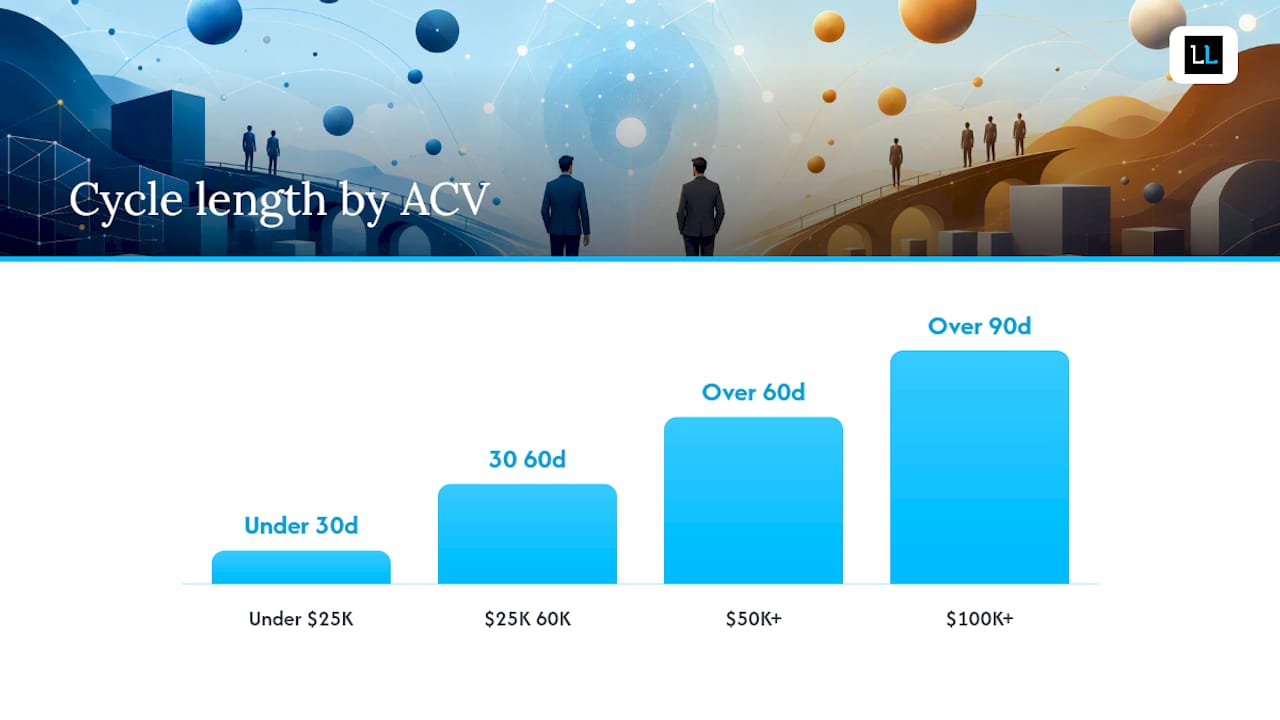
- Under $25K ACV, single decision-maker, cycle under 30 days: Run BANT. If all four letters check out, pass the lead.
- $50K+ ACV, buying committee, cycle over 60 days: MEDDIC is the map. BANT alone will miss the political and process risk that kills late-stage deals.
- $25K–$50K gray zone: Use BANT as the initial screen; escalate to MEDDIC if the deal has more than two stakeholders or a formal procurement step.
- Hybrid default: SDR runs BANT in the first 3–5 minutes of a discovery call. Deals that clear the size and fit threshold move to AE for full MEDDIC discovery.
- Never swap frameworks mid-quarter without requalifying open pipeline; mixed signals destroy forecast accuracy.
Practitioner guidance confirms this two-gate model as the pragmatic default for B2B teams that sell across both SMB and enterprise segments.
Key Takeaways
BANT and MEDDIC are not interchangeable: the right choice depends on deal size, stakeholder count, and cycle length, and the most effective revenue teams use both as sequential gates.
| Point | Details |
|---|---|
| Match framework to deal size | Use BANT under $25K ACV; use MEDDIC at $50K+ or when a buying committee is involved. |
| Run a two-gate hybrid model | SDR screens with BANT in 3–5 minutes; deals that clear the threshold move to AE for full MEDDIC discovery. |
| Require evidence, not opinions | MEDDIC fields must contain named contacts and documented proof; guesses produce false forecasts. |
| Measure late-stage conversion | Track stage-to-stage conversion and forecast accuracy as your primary framework KPIs each quarter. |
| The Lead Lab | Delivers qualified LinkedIn meetings to keep your BANT-to-MEDDIC funnel consistently full. |
Table of Contents
- What is BANT and when does it actually work?
- What is MEDDIC and how does it reduce late-stage losses?
- How do BANT and MEDDIC compare on the dimensions that matter?
- Pros, cons, and what each framework costs your team operationally
- How to choose between BANT and MEDDIC: a decision checklist
- How to implement and enforce your chosen framework across the team
- How to run a BANT-to-MEDDIC handoff without losing pipeline data
- What the data shows about MEDDIC’s impact on late-stage conversion
- A pragmatic take on framework selection
- How The Lead Lab helps you fill the top of your qualification funnel
- Sources
What is BANT and when does it actually work?
Salesforce describes BANT as a fast qualification screen built around four variables: Budget, Authority, Need, and Timeline. IBM developed it decades ago for high-volume, transactional selling, and it still earns its place in that context. The problem is when teams apply it to deals it was never designed for.
What each letter actually tests in modern practice:
- Budget: Does the prospect have allocated funds, or are they window-shopping? The goal is not to get a number; it is to confirm money exists and is accessible.
- Authority: Are you talking to someone who can say yes, or someone who can only say “I’ll pass it along”?
- Need: Is there a real, felt problem that your solution addresses, or is this exploratory curiosity?
- Timeline: Is there a forcing function (contract renewal, compliance deadline, board initiative) that creates urgency, or is this indefinitely “on the roadmap”?
Sample discovery questions an SDR can ask in a 3–5 minute screen:
- “Has your team set aside budget for a solution like this, or would this need to go through an approval process?”
- “Are you the person who would sign off on this, or would others need to be involved in the decision?”
- “What’s driving the interest right now? Is there a specific problem you’re trying to solve?”
- “If this looked like a fit, what would your timeline look like to get something in place?”
- “Is there a deadline or event that’s creating urgency on your end?”
BANT in action: A SaaS company selling a $12K/year project management tool to SMB operations managers uses BANT on every inbound demo request. The SDR spends four minutes on the phone: budget confirmed (the prospect has discretionary spend), authority confirmed (she’s the operations director), need confirmed (the team is running projects in spreadsheets), timeline confirmed (they want something live before Q3). The lead moves to a product demo the same week. Cycle closes in 18 days. BANT works here because the deal is simple, the buyer is singular, and speed matters more than depth.
Pro Tip: BANT’s biggest misuse is treating a “no” on budget as a permanent disqualification. A prospect without current budget but with clear need and authority is a nurture candidate, not a dead lead. Flag them in your CRM and set a follow-up for the next budget cycle.
What is MEDDIC and how does it reduce late-stage losses?
MEDDIC is a deal qualification map, not a screening checklist. It was developed at PTC in the 1990s by Jack Napoli and Dick Dunkel to bring structure to complex, enterprise sales cycles where multiple people influence the outcome and the buying process itself is a risk factor. MEDDIC stands for Metrics, Economic Buyer, Decision Criteria, Decision Process, Identify Pain, and Champion.
What each element tests and the evidence that “passes” each check:
- Metrics: What measurable outcome does the prospect expect? Passing evidence: a specific number (“reduce onboarding time by 30%,” “cut support tickets by 40%”).
- Economic Buyer: Who controls the budget and has final authority? Passing evidence: the AE has spoken directly with this person, not just heard their name.
- Decision Criteria: What factors will the buying committee use to evaluate vendors? Passing evidence: a documented list, ideally shared by the prospect.
- Decision Process: What are the steps from “interested” to “signed”? Passing evidence: a named sequence with owners and dates (security review, legal, procurement).
- Identify Pain: What is the specific, quantified business pain? Passing evidence: the prospect has articulated the cost of inaction in their own words.
- Champion: Who inside the account is selling for you when you’re not in the room? Passing evidence: this person has taken a visible action on your behalf (forwarded materials, arranged an exec meeting).
Sample MEDDIC discovery questions for a 30–90 minute AE session:
- “If this project succeeds, what does success look like in numbers 12 months from now?”
- “Who ultimately owns the budget for this initiative, and have you had a chance to loop them in yet?”
- “What criteria will your team use to evaluate the options on the table?”
- “Walk me through how a decision like this typically gets made here. Who else needs to weigh in?”
- “What happens if you don’t solve this problem by the end of the year? What’s the cost of staying where you are?”
- “Is there someone on your team who’s been championing this internally? I’d love to make sure they have everything they need.”
MEDDIC in action: An enterprise software AE is working a $180K deal with a financial services firm. Three months in, the deal stalls. Running MEDDIC reveals the problem: the AE has never spoken to the Economic Buyer (the CFO), and the internal “champion” has no real influence over the final decision. The AE requests a CFO briefing, reframes the ROI in financial terms the CFO cares about, and identifies a second champion in the finance team. The deal closes two months later. Without MEDDIC, the AE would have kept forecasting the deal as “likely” until it died quietly at the end of the quarter. Gartner’s research on modern B2B purchases involving 6–10 decision-makers makes this scenario the rule, not the exception.
How do BANT and MEDDIC compare on the dimensions that matter?
| Dimension | BANT | MEDDIC |
|---|---|---|
| Best for (deal size) | Under $25K ACV, SMB/transactional | $50K+ ACV, enterprise/complex |
| Primary focus | Lead qualification (go/no-go) | Deal qualification (risk mapping) |
| Typical sales cycle | Under 30–45 days | 60–180+ days |
| Buying-team fit | Single buyer or small team | Multi-stakeholder committee |
| Implementation difficulty | Low; 1–2 hours of SDR training | High; requires AE coaching, CRM discipline, and manager calibration |
| CRM tracking needs | 4 fields (Budget, Authority, Need, Timeline) | 6+ fields with evidence requirements (named Economic Buyer, documented Decision Process, Champion activity log) |
| Risks and failure modes | Disqualifies winnable deals too early; misses political complexity | Filled with guesses instead of evidence; too slow for high-volume motions |
| Expected benefits | Higher SDR throughput, faster cycle velocity | Better forecast accuracy, higher late-stage win rates |
Operational decision rules (if/then):
- If ACV is under $25K and the buying team is one or two people, run BANT and move fast.
- If ACV is $50K+ or the prospect mentions a committee, procurement, or legal review, MEDDIC is the right tool.
- If you are unsure, ask one question: “Who else needs to be involved in this decision?” More than two names means MEDDIC.
GTM practitioners note that structured qualification correlates with higher win rates when executed well, but the framework must match the deal type. Applying MEDDIC to a $10K deal wastes AE time. Applying BANT to a $200K deal with six stakeholders is how you lose at the finish line.
Pros, cons, and what each framework costs your team operationally
BANT: fast, blunt, and easy to misuse
Pros:
- Trains in under two hours; SDRs can apply it from day one.
- Creates a consistent, repeatable screen that keeps unqualified leads out of the AE pipeline.
- Works well in high-volume inbound motions where speed is the constraint.
- Easy to track in any CRM with four standard fields.
Cons:
- Budget-first ordering is counterproductive when buyers haven’t yet quantified their need. Asking about money before establishing value signals a vendor mindset, not a consultative one.
- Misses political complexity entirely. A deal with one willing buyer and five silent blockers looks clean on BANT.
- Encourages binary thinking. Reps who treat BANT as a pass/fail test will discard leads that need nurturing, not disqualification.
Operational implications: BANT increases SDR throughput because it cuts call time. The tradeoff is a higher rate of false negatives: leads marked “unqualified” that would have converted with a longer nurture cycle. Teams running BANT should track lead nurturing outcomes for recycled leads to calibrate how aggressive their disqualification threshold should be.
MEDDIC: thorough, powerful, and demanding
Pros:
- Surfaces deal risk before it becomes a late-stage surprise. A deal with no confirmed Champion or Economic Buyer access is a warning sign, not a forecast entry.
- Improves forecast accuracy because each field requires evidence, not a rep’s optimism.
- Aligns AE activity to the buyer’s actual decision process rather than the seller’s preferred sequence.
Cons:
- Time-intensive. A full MEDDIC discovery takes 30–90 minutes and multiple touchpoints. At cold-call speed, it is not feasible.
- Requires manager coaching to enforce. Without calibration meetings, AEs fill MEDDIC fields with guesses, which defeats the purpose entirely.
- CRM hygiene becomes a bottleneck. If AEs don’t log evidence correctly, the data is useless for forecasting.
Red flags to watch for:
- BANT used on enterprise deals because “it’s faster.” Speed is not the goal when ACV is $100K+.
- MEDDIC fields populated with “TBD” or rep assumptions instead of prospect-sourced evidence.
- Framework switches mid-quarter without requalifying open deals. This is one of the most common ways teams corrupt their pipeline data.
Pro Tip: The single most reliable signal that MEDDIC is being gamed: every deal in the pipeline has a “Champion” listed, but no AE can name a specific action that Champion took. A real champion does things. If yours hasn’t, the field is a guess.
How to choose between BANT and MEDDIC: a decision checklist
Work through these steps before your next pipeline review:
- Calculate your average ACV by segment. Pull the last 12 months of closed-won deals and segment by deal size. Where does your median land?
- Count stakeholders per deal. For your last 20 closed deals, how many contacts were involved in the decision? If the average is above three, BANT alone is insufficient.
- Measure average sales cycle length. Deals closing in under 45 days are BANT territory. Deals averaging 90+ days need MEDDIC.
- Assess SDR capacity. If your SDRs are handling 50+ conversations per week, MEDDIC at the top of funnel will create a bottleneck. Protect throughput with BANT at that stage.
- Check your late-stage loss rate. If more than 20% of deals that reach proposal stage are lost to “no decision” or “went with a competitor,” that is a MEDDIC problem: you are not mapping the decision process or the champion early enough.
- Decide on a hybrid or single-framework approach based on steps 1–5, then document the handoff criteria before piloting.
Deal-size and complexity matrix:
| ACV Range | Stakeholders | Cycle Length | Recommended Framework |
|---|---|---|---|
| Under $25K | 1–2 | Under 30 days | BANT |
| $25K–$50K | 2–3 | 30–60 days | BANT with MEDDIC elements (Economic Buyer, Pain) |
| $50K+ | 3–5 | over 60 days | Full MEDDIC |
| $100K+ | 5+ | over 90 days | MEDDIC or MEDDPICC |
Running a 6–12 week pilot:
Pick one segment (e.g., all inbound enterprise deals above $50K) and apply MEDDIC exclusively for 8 weeks. Track three KPIs: late-stage conversion rate, forecast accuracy (predicted vs. actual close), and average cycle length. Compare against the prior 8-week baseline. If late-stage conversion improves and forecast variance narrows, expand. If AE time-per-deal spikes without a corresponding win-rate improvement, revisit the evidence requirements and simplify the CRM fields. Prospect segmentation before the pilot ensures you are comparing like-for-like deals.
How to implement and enforce your chosen framework across the team
CRM field setup
For BANT: Add four required fields to your lead or opportunity record: Budget Confirmed (yes/no/unknown), Authority Level (decision-maker/influencer/end-user), Need Documented (free text, required), Timeline (date field). Make all four required before a lead can be marked “qualified.”
For MEDDIC: Add six fields, each requiring evidence rather than a rep’s assessment:
- Metrics: free text, required (must include a number)
- Economic Buyer: contact name field linked to a CRM contact record (not a job title; a named person)
- Decision Criteria: free text or multi-select (sourced from prospect, not assumed)
- Decision Process: free text with a required date for next step
- Identified Pain: free text (must be in the prospect’s own words)
- Champion: contact name field with a “Champion Activity” note (what action did they take?)
KPIs to track
- SDR throughput: qualified leads per SDR per week (BANT should hold or improve this; MEDDIC at SDR stage will reduce it)
- Stage-to-stage conversion: what percentage of BANT-qualified leads convert to AE discovery? What percentage of MEDDIC-qualified deals reach proposal?
- Forecast accuracy: predicted close value vs. actual close value per quarter, measured at the deal level
- AE qualification audit rate: percentage of deals reviewed by a manager each week with complete CRM evidence
Training cadence
For SDRs adopting BANT:
- Two-hour onboarding session with live call examples and role-play.
- Weekly 15-minute call review for the first four weeks.
- Monthly calibration: manager reviews five randomly selected BANT assessments and scores them against the standard.
For AEs adopting MEDDIC:
- Half-day workshop covering each element with real deal examples.
- Bi-weekly deal review where the AE presents MEDDIC evidence for their top five deals.
- Quarterly pipeline audit: every deal above $50K must have all six MEDDIC fields populated with evidence before it can be included in the forecast.
Pro Tip: The fastest way to enforce MEDDIC is to make it a forecasting requirement, not a training exercise. If a deal can’t be included in the weekly forecast call without a named Economic Buyer and Champion, AEs will find those people. Tie the framework to the process that matters most to them.
Governance
- Flag any deal that has been in the same stage for more than 30 days (BANT) or 45 days (MEDDIC) without a logged activity or updated field.
- Run a monthly pipeline health review where managers audit 10% of deals for evidence quality.
- Treat a MEDDIC field filled with “unknown” or “TBD” the same as an empty field: it does not count toward forecast inclusion.
How to run a BANT-to-MEDDIC handoff without losing pipeline data
The two-gate model works like this: SDR runs BANT in the first call (3–5 minutes). If the deal clears the size and fit threshold, it moves to AE. The AE runs MEDDIC discovery in a dedicated 30–60 minute session. The handoff is not a warm introduction; it is a structured data transfer.
What must be populated before a deal graduates from BANT to MEDDIC:
- Budget: confirmed (yes or “budget process identified”)
- Authority: contact name of the decision-maker or Economic Buyer (even if not yet spoken to)
- Need: one sentence in the prospect’s own words
- Timeline: a date or a triggering event
If any of these are missing, the deal does not graduate. It goes back to the SDR for a follow-up call or into a nurture sequence. Leads that fail the initial screen are not dead; they are early-stage opportunities that need a different motion.
Escalation rules:
- ACV above $50K: automatic MEDDIC escalation regardless of BANT score.
- Prospect mentions procurement, legal review, or a buying committee: escalate to MEDDIC even if ACV is below the threshold.
- Deal has been in BANT-qualified status for more than 21 days without an AE meeting: either escalate or recycle to nurture.
Pro Tip: Never switch frameworks on an open deal mid-quarter. If you move a deal from BANT-qualified to MEDDIC mid-cycle, requalify it from scratch using MEDDIC criteria. A deal that looked clean under BANT often reveals missing Economic Buyer access or no real Champion under MEDDIC scrutiny. Better to know now than at the end of the quarter.
What the data shows about MEDDIC’s impact on late-stage conversion
One of the clearest data points in the practitioner literature: a sales team that replaced first-touch BANT with MEDDIC for deal management reported a 23% improvement in late-stage conversion after 12 months. The source attributes the gain specifically to two MEDDIC elements: verifying Economic Buyer access and confirming an active Champion, not to the framework as a whole.
That attribution matters. Teams that implement MEDDIC as a CRM checkbox exercise without actually changing how AEs run discovery will not see the same lift. The improvement comes from behavioral change: AEs who ask harder questions earlier, who refuse to forecast deals without named contacts, and who treat a missing Champion as a deal risk rather than a to-do item.
Implementation caveats before you expect the same result:
- The 23% figure comes from a team that made MEDDIC a forecasting requirement, not just a training topic.
- The improvement took 12 months. Expect a 6–8 week dip in forecast confidence as AEs adjust.
- MEDDIC adoption correlates with forecasting improvements in complex deals when AEs properly validate Economic Buyer and Champion; the overhead makes it infeasible at cold-call speed.
What to verify before expecting the same lift in your organization:
- Do your AEs have the access and seniority to reach Economic Buyers directly?
- Is your CRM configured to require evidence fields, or can reps skip them?
- Does your manager cadence include deal-level MEDDIC reviews, or only pipeline totals?
If the answer to any of these is no, fix the process before rolling out the framework. A framework without governance is just vocabulary.
A pragmatic take on framework selection
Most framework debates miss the real problem: it is not which framework is better. It is whether the team will actually use it. BANT fails when reps treat it as a formality and mark every lead as qualified to hit their numbers. MEDDIC fails when AEs fill in fields with guesses to satisfy a manager and move on.
Three rules worth following when advising on framework selection:
First, match the framework to the deal, not the company. A firm that sells both a $15K SMB product and a $200K enterprise platform needs both frameworks, applied at the right stage. Picking one for the whole company is a compromise that serves neither motion well.
Second, make the framework a forecasting gate, not a training topic. The moment a deal cannot enter the forecast without complete MEDDIC evidence, adoption follows. Incentives drive behavior faster than workshops.
Third, measure framework effectiveness at the deal level, not the team level. Aggregate win rates hide the signal. Track conversion by framework compliance: deals with complete MEDDIC evidence vs. deals with partial evidence. The gap will tell you whether the framework is working or just being performed.
These rules connect directly to forecast accuracy and throughput. Teams that apply them tend to see tighter forecast variance and fewer late-stage surprises within two quarters of consistent enforcement.
How The Lead Lab helps you fill the top of your qualification funnel
Qualification frameworks only work when there is a consistent flow of conversations to qualify.
The Lead Lab offers LinkedIn outreach campaigns for professional services firms, designed to provide qualified meetings directly to your calendar. Prospect targeting, message copywriting, response management, and lead enrichment are all handled. Your SDRs get warm conversations to run BANT on, not cold lists to work through. For teams building a BANT-to-MEDDIC stack, that means the top of the funnel stays full while your AEs focus on deep MEDDIC discovery where it counts. Check out The Lead Lab’s LinkedIn lead generation services to see how an outsourced outreach program fits your qualification process.
Sources
- Sales Process Qualification Frameworks (BANT, MEDDIC)
- Gartner — B2B buying journey
- MEDDICC vs Other Qualification Frameworks like BANT
- BANT vs MEDDIC: Picking a Qualification Framework | Lead Seeker
- B2B Lead Qualification: BANT vs MEDDIC Guide