
The most effective discovery calls start with one goal: uncover real pain, confirm fit, and lock a next step before you hang up. Ask these questions on every first call, and you’ll know within 30 minutes whether to advance or move on.
Must-ask questions for your first call:
- “Walk me through what prompted you to take this call today.”
- “What does your current process look like for [relevant problem area]?”
- “What’s the biggest obstacle standing between you and [their stated goal]?”
- “If this problem isn’t solved in the next six months, what happens?”
- “Who else would need to be involved in a decision like this?”
- “What does your timeline look like for making a change?”
Immediate next step: Before the call ends, propose a specific follow-up date and confirm who should be on it.
Pro Tip: Write your top three must-ask questions on a sticky note and put it on your monitor. You’ll ask them even when the conversation goes sideways.
Key Takeaways
Strong discovery calls follow a consistent structure: open-ended questions, SPIN-style sequencing, BANT qualification, and a confirmed next step before the call ends.
| Point | Details |
|---|---|
| Question count and depth | Aim for 11–14 questions per call; top calls surface 3–4 distinct business problems. |
| Sequence over wording | Follow SPIN order (Situation, Problem, Implication, Need-Payoff) to build urgency naturally. |
| Qualify in order | Confirm pain and impact before asking about budget or authority to avoid killing momentum early. |
| Follow-up probes | “Tell me more about that” consistently surfaces the detail that makes a deal real. |
| The Lead Lab | Delivers pre-qualified calendar meetings with pain and timeline already confirmed, so discovery is done before the call. |
Table of Contents
- What is a discovery call, and what does success look like?
- What are the core principles behind great discovery questions?
- The best discovery call questions, organized by purpose
- A sample discovery call script and timing guide
- How to prepare before the call
- How do you qualify (and disqualify) a lead on the call?
- How The Lead Lab uses question-led discovery to book qualified meetings
- What most reps get wrong about discovery calls
- Qualified meetings delivered, without running discovery yourself
- Sources
What is a discovery call, and what does success look like?
A discovery call is the first scheduled sales conversation after a prospect has shown initial interest. It’s not a demo, not a pitch, and not a check-in. The job is to learn enough about the prospect’s situation to determine whether your solution is worth pursuing together.
HubSpot describes discovery calls as open-ended conversations focused on obstacles, processes, and goals, not a checklist interrogation. That framing matters. The moment a call feels like a form being filled out, the prospect stops sharing real information.
Three things define a successful discovery call:
- Evidence of pain: The prospect has articulated a specific problem with real consequences, not just a vague interest.
- Decision process clarity: You understand who decides, how they decide, and what the timeline looks like.
- A confirmed next step: Both parties have agreed on what happens next, whether that’s a demo, a proposal, or a follow-up with additional stakeholders.
Miss any one of these, and you’re not done with discovery. You’re just done with the call.
What are the core principles behind great discovery questions?
The difference between a rep who books meetings and one who gets ghosted after the call often comes down to how they ask questions, not just which ones they ask.
Open-ended, story-inviting phrasing. Questions that start with “walk me through” or “tell me about” invite narrative answers. Closed questions invite one-word answers. Gong’s research on top-performing discovery calls shows that prompts like “Can you walk me through…” and “Tell me more about…” consistently produce longer, more useful responses from prospects.
Sequence matters more than wording. The SPIN selling framework maps the ideal flow: Situation questions establish context, Problem questions surface pain, Implication questions reveal consequences, and Need-Payoff questions connect the solution to value. Jumping straight to implications before you’ve confirmed the situation is how you end up arguing with a prospect about whether they even have a problem.
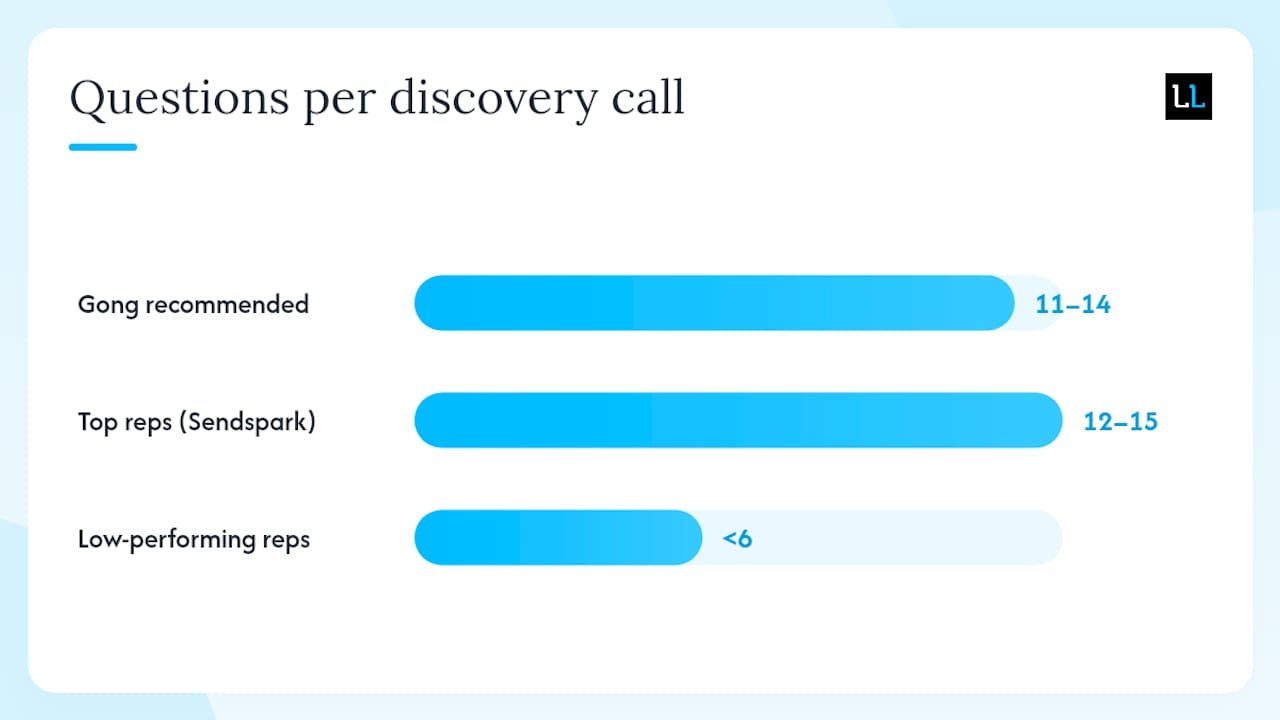
Aim for 11–14 questions, but prioritize depth. Gong’s call analysis finds that asking 11–14 discovery questions correlates with better outcomes, and top calls surface 3–4 distinct business problems. That’s not a license to fire off 14 questions in sequence. It means staying curious long enough to uncover multiple layers of pain. Sendspark reports that top reps ask roughly 12–15 thoughtful questions per call, while reps who ask fewer than six and talk too much see lower win rates.
Active listening and calibrated silence. After a prospect answers, pause for two seconds before your next question. Most reps jump in too fast and cut off the most revealing part of the answer. A simple follow-up probe like “Tell me more about that” can double the usable information you get from a single exchange.
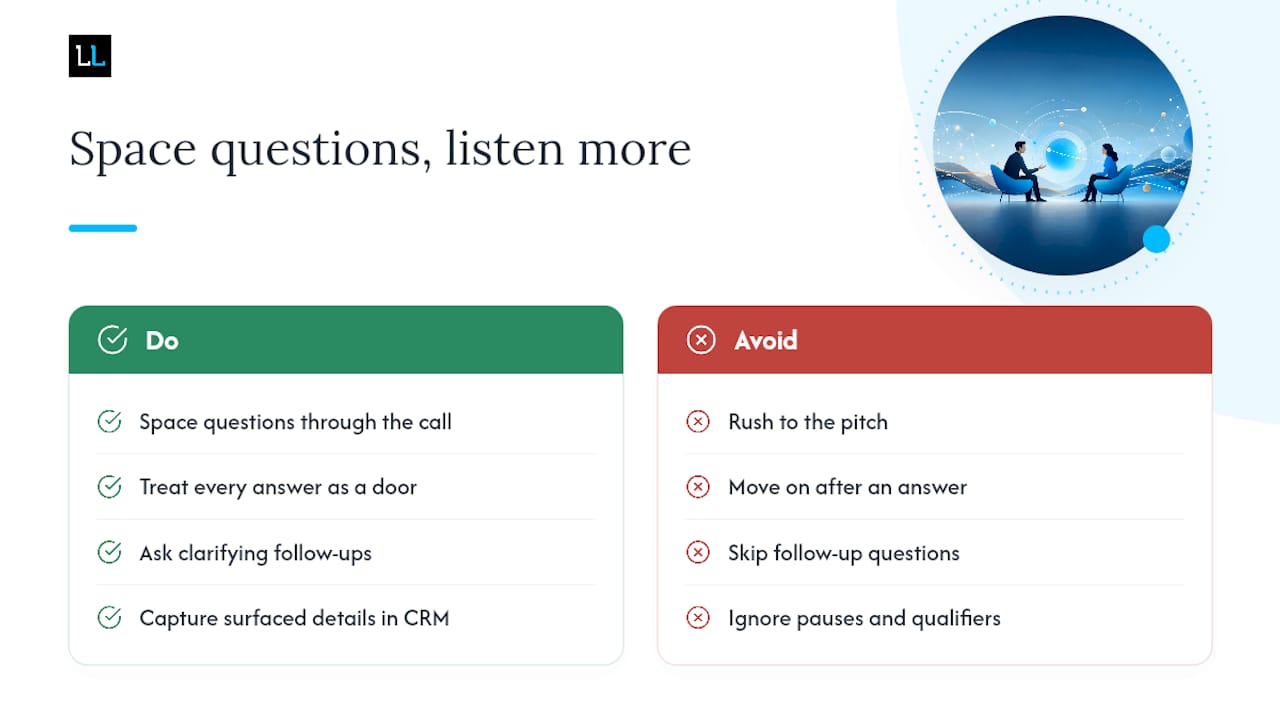
- Space your questions through the call rather than frontloading them.
- Qualify as you go: listen for budget signals, authority cues, and urgency without making it feel like an interrogation.
- When you hear a vague answer, probe before moving on. “What do you mean by that?” is underused and underrated.
Pro Tip: Record your calls with tools like Gong, Highspot, or Allego and review one per week with your manager. Focus on where you talked over the prospect or skipped a follow-up probe. That single habit produces faster improvement than any training course.
The best discovery call questions, organized by purpose
Use this bank to build your call plan. Pull questions by category based on what you need to learn and how much time you have.
Current state
These establish context without wasting time on facts you could have researched beforehand.
- “Walk me through how your team currently handles [relevant process].”
- “How long have you been running things this way?”
- “What tools or systems are you using today for [area]?”
- “How many people are involved in this process on your team?”
- “What’s working well about your current setup?”
Follow-up probe: “And what would you change about it if you could?”
Phrasing tip: Lead with “walk me through” rather than “describe” — it signals you want a story, not a summary.
Problem and pain
This is where the real conversation starts. HubSpot recommends structuring these questions to surface obstacles, not just dissatisfaction.
- “What’s the biggest challenge you’re running into with [area] right now?”
- “How long has this been a problem?”
- “What have you tried to fix it, and what happened?”
- “On a scale of one to ten, how painful is this issue for your team?”
- “Is this something your leadership is aware of and prioritizing?”
Follow-up probe: “Tell me more about that — what does that look like day to day?”
Phrasing tip: Ask about duration before severity. Knowing a problem has existed for 18 months tells you more about urgency than any rating scale.
Impact and implication
These questions turn a problem into a business case. They’re the most skipped category and the most valuable.
- “What’s the cost of not solving this — in time, revenue, or headcount?”
- “How does this problem affect other parts of the business?”
- “If this continues for another year, what does that mean for your team?”
- “Has this issue caused you to miss a target or lose a deal?”
- “What would change internally if this problem were solved?”
Follow-up probe: “Can you put a number on that?”
Phrasing tip: Implication questions feel natural after pain questions. If you ask them too early, they feel presumptuous.
Goals and future state
- “What does success look like for you in the next 12 months?”
- “If everything went perfectly, where would you want to be six months from now?”
- “What’s driving the urgency to address this now versus six months ago?”
- “What would a win look like for your team specifically?”
Follow-up probe: “How would you measure that?”
Decision process
Ask these after you’ve confirmed pain and impact. Asking them too early signals you care more about closing than solving.
- “Who else would be involved in evaluating a solution like this?”
- “How have you made decisions like this in the past?”
- “Is there an executive sponsor on your side who would need to be aligned?”
- “What does your procurement or approval process look like?”
- “Are you evaluating other options right now?”
Follow-up probe: “What would need to be true for this to move forward?”
Budget and timeline
- “Do you have a budget allocated for solving this, or is that still being determined?”
- “What’s your target timeline for having something in place?”
- “Is this a current-quarter priority, or are you planning for next year?”
- “Who controls the budget for a project like this?”
Phrasing tip: Frame budget questions around the problem’s cost first. “Given what you’ve described about the impact, is there a budget set aside to address it?” lands better than asking directly about spend.
Metrics and KPIs
- “How do you currently measure success in this area?”
- “What metrics would improve if this problem were solved?”
- “What does your team track that this would affect?”
Prior solutions and competitors
- “Have you tried to solve this before? What happened?”
- “Are you looking at other vendors or approaches right now?”
- “What made you start looking now rather than six months ago?”
SDR vs. AE note: If you’re an SDR running a 15–20 minute qualification call, focus on current state, pain, and one implication question. Leave decision process and budget for the AE’s deeper discovery. If you’re an AE running a 45-minute call, work through all categories but spend the most time on impact and decision process.
A sample discovery call script and timing guide
A 30–45 minute discovery call has a natural shape. Here’s how to structure it.
HubSpot’s discovery call checklist recommends keeping lighter calls to 10–15 minutes and always ending with a scheduled next meeting to preserve momentum.
Sample opening script (30–60 seconds)
This opening does three things: it sets expectations, signals you’re not going to pitch immediately, and plants the idea of a next step before the call has started.
Transition phrases
- Moving from current state to pain: “That context is helpful. I want to dig into what’s not working. What’s the biggest challenge you’re running into right now?”
- Moving from pain to implication: “So if I’m hearing you right, this has been going on for about a year. What’s the downstream effect of that on the business?”
- Moving from implication to decision process: “Given what you’ve described, it sounds like solving this would have real impact. Can I ask — how would a decision like this typically get made on your end?”
Sample closing lines
- “Based on what you’ve shared, I think there’s a real fit here. I’d like to set up a follow-up with [relevant stakeholder] — does [specific date] work?”
- “Let me recap what I heard: [pain point], [impact], [timeline]. Does that match how you see it?”
- “What would need to happen on your end for us to move this forward?”
How to prepare before the call
Preparation is what separates a rep who asks generic questions from one who asks the right ones. Fifteen minutes of research before a call changes the entire conversation.
Pre-call research checklist:
- Review the prospect’s LinkedIn profile and company page — note their role, tenure, and any recent posts.
- Check the company’s website for recent news, funding announcements, or product launches.
- Look for tech stack signals using tools like LinkedIn Sales Navigator or Salesforce data enrichment.
- Review any prior email exchanges or CRM notes for context on what they’ve already shared.
- Identify the likely decision-maker and any known stakeholders using your CRM or HubSpot contact records.
What to bring into the call:
- Two or three tailored insights based on your research (“I noticed you recently expanded your team — I’m curious how that’s affected [relevant process].”)
- One hypothesis about fit: “Based on what I’ve seen, I think [specific pain] might be relevant for you. Is that on your radar?”
- A clear goal for the call: know what you need to learn to decide whether to advance.
Pre-call email template:
Subject: Quick agenda for our call [date]
Hi [Name], looking forward to our call on [date/time]. Here’s what I was thinking we’d cover: your current setup for [area], what’s working and what isn’t, and whether there’s a fit worth exploring. Feel free to add anything you’d like to discuss. See you then.
Sending an agenda in advance increases the likelihood that the right stakeholders show up and keeps the call focused on qualification rather than introductions.
Connecting your pre-call research to LinkedIn lead generation tactics gives you richer signals before you even dial.
How do you qualify (and disqualify) a lead on the call?
Qualification isn’t a separate step. It runs in parallel with discovery. The goal is to gather enough evidence across four dimensions to make a clear decision: advance, nurture, or disqualify.
BANT qualification checklist:
- Budget: Is there a budget allocated? Who controls it? Is the problem expensive enough to justify spend?
- Authority: Is your contact the decision-maker? Who else needs to approve? Is there an executive sponsor?
- Need: Is the pain specific, documented, and consequential? Have they tried to solve it before?
- Timeline: Is there a target date? What’s driving urgency? Is this a current priority?
Confirm pain and impact first, then surface budget and authority questions. Asking about budget before you’ve established pain feels transactional and often kills the conversation. HubSpot’s BANT guidance recommends structuring questions to address goals, timing, the root problem, and funding ownership in that order.
For B2B prospecting specifically, confirming the authority dimension early prevents wasted cycles with contacts who can’t move a deal forward.
Scoring rubric
| Dimension | Strong signal (advance) | Weak signal (nurture) | Red flag (disqualify) |
|---|---|---|---|
| Budget | Allocated, owner identified | Under discussion | No budget, no timeline |
| Authority | Decision-maker on the call | Influencer, no sponsor | No access to decision-maker |
| Need | Specific pain, real consequences | Vague interest | No clear problem |
| Timeline | 30–90 days | six months | No timeline, no urgency |
Common red flags:
- The prospect can’t articulate a specific problem, only a general interest.
- No one on the call has authority to move a decision forward.
- The timeline is “someday” with no business event driving urgency.
- They’ve evaluated three vendors already and gone with none of them.
- Budget is “not yet determined” and there’s no process to determine it.
When you hit two or more red flags, don’t force the advance. Move the prospect to a nurture sequence and revisit in 60–90 days. Disqualifying early protects your pipeline quality and your time.
How The Lead Lab uses question-led discovery to book qualified meetings
Most outreach fails not because the message is wrong, but because the qualification never happened. The Lead Lab’s approach to LinkedIn outreach is built around the same diagnostic logic as a strong discovery call: identify the right prospect, surface the right pain, and create a reason to meet.
In a representative campaign for a professional services firm, The Lead Lab’s process worked like this:
- Targeting: Prospects were filtered by role, company size, and signals suggesting a relevant pain point (recent hiring, team expansion, or a known operational gap).
- Outreach messaging: Initial messages were framed around a hypothesis about fit, not a pitch. The goal was to get a response that confirmed or denied the pain before any meeting was booked.
- Qualification before booking: Response management filtered out contacts who showed no urgency or no decision-making authority. Only prospects who confirmed a relevant problem and a timeline were moved to a calendar meeting.
- Outcome: Meetings delivered to the client were pre-qualified, with context on the prospect’s pain and decision process already captured.
Gartner notes that by 2030, 75% of B2B buyers will prefer sales experiences that prioritize human interaction for complex decisions. That makes the quality of your diagnostic questions more valuable, not less. When AI handles volume, human judgment in the conversation is the differentiator.
Pairing strong discovery with a lead nurturing strategy after the call keeps prospects who aren’t ready to buy from falling out of your pipeline entirely.
What most reps get wrong about discovery calls
The conventional wisdom says discovery is about asking the right questions. That’s half right. The other half is knowing when to stop asking and start listening.
Most reps treat discovery as a form to complete. They work through their question list in order, check the boxes, and move to the pitch. The problem is that the most valuable information in a discovery call rarely comes from a direct answer to a direct question. It comes from the pause after the answer, the qualifier the prospect adds unprompted, or the thing they mention almost in passing that turns out to be the real issue.
The reps who consistently book qualified meetings are the ones who treat every answer as a door, not a destination. When a prospect says “we’ve tried to fix this before,” the rep who asks “what happened?” gets a 10-minute story about internal politics, a failed vendor relationship, and a budget that got pulled. The rep who moves to the next question gets nothing.
Gong’s call analysis reinforces this: top performers space their questions through the call and achieve a better talk-to-listen balance. They’re not asking fewer questions. They’re leaving more room between them.
One tip that only becomes obvious after you’ve run a few hundred calls: the best single question you can ask after any answer is “what do you mean by that?” It sounds almost too simple. But it consistently surfaces the specific detail that makes a deal real, whether that’s the actual cost of the problem, the name of the executive who cares about it, or the deadline that’s driving urgency. Platforms like Salesforce and HubSpot can capture these details in CRM notes, but only if you asked the question that surfaced them.
Qualified meetings delivered, without running discovery yourself
If the question bank and scripts above are useful, but you’d rather have qualified meetings land on your calendar than run the discovery process yourself, that’s exactly what The Lead Lab delivers.
The Lead Lab runs done-for-you LinkedIn outreach campaigns for professional services firms, handling every step from prospect targeting and message copywriting to response management and appointment setting. The qualification logic described in this article, confirming pain, authority, and timeline before a meeting is booked, is built into every campaign. Clients receive calendar meetings with pre-qualified prospects, not raw leads to chase.
Book a call with The Lead Lab to see how a done-for-you outreach campaign maps to your pipeline goals.
Sources
The following sources informed the data, frameworks, and question examples throughout this article.
- 28 Questions to Ask on a Discovery Call During the Sales Process
- DISCOVERY CALL CHECKLIST
- 30 Top-Performing Discovery Questions For Sales
- Discovery Call Questions: 30 Best for B2B Sales | Sendspark