
TL;DR:
- Pipeline development involves proactively nurturing prospects to generate predictable, qualified meetings over time. It requires stage-based design, clear metrics, and continuous feedback to optimize outreach and conversion rates effectively. The Lead Lab offers end-to-end pipeline services for professional firms, eliminating the need for in-house setup.
Pipeline development is the proactive, continuous system that identifies, qualifies, and nurtures target prospects so your firm has predictable qualified meetings on a long-term horizon. Unlike an applicant pool or a reactive lead list, a pipeline is built before demand peaks — prospects are engaged, segmented, and warmed up long before they raise their hand. For professional services firms running LinkedIn outreach, that means combining LinkedIn Sales Navigator for sourcing, HubSpot or Salesforce for tracking, and a disciplined sequence of touches that converts cold contacts into booked calls.
Table of Contents
- What pipeline development actually looks like stage by stage
- KPIs that tell you whether your pipeline is working
- How to map pipeline stages to LinkedIn activities and your CRM
- Automate only what you have already proven manually
- Governance and feedback loops that keep the pipeline reliable
- Common pitfalls and how to fix them fast
- Key Takeaways
- When to build it yourself and when to hire a specialist
- The Lead Lab builds and runs your pipeline from day one
What pipeline development actually looks like stage by stage
A pipeline is only as strong as its design. Each stage produces a specific artifact and hands off to the next with a clear decision gate.
- Planning: Define your ideal client profile, firmographic filters, and revenue target. Output: a written ICP and a list of qualifying criteria.
- Target mapping: Build a filtered Sales Navigator search list segmented by industry, seniority, company size, and geography. Output: a verified prospect list, deduplicated against your CRM.
- Prospecting/sourcing: Send connection requests with a short, relevant note. Output: accepted connections tagged in HubSpot or Salesforce as “Stage 1 — Connected.”
- Outreach sequencing: Run a 3–5 touch message sequence over 10–14 days (value opener, relevance proof, soft ask). Output: replies flagged for qualification.
- Qualification: Score replies against your criteria (budget, authority, need, timeline). Output: a qualification checklist completed for each prospect; disqualified contacts moved to a nurture track.
- Nurture: For prospects not yet ready, multi-cycle nurturing keeps your firm visible through periodic content shares and check-ins. Output: re-engagement triggers set in CRM.
- Conversion/handoff: Qualified prospects receive a calendar link or are handed to a sales rep. Output: a booked meeting logged in CRM with source attribution.
A single prospect’s path looks like this: Sales Navigator search → connection accepted → value message sent → reply received → qualification call → meeting booked. At each gate, a prospect either advances, pauses in nurture, or exits. That clarity is what separates a pipeline from a spreadsheet of names.
KPIs that tell you whether your pipeline is working
Success is measured through conversion metrics over a 6–18 month rolling horizon, not by how many messages you sent last week.
Pipeline conversion rate measures the percentage of prospects who reach a defined stage. Example: 200 connections made, 14 meetings booked = 7% connection-to-meeting rate. Track this at every stage transition, not just the final one.
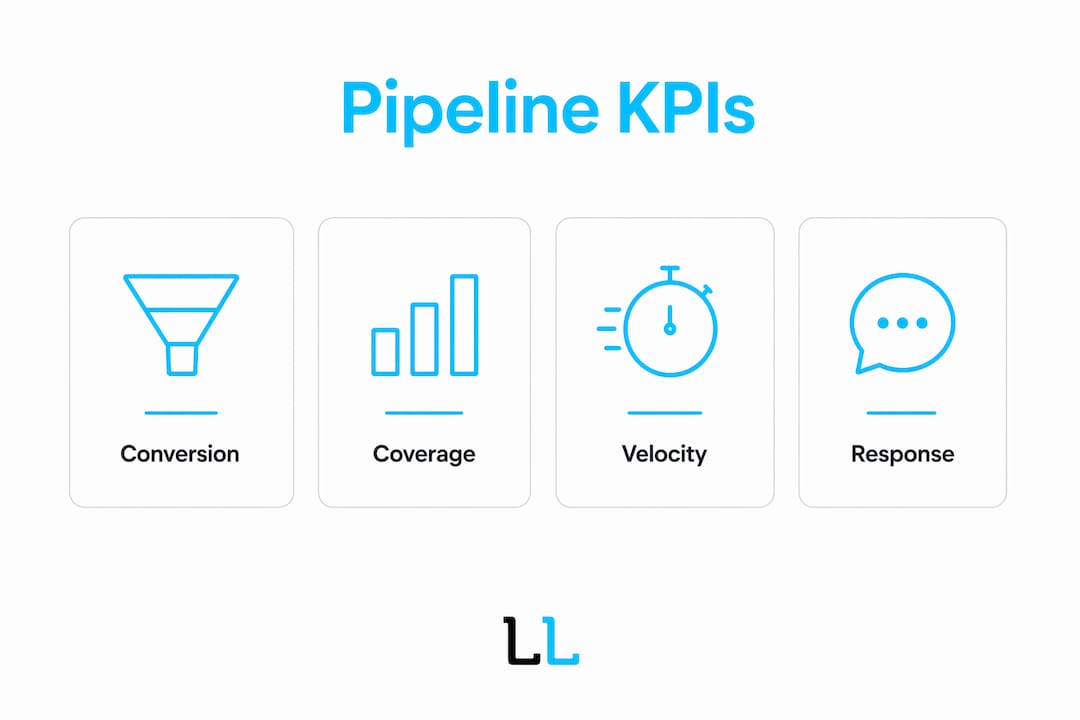
Pipeline coverage ratio answers: do you have enough prospects in the pipeline to hit your meeting target? If you need meetings regularly and your conversion rate is a certain percentage, you need a sufficient number of active prospects in the pipeline at all times. Coverage ratio = active prospects ÷ (target meetings ÷ conversion rate).
Velocity measures average days from connection to meeting. If your target is 21 days and your actual average is 38, something is stalling in the nurture or qualification stage.
Reply rate and meeting rate are your leading indicators for LinkedIn specifically. A low reply rate on a cold sequence usually signals a targeting or messaging problem, not a volume problem.
Reporting cadence: Monitor stage-level metrics weekly, run monthly trend reports, and conduct quarterly strategic reviews. Over a 6–18 month horizon, you will have enough data to distinguish a messaging problem from a targeting problem — and fix the right one.
To optimize outreach quality, track these metrics per campaign variant, not just in aggregate.
How to map pipeline stages to LinkedIn activities and your CRM
| Pipeline stage | LinkedIn activity | CRM tag | Metric tracked |
|---|---|---|---|
| Target mapping | Sales Navigator filtered search | List: ICP Segment A | List size, match rate |
| Prospecting | Connection request with note | Stage 1 — Connected | Acceptance rate |
| Outreach sequence | 3–5 message sequence (10–14 days) | Stage 2 — In Sequence | Reply rate |
| Qualification | InMail or direct reply conversation | Stage 3 — Qualified | Qualification rate |
| Nurture | Periodic content share or check-in | Stage 4 — Nurture | Re-engagement rate |
| Conversion | Calendar link or rep handoff | Stage 5 — Meeting Booked | Meeting rate, CPL |

For the message sequence itself, keep three tiers in mind. The value opener references a specific challenge your prospect’s firm faces. The relevance proof names a result you have delivered for a similar firm. The soft ask proposes a 20-minute call, not a demo. Personalization at the first touch lifts reply rates meaningfully; touches two and three can be lighter. For segmentation-based personalization, group prospects by vertical before writing variants.
Pro Tip: The Lead Lab sequences outreach across verified LinkedIn accounts with dedicated response management and lead enrichment (mobile and email) at the qualification stage. This preserves deliverability, keeps acceptance rates healthy, and means no qualified reply goes unanswered.
Automate only what you have already proven manually
Automating a broken process accelerates poor outcomes — that is the core principle from GitHub and Microsoft’s guidance on pipeline design, and it applies directly to LinkedIn outreach. Before you connect Zapier to anything, run your sequence manually for a sustained period and confirm stable reply and meeting rates.
Once you have a proven sequence, the automation checklist looks like this:
- Reply rate is consistent across at least two audience segments
- Qualification criteria are written down and applied the same way every time
- CRM tagging is clean and uniform (no duplicate stages, no orphaned contacts)
- Message variants are finalized and approved
A safe integration pattern: Sales Navigator export → Zapier → HubSpot contact creation with stage tag → outreach tool triggers sequence → reply detected → Zapier notifies rep for manual qualification. Enrich contacts before the first touch, not after, so personalization is accurate from the start.
Pipeline maturity requires approval gates even in highly automated systems. Set rate limits on daily connection requests, require human review before any InMail blast over 50 contacts, and build an escalation trigger for any sequence generating a spam complaint.
Governance and feedback loops that keep the pipeline reliable
Continuous reliability and feedback loops are what separate a self-optimizing pipeline from a fragmented tool chain. Atlassian and Red Hat make this point about DevOps systems; it holds equally for outreach pipelines.
Assign four roles: a campaign owner who sets targets and reviews weekly metrics, a CRM data steward who maintains tag hygiene, a copy owner who manages message variants, and an escalation owner who handles deliverability issues and ethics flags.
Run experiments with a simple template: state the hypothesis (e.g., “A subject line referencing the prospect’s industry will lift reply rate by 2 percentage points”), define the audience split, set the metric to move, and fix a 3-week duration. One variable per test.
The feedback loop runs like this:
- Capture weekly stage-level performance data from CRM
- Identify the stage with the largest drop-off
- Adjust targeting filters or message copy for that stage
- Redeploy the updated variant and re-measure over the next cycle
Data-driven tuning at each stage is what makes a pipeline self-optimizing over a 6–18 month horizon rather than a one-time campaign.
Common pitfalls and how to fix them fast
Most pipeline failures come down to a handful of recurring problems. Recognizing them early saves months of wasted outreach.
- Fragmented tools with no single source of truth: Fix by enforcing one CRM (HubSpot or Salesforce) as the system of record and routing all stage updates through it.
- Automating before validating: Pause the automation, run a manual test for sufficient time, and confirm reply rates before re-enabling. Common LinkedIn outreach mistakes almost always trace back to this.
- Poor targeting: If reply rates are low, the problem is usually the list, not the message. Re-segment by intent signals (recent job change, company growth, content engagement).
- Dropped responses: A qualified reply that goes unanswered for 48 hours is a lost meeting. Build a response SLA into your governance rules and assign a named owner.
- Low coverage ratio: If your pipeline does not hold enough active prospects to hit your meeting target, add sourcing volume before adjusting messaging.
- Spammy patterns: Respect LinkedIn’s daily limits, avoid generic bulk messages, and never add contacts to sequences without a relevant connection point. Ethics and deliverability are the same problem.
Key Takeaways
Pipeline development is a proactive, stage-gated system measured by conversion metrics over a 6–18 month rolling horizon, not by activity volume.
| Point | Details |
|---|---|
| Measure outcomes, not activity | Track pipeline conversion rate, coverage ratio, and velocity — not messages sent. |
| Prove the manual process first | Run a 4–6 week manual sequence before connecting Zapier or any automation tool. |
| Coverage ratio drives forecasting | Active prospects ÷ (target meetings ÷ conversion rate) tells you if your pipeline is big enough. |
| Feedback loops are non-negotiable | Weekly stage-level reviews and quarterly strategic adjustments keep the pipeline self-optimizing. |
| The Lead Lab maps all stages | Prospect targeting, copy, outreach, response management, and appointment setting are handled end-to-end. |
When to build it yourself and when to hire a specialist
The honest answer depends on three factors: how quickly you need your first qualified meeting, whether your target market is narrow, and how much internal capacity you actually have.
DIY pros: You build institutional knowledge, control the messaging, and keep costs lower in the early stages. DIY cons: The learning curve on Sales Navigator targeting, CRM tagging discipline, and response management typically adds 3–4 months before a sequence is stable enough to automate. Most marketing teams often underestimate the copy iteration required.
Agency pros: Faster time to first meeting, proven sequences, and no internal headcount cost. Agency cons: You are dependent on the agency’s process visibility and reporting quality.
Decision criteria worth weighing: role recurrence (is this a one-time push or an ongoing need?), prospect scarcity (narrow verticals punish poor targeting severely), and internal capacity for multi-cycle nurturing. If you want to try in-house first, commit to a manual pilot with a defined test audience before drawing any conclusions. Scalable lead generation only makes sense once that pilot has a stable conversion rate.
The Lead Lab builds and runs your pipeline from day one
Qualified meetings from LinkedIn do not require a six-month internal build. The Lead Lab delivers done-for-you pipeline campaigns for professional services firms: accurate prospect targeting, personalized message copywriting, verified LinkedIn account rental, automated outreach, response management, and enrichment with mobile and email data. Every stage from sourcing to booked calendar meeting is covered.
A typical pilot runs over several months, starting with ICP setup and list building, followed by manual sequence testing and copy refinement, and concluding with scaled outreach with full response management. Clients receive weekly reporting on reply rates, meeting rates, and pipeline coverage so there are no surprises at the quarterly review.
If your firm needs predictable qualified meetings without building the infrastructure yourself, see how The Lead Lab works or review campaign outcomes and timelines before requesting a pilot.