
TL;DR:
- Client acquisition involves the full process of turning prospects into paying customers, from first contact to signed agreement. It relies on tracking metrics like customer acquisition cost and conversion rate to build a reliable system. Referral programs offer the highest returns, but speed and documentation are essential for scalable growth.
Client acquisition is defined as the full process of identifying, attracting, and converting prospects into paying customers, covering every step from first awareness to signed contract. It is the engine behind predictable revenue growth for any service business. Unlike lead generation, which fills the top of the funnel, client acquisition covers the full journey from first contact to closed deal. Entrepreneurs who confuse the two end up with fractured sales and marketing efforts that cost more and deliver less. Understanding the difference is the first step toward building a system that produces consistent results.
What is client acquisition and how does it work?
Client acquisition follows five defined stages: awareness, interest, evaluation, commitment, and onboarding. Each stage represents a specific shift in the prospect’s relationship with your business. Awareness is when a potential client first encounters your brand. Onboarding is when they become a paying customer and begin receiving your service.

The most important financial metric in this process is customer acquisition cost, or CAC. CAC is calculated by dividing total sales and marketing spend by the number of new clients won in a given period. CAC for service businesses typically ranges between $50 and $500, with a healthy benchmark sitting at 10–20% of the first-year contract value. A client worth $3,000 annually implies a target CAC of $300 to $600. Tracking this number tells you whether your acquisition efforts are profitable or bleeding cash.
Conversion rate is the second critical metric. It measures the percentage of prospects who move from one funnel stage to the next. A drop-off between evaluation and commitment, for example, signals a sales process problem rather than a marketing problem. Identifying where prospects exit the funnel is more useful than tracking total leads alone.
Pro Tip: Track conversion rates at every funnel stage, not just the final close rate. A 10% improvement in mid-funnel conversion compounds into significant revenue gains over a full year.
Which client acquisition strategies work best for service businesses?
Referral programs produce the highest close rates and the lowest cost of any acquisition channel. Referral CAC often falls between $0 and $50, with close rates of 40–60%. That performance reflects the trust already built between the referrer and the prospect. No other channel replicates that trust from a cold start.
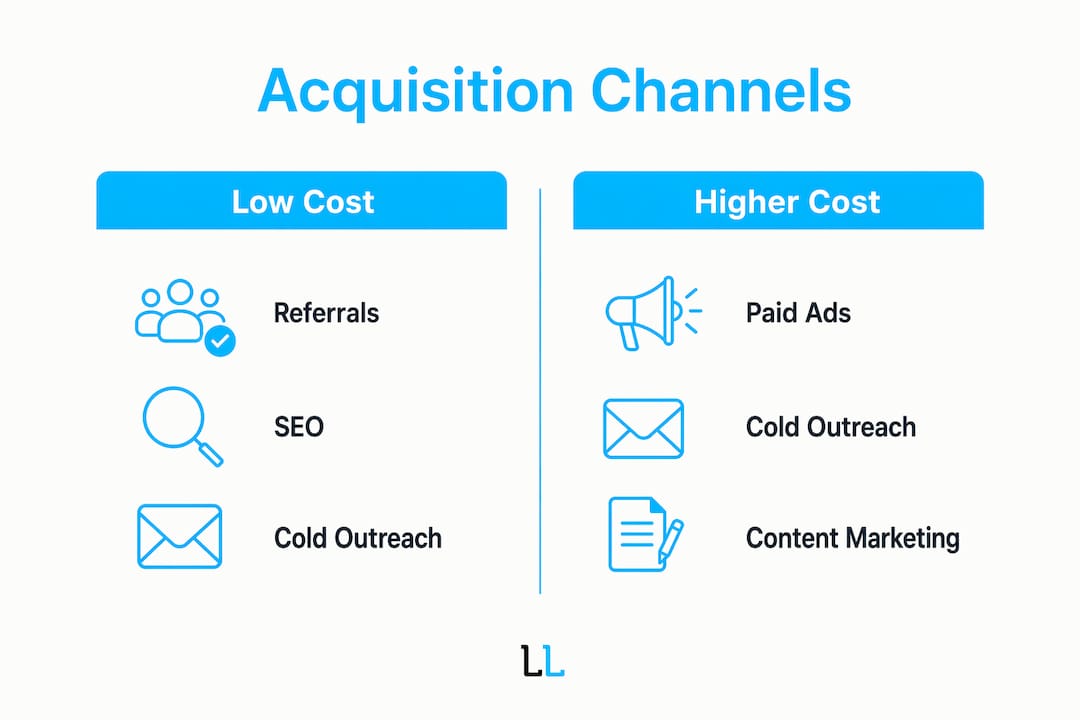
SEO and content marketing take longer to produce results. These channels typically need 3–6 months to mature before generating consistent inbound leads. The payoff is a lower long-term CAC and a compounding asset that keeps working without additional spend. For service businesses with a longer sales cycle, this profile fits well.
Paid advertising delivers leads quickly but at a higher cost. Paid ad CAC typically runs $100 to $400 per acquisition for service businesses. The speed makes paid channels useful for testing new offers or filling pipeline gaps. The cost makes them unsustainable as a sole acquisition source.
Cold outreach, including LinkedIn prospecting and email campaigns, sits between referrals and paid ads in both cost and conversion rate. The effectiveness depends heavily on targeting quality and message relevance. Organic social media builds brand awareness but rarely closes deals on its own. It works best as a supporting channel that warms prospects before outreach begins.
| Channel | Typical CAC | Close rate profile |
|---|---|---|
| Referrals | $0–$50 | High (40–60%) |
| SEO and content | Low long-term | Moderate, builds over time |
| Paid advertising | $100–$400 | Variable, depends on targeting |
| Cold outreach | Low to moderate | Low to moderate |
| Organic social | Near zero | Low as standalone channel |
Pro Tip: Align your channel mix with your sales cycle length. A high-ticket consulting firm with a 90-day sales cycle will get more value from referrals and content than from paid ads optimized for quick conversions.
How do you build a repeatable client acquisition system?
A repeatable acquisition system starts with a documented Ideal Client Profile, or ICP. Building an ICP from your most profitable past deals improves conversion efficiency and prevents wasted effort on prospects who rarely close. Without an ICP, sales and marketing teams pursue different types of buyers and never build momentum in any one segment.
Here is a practical sequence for building a system that scales:
- Define your ICP. Pull data from your top 10 clients. Identify shared industry, company size, role, and pain point. This profile becomes the filter for every prospecting decision.
- Map your funnel stages. Document what moves a prospect from awareness to interest to evaluation. Assign ownership for each stage between marketing and sales.
- Set measurable conversion targets. Assign a target conversion rate to each funnel transition. Review these monthly and adjust tactics when a stage underperforms.
- Integrate your channels. Align your content, outreach, and follow-up sequences so each channel reinforces the others. A prospect who reads a case study before a sales call closes at a higher rate than one who receives a cold pitch.
- Track CAC by channel. Knowing which channel produces the lowest CAC for your specific ICP tells you where to concentrate budget and effort.
The most common failure in this process is treating lead generation and acquisition as the same activity. Lead generation fills the funnel. Acquisition converts what is in the funnel. Both require separate processes, separate metrics, and often separate team responsibilities.
Pro Tip: Review your ICP every six months. Your best client profile shifts as your business grows, and an outdated ICP quietly drains conversion rates without an obvious cause.
What operational tactics improve client acquisition outcomes?
Speed-to-lead is one of the most underrated operational variables in client acquisition. Responding to a new lead within five minutes can increase contact rates by up to 100 times compared to a 30-minute delay. Most service businesses respond in hours or days. That gap is where deals are lost before a conversation even starts.
The second shift is measuring cost per client rather than cost per lead. A cheaper lead with poor conversion is less valuable than a pricier lead that closes. Focusing on cost per lead encourages volume over quality. Focusing on cost per client encourages better targeting and stronger qualification.
The businesses that win at client acquisition treat it as an operational discipline, not a marketing activity. Speed, qualification, and follow-up consistency matter as much as the channel that generated the lead.
Sales qualification and scripting also have a compounding effect. Small improvements in lead qualification or sales scripting produce outsized revenue results over time. A 5% improvement in close rate across 100 leads per month adds up to significant additional revenue annually. This is why refining the sales conversation is worth more than increasing ad spend.
Balancing acquisition with retention rounds out the picture. Acquiring a new client costs significantly more than retaining an existing one. Businesses that build strong client onboarding processes reduce early churn and increase the lifetime value of every client they win. Acquisition and retention are not competing priorities. They are two sides of the same revenue equation.
Key Takeaways
Effective client acquisition requires a documented system that tracks CAC, aligns sales and marketing, and prioritizes speed and qualification at every funnel stage.
| Point | Details |
|---|---|
| Define acquisition correctly | Client acquisition covers the full journey from first contact to signed deal, not just lead generation. |
| Track CAC, not just leads | A healthy CAC benchmark is 10–20% of the first-year client contract value. |
| Referrals outperform other channels | Referral close rates of 40–60% and near-zero cost make them the highest-ROI acquisition channel. |
| Speed-to-lead drives contact rates | Responding within five minutes can increase contact rates by up to 100 times over a 30-minute delay. |
| Build an ICP before scaling | Documenting your Ideal Client Profile from top past deals prevents wasted spend and improves conversion. |
Why most acquisition efforts stall before they scale
After working with professional services firms across industries, the pattern I see most often is this: founders treat client acquisition as a collection of tactics rather than a system. They run a LinkedIn campaign one month, try paid ads the next, and ask for referrals when pipeline runs dry. Each tactic works in isolation. None of them compound.
The businesses that grow predictably do one thing differently. They document everything. They know their CAC by channel. They know where prospects drop out of the funnel. They have a written ICP that every team member uses. That documentation turns random wins into repeatable outcomes.
The other mistake I see constantly is confusing a full pipeline with a healthy acquisition system. A pipeline full of poorly qualified leads creates the illusion of momentum. It keeps sales teams busy without producing revenue. The fix is not more leads. It is better prospect segmentation and tighter qualification criteria applied earlier in the funnel.
Client acquisition is ultimately a discipline of measurement and iteration. The entrepreneurs who treat it that way build businesses that grow on schedule, not by accident.
— Toby
How The Lead Lab helps you acquire clients at scale
Building a client acquisition system from scratch takes time, testing, and a clear understanding of which channels fit your business model.
The Lead Lab specializes in done-for-you LinkedIn outreach campaigns built specifically for professional services firms. Every campaign starts with targeted prospect research, personalized message sequences, and response management that keeps your pipeline moving without adding to your workload. The team handles the operational side of acquisition so you can focus on closing deals and delivering results. If you want to see what a structured, data-driven acquisition program looks like in practice, explore The Lead Lab’s work or visit The Lead Lab to book a consultation.
FAQ
What is client acquisition in simple terms?
Client acquisition is the process of turning a stranger into a paying customer. It covers every step from first awareness through signed contract and onboarding.
How is client acquisition different from lead generation?
Lead generation fills the top of the funnel with potential prospects. Client acquisition covers the full journey from that first contact to a closed deal, including sales, qualification, and onboarding.
What is a good customer acquisition cost for a service business?
A healthy CAC benchmark for service businesses is 10–20% of the first-year contract value. For a client worth $3,000 annually, that means a target CAC of $300 to $600.
Which client acquisition channel has the highest close rate?
Referrals consistently produce the highest close rates, typically 40–60%, with near-zero acquisition cost. No other channel replicates the built-in trust that comes with a personal recommendation.
How do I start building a client acquisition system?
Start by documenting your Ideal Client Profile from your most profitable past clients. Then map your funnel stages, assign conversion targets to each stage, and track CAC by channel to identify where to focus your resources.