
TL;DR:
- AI-driven marketing represents a shift from campaign cycles to real-time, data-informed operating models that adapt continuously.
- Building a unified data environment and establishing governance are essential before deploying AI tools to ensure meaningful results and maintain trust.
Most marketers still think of AI as a productivity tool. Write faster. Schedule smarter. Generate more variations. That framing undersells what’s actually happening. AI-driven marketing, or what the industry increasingly calls intelligent marketing automation, is not a faster version of what you already do. It’s a different operating model entirely. One that replaces fixed campaign cycles with real-time adaptation, and gut-feel decisions with continuous, data-informed signals. If you’re a marketing professional or business owner still on the fence, the question isn’t whether AI belongs in your strategy. It’s whether your organization is building toward it with intention.
Table of Contents
- Key takeaways
- Why AI-driven marketing changes everything
- The real benefits of AI marketing
- Trust, ethics, and governance in AI marketing
- How to implement AI marketing that actually works
- My honest take on where most teams go wrong
- How Theleadlab puts AI marketing to work for you
- FAQ
Key takeaways
| Point | Details |
|---|---|
| AI changes the operating model | Marketing shifts from periodic campaigns to always-on systems that adapt in real time. |
| Personalization at scale is achievable | AI makes it possible to serve relevant content to large audiences without proportional increases in effort. |
| Infrastructure comes before results | Real gains require clean data environments and governance, not just access to tools. |
| Trust is a competitive asset | Transparency and responsible governance directly influence consumer purchase intent. |
| Start with bottlenecks, not tools | The most effective AI implementations begin with specific organizational pain points, not vendor demos. |
Why AI-driven marketing changes everything
Think with Google describes the shift as a move away from big, fixed campaigns toward ongoing adaptation, where AI enables always-on marketing across channels like Search and YouTube. That is a structural change, not a tactical upgrade.
Traditional marketing operates in cycles. You plan, create, launch, measure, and repeat, usually over weeks or months. AI breaks that rhythm. It feeds on live signals — search behavior, content engagement, conversion patterns — and adjusts in near real time. The campaign never really ends. It learns.
This shift matters for several reasons:
- Continuous experimentation: Rather than A/B testing two headlines once per quarter, AI can test dozens of variants simultaneously and reallocate spend toward what’s working within hours.
- Real-time decisioning: EY’s 2026 report highlights how AI reshapes the marketing rhythm itself, demanding that leaders set guardrails for quality at scale rather than just approving outputs after the fact.
- Accelerated customer journeys: AI shortens the path from discovery to decision by matching the right message to the right person at the right stage, automatically.
- Agentic discovery: AI agents now shape how potential customers discover products and services beyond brand-owned channels. Your brand increasingly appears in AI-generated answers and recommendations that you don’t fully control.
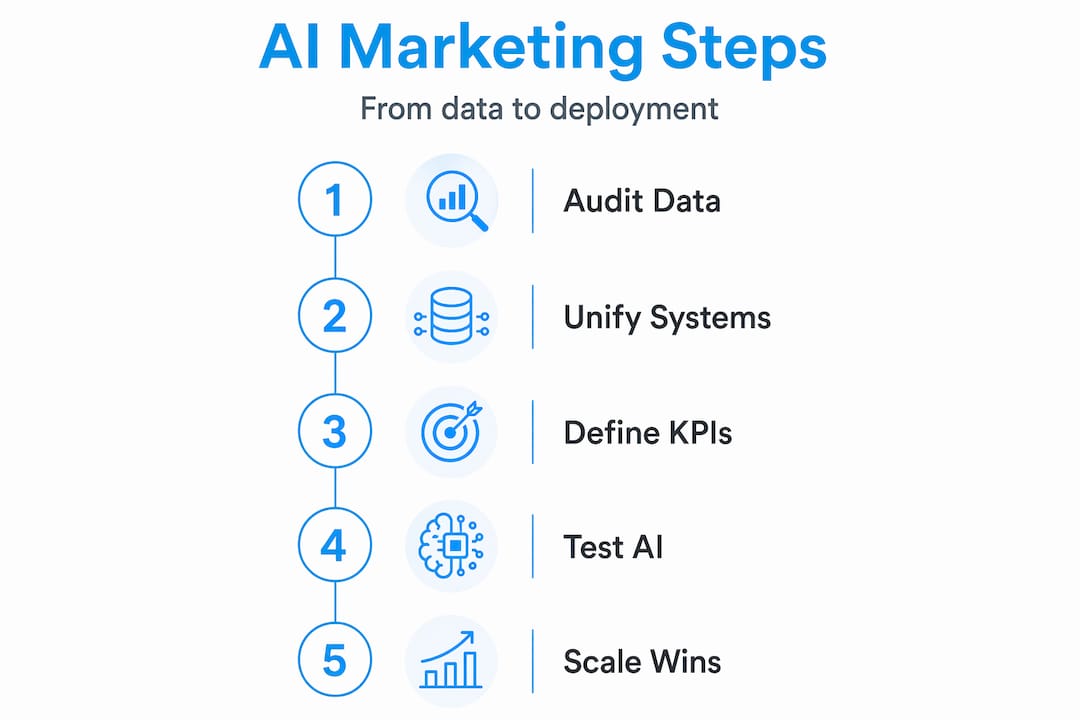
Building toward this model requires a unified data environment. Scattered data across disconnected systems forces AI to make decisions on incomplete signals. Google Marketing Live underlined this directly: unified data environments are what enable effective AI marketing decisioning. Without clean, instrumented data, even the best AI tools underperform.
Pro Tip: Before investing in any new AI marketing platform, audit where your data actually lives. If prospect data, campaign performance, and CRM records don’t connect cleanly, fix that first. The tools can wait.
For professional services firms adapting to this shift, how automation transforms B2B marketing offers a practical starting point grounded in real-world application.
The real benefits of AI marketing
The advantages of automated marketing are not hypothetical. They are measurable, replicable, and increasingly table stakes in competitive categories. Here is where teams consistently see returns:
- Hyper-personalization at scale. Customer expectations for relevant experiences have outpaced what human teams can manually deliver. AI closes that gap by analyzing behavioral signals and serving personalized content, offers, or messages at a scale no team can replicate manually.
- Faster content production. Generative AI delivers gains in content creation and personalized campaigns, reducing time-to-market for assets that used to take days to produce.
- Leaner, more efficient workflows. Teams that previously spent significant time on manual segmentation, reporting, and copy variations redirect that time toward strategy and creative direction.
- Smarter ad spend. AI in digital advertising removes a lot of the guesswork. Platforms optimize bids, audiences, and placements in real time based on conversion signals, not intuition.
The Hershey Company illustrates what mature AI marketing infrastructure actually looks like. After spending a full year building their back-end AI marketing infrastructure before launch, they moved to near-real-time data-informed decisions rather than relying on outdated campaign results. That timeline is instructive. The infrastructure investment preceded the public-facing benefit.
The personalization benefit also has a ceiling that most articles skip over. It works when it is relevant and transparent. It backfires when customers feel surveilled rather than understood. The line between the two is thinner than marketers assume, which is why governance matters as much as capability.

For teams specifically focused on building pipeline, personalized prospecting strategies show how AI-assisted outreach can translate these benefits directly into qualified leads for professional services firms.
Trust, ethics, and governance in AI marketing
Speed and personalization are only advantages if people trust what you’re doing with their data and attention. That trust is not automatic. Research shows that personalization’s effect on purchase intent is directly moderated by transparency, explainability, and responsible governance. Strip those out and the personalization benefit evaporates.
Three tensions marketing leaders need to manage:
- Personalization vs. privacy: Customers want relevance. They don’t want to feel tracked. The line is about perceived value exchange, and getting it wrong damages both conversion and brand trust.
- Automation vs. authenticity: AI-generated content at volume risks feeling generic. The brands winning at scale are those with clear tone-of-voice standards that AI is trained to follow, not replace.
- Speed vs. accuracy: AI outputs are fast, but they can be wrong, biased, or off-brand. Human-in-the-loop review is not a bottleneck. It’s quality control.
The ICC’s 2026 guidance applies existing advertising codes directly to AI-generated content, requiring transparency and human oversight as the baseline. This is not optional compliance. It’s the standard your enterprise clients and regulated-industry prospects already expect from their vendors and partners.
“The biggest mindset shift is from approving outputs to creating conditions for quality at scale.” — EY, 2026
There is also a commoditization risk that rarely gets discussed honestly. When every marketing team uses the same AI tools and the same prompting patterns, outputs converge. Martech.org warns that similar AI tools used uniformly erode competitive advantage unless brands create what they call “asymmetric impact” through unique channel mixes, targeting logic, and authentic positioning. For professional services and consulting firms, that differentiation is the brand itself.
Pro Tip: Document your brand guardrails before deploying AI at scale. Voice guidelines, claim standards, and personas should be inputs to AI, not afterthoughts. This is where governance becomes a creative asset, not just a compliance checkbox.
For firms in regulated industries or client-facing professional services, AI marketing governance frameworks offer a practical lens on how documentation and ethical standards translate into sustainable competitive advantage.
How to implement AI marketing that actually works
Knowing why AI-driven marketing matters is different from knowing where to start. Most teams get stuck because they approach it as a tool selection problem rather than an organizational readiness problem.
| Approach | What it looks like | Likely outcome |
|---|---|---|
| Tool-first adoption | Buy AI platforms, assign to existing workflows | Limited gains, team frustration, inconsistent results |
| Bottleneck-first approach | Identify where marketing slows down, map AI to those gaps | Targeted improvements with clear, measurable impact |
| Strategic embedding | AI integrated into operating model, KPIs, and governance | Scalable, compounding returns over time |
Practitioner guidance is consistent on this: start with specific organizational bottlenecks, not vendor demos. Ask where your marketing process breaks down. Is it lead qualification speed? Content production volume? Audience targeting precision? Each of those has a different AI solution, and knowing the problem first prevents expensive mismatches.
From there, the sequence matters:
Build your data layer first. Clean, connected, normalized data is the foundation everything else sits on. Skipping this step is the most common reason AI marketing investments disappoint.
Embed AI in strategy, not just tactics. Deloitte Canada notes that many teams get comfortable prompting AI but never reach the orchestration level required for real transformation. Prompting is tactical. Orchestrating AI across your operating model is strategic.
Define your KPIs before you deploy. Measure what changes. Pipeline velocity, cost-per-qualified-lead, content engagement by segment. If you cannot tie AI adoption to a metric that matters to the business, you cannot defend the investment or improve it.
Pro Tip: Scalable success often starts small. Pick one bottleneck, run a 90-day AI experiment with clear success criteria, document what you learn, and expand from there. This beats a full-stack overhaul that stalls in month three.
Teams ready to scale what’s working can explore scalable lead generation strategies to understand how the infrastructure principles above translate into consistent pipeline growth.
My honest take on where most teams go wrong
I’ve worked with enough marketing teams to spot the pattern quickly. They come in excited about an AI tool, spend weeks getting the integration right, and then wonder why the results feel underwhelming. The issue is almost never the tool. It’s that they jumped to execution without building the operating conditions that make AI outputs worth anything.
What I’ve seen work consistently is treating AI less like a creative assistant and more like a system that needs clear inputs to produce useful outputs. That means brand standards, audience definitions, and quality benchmarks need to exist before the AI touches any customer-facing content. When those things are in place, AI genuinely multiplies the team’s capacity. When they’re not, it just produces more content that looks like everyone else’s.
The uncomfortable truth about speed is that AI can make you faster at producing things nobody wants. Volume without relevance is not a marketing advantage. The teams I respect most are not trying to outproduce their competitors with AI. They are trying to out-think them, using AI to sharpen their understanding of what customers actually need and then creating fewer, better interactions.
Governance is where I’d push hardest. Most teams treat it as a legal obligation. The smart ones treat it as a creative framework that keeps AI outputs aligned with what makes their brand worth buying from in the first place.
— Toby
How Theleadlab puts AI marketing to work for you
If the ideas in this article resonate, the question becomes whether your team has the infrastructure, processes, and specialized expertise to execute them at the level that produces real pipeline. That’s exactly where Theleadlab operates.
Theleadlab specializes in AI-driven LinkedIn outreach and lead generation for professional services firms. Every campaign is built around targeted prospecting, personalized message sequences, and analytics that tell you what’s working and why. The team handles copywriting, response management, and campaign optimization so you can focus on closing the qualified meetings that come through the pipeline. If you want to see what this looks like in practice, explore the client results and case studies, or visit Theleadlab’s main site to book a consultation and see what a bespoke campaign would look like for your firm.
FAQ
What is AI-driven marketing in practice?
AI-driven marketing uses machine learning and automation to make real-time decisions about content, targeting, and spend, replacing fixed campaign cycles with always-on systems that adapt based on live data signals.
Why use AI in marketing instead of traditional methods?
Traditional marketing relies on historical data and periodic optimization. AI improves on this by processing live behavioral signals continuously, enabling faster personalization, more efficient ad spend, and shorter paths from awareness to conversion.
What are the biggest risks of AI in digital advertising?
The main risks are privacy violations from over-personalization, brand erosion from generic AI outputs, and regulatory exposure from undisclosed AI-generated content. Documented governance and human review mitigate all three.
How does AI marketing affect consumer trust?
Research shows that transparency and explainability directly moderate whether personalization improves or damages purchase intent. Consumers respond positively to relevance and negatively to content that feels manipulative or opaque.
Where should a business start with AI marketing strategies?
Start by identifying where your marketing process creates the most friction or delay, then map AI capabilities to those specific gaps rather than adopting tools broadly. Clean, unified data should be the first investment before any AI layer is added.