
TL;DR:
- Drip campaigns are behavior-responsive systems that generate 41% of total email revenue while encompassing only 5.3% of send volume. Effective design involves lifecycle mapping, behavioral branching, suppression strategies, and AI integration, which significantly boost conversion rates and revenue. Regular optimization and treating drip programs as living systems are crucial for sustained success in modern marketing.
Most marketers know drip campaigns exist. Far fewer understand the real role of drip campaigns in a modern marketing program. They are not just scheduled emails sent on a timer. They are behavior-responsive, lifecycle-aware systems that generate 41% of total email revenue while accounting for only 5.3% of total send volume. That gap between effort and output is why smart marketers treat drip programs as a core revenue channel, not a nice-to-have. This article breaks down how drip campaigns work, how to design them for maximum impact, and what separates programs that convert from ones that quietly drain your list.
Table of Contents
- Key takeaways
- The role of drip campaigns in modern marketing
- Strategic design principles for drip campaigns
- Best practices and avoiding common pitfalls
- How AI is changing drip campaigns in 2026
- Applying drip campaigns: where to start
- My honest take on why most drip programs underperform
- How Theleadlab helps you build campaigns that convert
- FAQ
Key takeaways
| Point | Details |
|---|---|
| Flows outperform bulk sends | Automated email flows deliver 17.6x higher revenue per recipient than standard campaign emails. |
| Behavior triggers matter most | Branching workflows that adapt to opens, clicks, and visits produce far stronger conversion rates than fixed schedules alone. |
| Suppression prevents list burnout | A three-layer suppression strategy keeps messaging relevant and reduces unsubscribe rates significantly. |
| AI is now the baseline | Full-stack AI integration across segmentation and send-time optimization lifts revenue 41% over manual campaigns. |
| Programs need regular redesign | Drip sequences should be rewritten as cohort behavior and product usage data evolve, not just when open rates dip. |
The role of drip campaigns in modern marketing
A drip campaign is a sequence of pre-written messages sent to contacts based on time intervals, specific behaviors, or lifecycle stage. The name comes from the idea of a slow, consistent drip of communication rather than a single blast. But the mechanics matter more than the metaphor.
There are two core types. Time-based drips send messages on a fixed schedule after a trigger event, such as a welcome series that goes out on days 1, 3, 7, and 14 after signup. Behavior-triggered flows respond to what a contact actually does: clicking a pricing page, abandoning a cart, or attending a webinar. Most high-performing programs use both in combination.
The benefits of drip campaigns become obvious when you look at the numbers. Automated flows yield 5.58% click rates compared to 1.69% for broadcast campaigns, and a 13x higher placed order rate. That is not a marginal improvement. It reflects a fundamental difference in how the message is received: the right person, at the right moment, with context that matches where they are in their decision process.
The core benefits worth understanding before you build anything:
- Sustained lead nurturing over weeks or months without manual intervention
- Higher conversion rates driven by timing and behavioral relevance
- Reduced unsubscribe rates when subscribers receive messages that match their current needs
- Scalable personalization through segmentation and dynamic content
- Automatic lead qualification when scoring and handoff triggers are built into the workflow
Pro Tip: Timing synchronization matters more than message quality in the early stages of a drip. A mediocre message sent at the exact right moment outperforms a perfect message sent three days too late.
Strategic design principles for drip campaigns
The difference between a drip campaign that works and one that sits quietly underperforming usually comes down to how it was designed, not what platform it runs on.

The starting point is lifecycle mapping. Before you write a single email, you need to know which stage of the customer journey each sequence addresses. Awareness, consideration, decision, onboarding, retention, and win-back all require different messages, different cadences, and different exit conditions. Trying to use one sequence for multiple lifecycle stages is one of the most common reasons drip programs underdeliver.
Most mature drip programs are actually systems that combine fixed-schedule flows and behavior-triggered sequences, with clear handoff logic between them. A new lead enters a welcome sequence. If they click on a product page, a triggered workflow takes over with more specific content. If they go silent, a re-engagement flow kicks in. Each flow has its own purpose, and the handoffs between them keep the experience coherent.
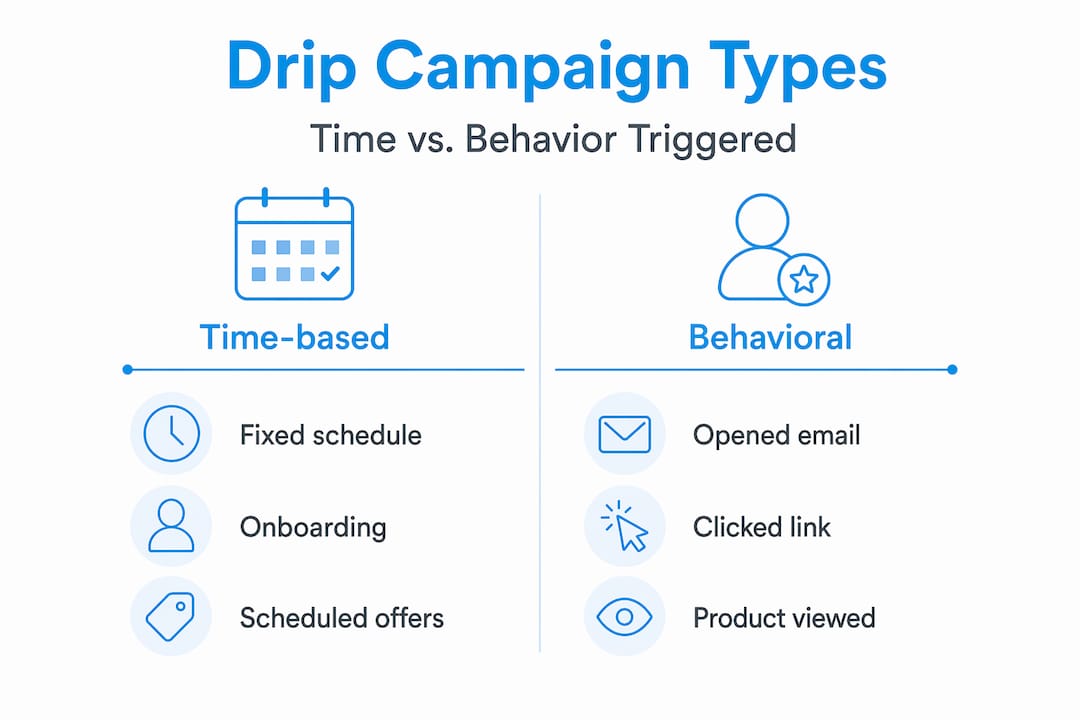
Here is how the main drip campaign types compare:
| Campaign type | Trigger | Best use case | Key characteristic |
|---|---|---|---|
| Time-based drip | Fixed schedule post-enrollment | Welcome series, onboarding | Predictable, easy to test |
| Behavior-triggered flow | Contact action (click, visit, purchase) | Cart abandonment, upsell | Highly relevant, higher conversion |
| Lifecycle nurture sequence | Lead score or stage change | Mid-funnel education | Long-term, multi-touch |
| Re-engagement campaign | Inactivity threshold | Win-back, list hygiene | Requires suppression coordination |
Branching logic is what separates functional drips from truly responsive programs. HubSpot’s nurture workflows demonstrate how behavioral branching personalizes lead paths automatically, triggering sales handoffs when a contact hits a scoring threshold. You do not need to build 20 separate sequences. You need one well-designed workflow with branches that respond to what contacts actually do.
Cohort analysis should feed back into your design decisions on a regular basis. When a specific segment of contacts consistently drops off at message three, that is a signal about content fit or cadence, not just a data point to note and ignore.
Pro Tip: Segment your prospecting process before you design sequences. Segmenting your prospects before building flows reduces wasted content creation and makes behavioral branching far more precise.
Best practices and avoiding common pitfalls
Even well-designed drip campaigns fail when implementation gets sloppy. These are the mistakes that quietly erode list health and conversion rates over time.
-
Skip the suppression system and you will over-message. A three-layer suppression strategy covers workflow-level rules, global contact frequency caps, and specialized suppression lists for contacts in active sales conversations or recent purchasers. Without all three layers, contacts end up in multiple sequences simultaneously, which accelerates fatigue and unsubscribes.
-
Treat preference centers as a retention tool, not a compliance checkbox. High unsubscribe rates correlate more strongly with message frequency and relevance than with content quality. Giving subscribers control over how often they hear from you turns what would have been an unsubscribe into a preference adjustment. That is a contact you keep instead of lose.
-
Use behavioral branching before adding more sequences. The instinct when campaigns underperform is to add more emails. The better move is to add a branch. One sequence with three behavioral forks covers more ground than three separate sequences and costs far less to maintain.
-
Set exit conditions from the start. Every drip sequence needs clear criteria for when a contact leaves it. Purchased the product? Exit. Booked a call? Exit and notify sales. Went inactive for 60 days? Route to re-engagement. Without exit conditions, contacts pile up inside flows that no longer apply to them.
-
Match cadence to lifecycle stage. A welcome series can run daily for three to five days because the relationship is fresh and expectations are high. A mid-funnel nurture sequence running at that frequency will burn your list fast. Pausing re-engagement flows during active marketing campaigns prevents message conflicts that confuse and frustrate subscribers.
Personalization through tailored outreach content also directly affects drip campaign performance. Generic sequences that treat all leads the same produce generic results.
How AI is changing drip campaigns in 2026
Automated email campaigns have always been more effective than bulk sends. AI makes the gap even larger, and it does so by improving multiple variables at once rather than just one.
The Salesforce research from 2026 is clear: full-stack AI integration across segmentation, content assembly, and send-time optimization produces a 41% revenue lift over manual campaigns. Isolated AI features like subject line optimization alone only lift revenue by 8 to 14%. The compounding effect of coordinated AI across the entire workflow is where the real return comes from.
41% higher revenue is the documented lift from full-stack AI email integration compared to manual campaign management. Isolated features like subject line AI produce only 8-14% gains.
What that full-stack integration looks like in practice:
- Predictive segmentation that groups contacts by likely next action rather than demographic profile
- Dynamic content assembly that swaps product recommendations, testimonials, or CTAs based on real-time behavior data
- Send-time optimization that schedules each email to land when that specific contact is most likely to open
- Churn prediction that automatically routes at-risk contacts into retention flows before they disengage
AI-driven segmentation delivers 18 to 45% higher revenue per recipient compared to static demographic segmentation. The reason is simple: behavioral data is more predictive of purchase intent than firmographic or demographic data alone.
AI is not a differentiator in 2026. It is a competitive baseline requirement. Programs that still rely on manual segmentation and fixed content blocks are competing at a structural disadvantage.
Applying drip campaigns: where to start
Understanding the role of drip campaigns is one thing. Building a program that actually runs and generates results is another. Here is how to approach it without getting overwhelmed.
- Start with your highest-leverage flows first. Welcome series and abandoned cart sequences have the clearest triggers and the fastest payoff. Build and optimize those before expanding to complex nurture programs.
- Combine lead scoring with your nurture sequences. Score-based routing assigns points for behaviors like email opens, page visits, and demo bookings, then automatically notifies sales when a contact crosses a threshold. This removes the guesswork from handoffs.
- Use cohort behavior data to redesign sequences. Lifecycle mapping and business intelligence should drive your redesign decisions, not just open rate dips. When a segment of your audience changes its behavior, your sequence needs to respond.
- Coordinate multiple workflows with explicit priority rules. When a contact qualifies for two flows simultaneously, you need a rule that decides which one wins. Document this before you launch, not after you see the overlap in your data.
- Review and rewrite at regular intervals. A drip sequence written 18 months ago was built on data that no longer reflects your audience. Schedule quarterly reviews as a standing calendar item.
The automation examples that produce the best long-term results are the ones designed with maintenance in mind from the beginning.
My honest take on why most drip programs underperform
The biggest misconception I see in the market is that drip campaigns are a “set and forget” investment. You build a sequence, turn it on, and let it run. In my experience, that thinking is the primary reason most programs deliver mediocre results for years without anyone understanding why.
What actually separates effective programs from average ones is the willingness to treat drip campaigns as a living system. That means regular redesign based on cohort behavior, not just tweaking subject lines when open rates slip. It means building suppression logic from day one, not retrofitting it after your unsubscribe rate climbs. It means using behavioral branches instead of adding more emails to a sequence that already has too many.
I have also seen teams over-invest in content creation while under-investing in workflow logic. Ten beautifully written emails inside a poorly structured sequence will always underperform four straightforward emails inside a well-designed one. The architecture matters more than the copy.
The teams I see get the most out of drip marketing strategies are the ones who prioritize building flows over one-off campaigns. Flows compound. Campaigns do not. If your marketing budget and attention are primarily going toward broadcast sends, you are leaving a disproportionate share of your revenue on the table.
— Toby
How Theleadlab helps you build campaigns that convert
If you are a marketing professional or business owner who wants to move beyond generic email sequences, Theleadlab builds the kind of targeted, behavior-driven outreach programs that actually move the needle. From segmentation strategy to automated scaling, the team at Theleadlab specializes in personalized, done-for-you campaigns designed for professional services firms. You can explore what results look like in practice by browsing the client case studies, or accelerate your learning by registering for one of the upcoming marketing webinars covering lead nurturing, automation design, and conversion optimization. If you are serious about drip campaigns effectiveness, this is where to start.
FAQ
What is the role of drip campaigns in lead nurturing?
Drip campaigns deliver timed, behavior-triggered messages that guide leads through the buying process without requiring manual outreach at each step. They keep prospects engaged across long sales cycles by delivering relevant content based on where each contact is in the journey.
How do drip campaigns work differently from regular emails?
Regular campaigns go to your full list at once. Drip campaigns send messages to specific segments based on triggers like signup date, a link click, or a product page visit, which produces far higher engagement and conversion rates.
What are the biggest benefits of drip campaigns?
The primary benefits include higher revenue per recipient, automated lead qualification, reduced list churn through relevance, and the ability to scale personalized communication without adding headcount.
How often should you update a drip sequence?
Sequences should be reviewed at least quarterly and redesigned when cohort behavior data shows significant changes in engagement patterns or when your product offering or positioning evolves.
Does AI improve drip campaign performance?
Yes, significantly. Full-stack AI integration across segmentation, content, and send-time optimization delivers 41% higher revenue compared to manual campaign management, making it a practical necessity for competitive programs in 2026.