TL;DR:
- Effective LinkedIn outreach depends on well-crafted copy that guides prospects through a strategic sequence rather than relying on volume.
- Focusing on outcomes, specific proof points, and consultative messaging builds trust and increases reply and booked-call rates.
Decision-makers on LinkedIn receive dozens of cold outreach messages every week, and most get ignored within seconds. The difference between a message that books a call and one that vanishes into a buried inbox isn’t your service quality or even your targeting. It’s your copy. LinkedIn outreach must be approached as a workflow with defined metrics, not a one-off blast. This article gives you practical frameworks, proven structures, and real examples to help your professional services firm write LinkedIn messages that actually get replies.
Table of Contents
- Set clear outreach goals and measure results
- Lead with outcomes, not features
- Craft consultative first messages, then proof-driven follow-ups
- Comparison: Top message copywriting approaches for LinkedIn outreach
- Why most LinkedIn outreach fails and what actually works
- Ready to elevate your LinkedIn outreach?
- Frequently asked questions
Key Takeaways
| Point | Details |
|---|---|
| Measurable goals matter | Set clear targets for acceptance, reply, and booked calls to shape your message copy. |
| Outcomes over features | Translate product features into quantified business impacts with proof in your messaging. |
| Consultative first contact | Start outreach with a diagnosis-oriented approach before delivering offers or proof. |
| Sequenced approach wins | Blend multiple touchpoints and adjust copy for each stage of your LinkedIn workflow. |
| Continuous improvement | Regularly review performance metrics and message feedback to refine outreach. |
Set clear outreach goals and measure results
Before you write a single word, you need to know what success looks like. That sounds obvious, but most marketing teams skip straight to drafting messages without establishing baseline metrics. Without targets, you can’t tell whether your copy is working or just producing noise.
There are three core metrics every LinkedIn outreach campaign should track: connection acceptance rate, reply rate, and booked-call rate. Each one tells you something different. Acceptance rate tells you whether your profile and connection request note are credible enough to earn entry. Reply rate tells you whether your opening message is compelling. Booked-call rate tells you whether your follow-up sequence is converting interest into action.
Here’s a useful benchmark reference to calibrate your expectations:
| Metric | Low Performer | Average | Top Performer |
|---|---|---|---|
| Connection acceptance rate | Below 20% | 25-35% | Above 40% |
| Reply rate | Below 8% | 10-20% | Above 25% |
| Booked-call rate | Below 2% | 3-6% | Above 8% |
Use these numbers as your starting reference, not as fixed rules. Industry, persona, and message type all shift the bands. The key is that sequencing and metrics discipline are core methodologies for effective LinkedIn outreach. Without that structure, you’re guessing.
A well-built lead generation workflow maps each touchpoint to a specific goal. Your connection request does a different job than your first follow-up. Your second follow-up does a different job than your value-delivery message. When every step has a defined purpose and a measurable output, you can isolate what’s working and fix what isn’t.
Here’s a simple workflow sequence structure for LinkedIn outreach:
- Connection request with a short, personalized note (no pitch, just context)
- First message within 24 hours of acceptance, consultative and focused on fit
- Follow-up message three to five days later, adding proof or a case reference
- Final message one week later, providing a low-friction next step or resource
Good lead generation segmentation strategies make each step sharper because your messaging is matched to a specific persona, not a generic prospect pool.
Pro Tip: Before launching a sequence, review reply-rate benchmarks for your specific vertical. A 12% reply rate might be excellent in legal services but underperforming in SaaS. Always interpret metrics in context, then test one copy variable at a time to improve.
Lead with outcomes, not features
This is where most B2B copywriters fail. They write about what their service does instead of what it delivers. Features are internal. Outcomes are what decision-makers actually care about.
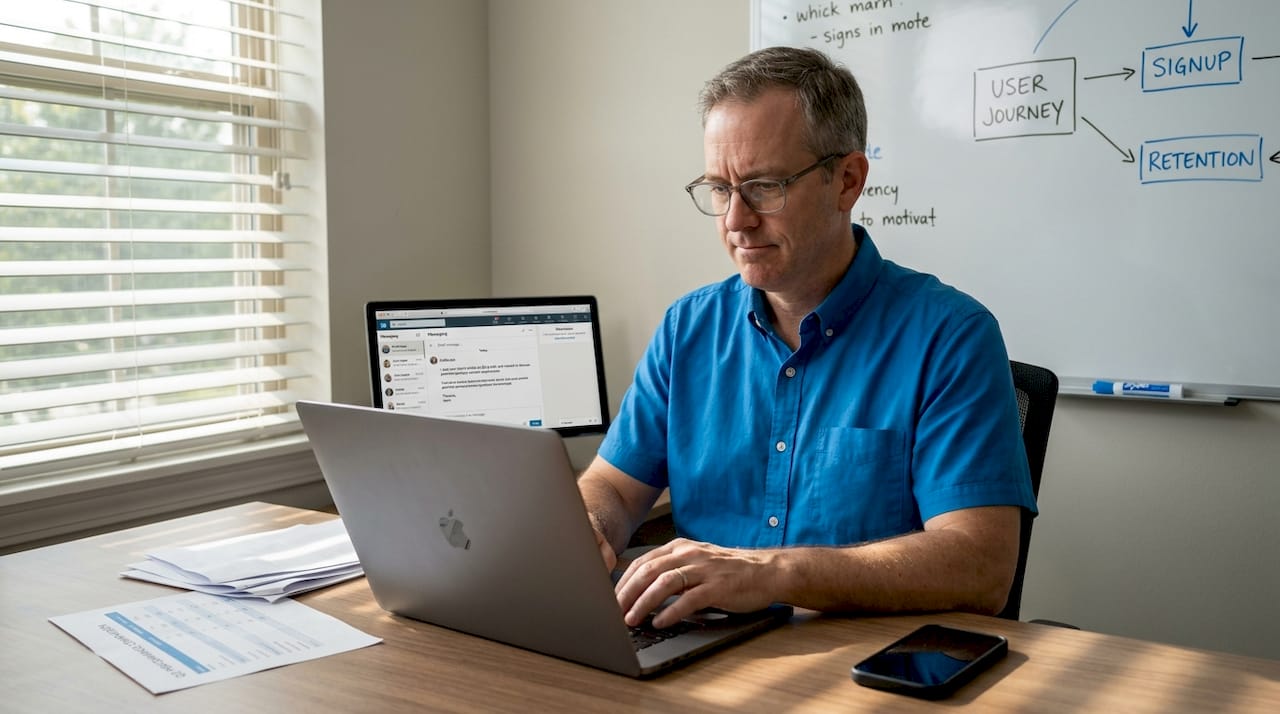
Think about a CFO receiving a LinkedIn message about financial consulting services. If the message says, “We offer fractional CFO support with experience in mid-market companies,” that’s a feature statement. It tells the reader nothing about what changes for them. Now rewrite it as, “Our clients typically reduce month-end close time by 30% and eliminate three to five manual reporting bottlenecks within the first 90 days.” That’s an outcome. That’s a reason to reply.
B2B copywriting for outbound should translate features into quantified business outcomes and use proof to back every claim you make. Proof is what separates a credible promise from a generic pitch.
Here’s what quantified outcome messaging looks like in practice for a professional services firm:
- Time savings: “Clients reduce proposal turnaround from five days to under 48 hours”
- Revenue impact: “Average engagement value increases by 22% within the first two quarters”
- Risk reduction: “Three of our last four clients avoided a regulatory fine that averaged $85,000”
- Efficiency gains: “Teams eliminate an average of eight manual touchpoints per client onboarding”
Each bullet should be backed by real data from your own client work. If you don’t have exact numbers yet, use ranges or reference anonymized client cases. The goal is specificity, because specificity signals credibility.
“Buyers build an internal case to justify a conversation. Your message copy needs to hand them the ammunition to do that—specific outcomes, proof points, and a clear reason why now.”
Strategic messaging for B2B leads always starts from the buyer’s internal question: “What’s in it for my business, and why should I trust this claim?” Your copy needs to answer both before the prospect even asks.
Craft consultative first messages, then proof-driven follow-ups
The biggest mistake professional services firms make in LinkedIn outreach is leading with the offer. It feels efficient, but it breaks trust before trust is built. Decision-makers in consulting, legal, financial, or advisory services are skeptical by nature. They’ve seen thousands of cold pitches. An offer-first message immediately signals that you’re treating them like a number.
A consultative, diagnosis-oriented first message changes the dynamic entirely. It signals that you’re interested in their situation, not just closing a deal. It positions you as a peer, not a vendor. And it opens a door to dialogue rather than forcing a binary yes-or-no on an offer they weren’t ready for.
Here’s what a consultative sequence looks like step by step:
- Connection note: Reference something specific about their role, company, or recent activity. Keep it under 60 words. No ask.
- First message: Identify a likely pain point in their world based on their industry, size, or growth stage. Ask one focused diagnostic question. Do not mention your service.
- Second message (proof): Share a specific case study or result from a similar client. Frame it as a relevant example, not a pitch.
- Third message (solution fit): Now introduce your service, but tie it directly to what you’ve learned from the conversation or their profile.
- Fourth message (low-friction close): Offer something easy, like a 15-minute call, a resource, or a short diagnostic assessment.
Pro Tip: Watch for prospect triggers before timing your follow-ups. A new job announcement, a company funding round, a LinkedIn post about a challenge, or a comment on industry news are all signals that someone is in a receptive moment. Triggered outreach consistently outperforms scheduled outreach by a wide margin.
The craft of high-impact outreach messages lies in matching tone to stage. Early messages should feel like a curious colleague reaching out. Later messages should feel like a trusted advisor presenting evidence. The shift from curious to credible, managed across a smart sequence, is what drives booked calls.
Comparison: Top message copywriting approaches for LinkedIn outreach
Now that you understand the building blocks, it helps to see the three dominant LinkedIn outreach messaging approaches side by side. Each one fits different stages of an outreach sequence and different types of prospects.
| Approach | Core focus | Strongest stage | Main risk |
|---|---|---|---|
| Consultative | Diagnosing prospect needs through questions | First message | Slow to build momentum if not followed up with proof |
| Value-first | Delivering quantified outcomes and proof upfront | Second to third message | Can feel presumptuous without prior rapport |
| Offer-based | Presenting a specific solution or deal | Final touchpoint only | Damages trust if used too early in the sequence |
Different approaches including feature translation, proof delivery, and metrics-driven sequencing are all available tools. The mistake is using only one of them across the entire sequence.
Here’s a quick guide to when each approach fits best:
- Consultative messaging works best when targeting senior decision-makers who are in the problem-awareness stage, not yet ready to evaluate solutions. It also works well for warm referrals or prospects who have engaged with your content.
- Value-first messaging fits prospects who are actively researching solutions, have interacted with your brand, or match a profile where you have strong, relevant proof. It shortens the trust-building cycle because you lead with evidence.
- Offer-based messaging belongs only at the end of a sequence, after a prospect has shown signal interest through a reply, a profile visit, or engagement with a prior message. Using it cold, in a first message, almost always backfires.
Winning copywriting strategies for LinkedIn layer all three approaches across a properly structured sequence rather than defaulting to one style for every touchpoint. The result is a more natural conversation arc that mirrors how real professional relationships develop.
Why most LinkedIn outreach fails and what actually works
Here’s our honest take after working with dozens of professional services firms on their LinkedIn outreach: volume is not a strategy. It’s a shortcut that signals low intent to every prospect it touches. Teams that chase connection request numbers instead of reply quality burn through their addressable market faster than they generate leads.
The firms that consistently fill their pipelines through LinkedIn do something different. They write fewer messages, but better ones. They invest time in understanding what a specific persona actually worries about on a Tuesday morning. They build sequences that feel like a thoughtful conversation, not a drip campaign in disguise.
Most marketing teams also skip consultative diagnosis entirely. They assume they know what prospects want and go straight to pitching. But top-performing outreach teams treat the first message like a discovery question in a sales call. They’re not selling yet. They’re qualifying and opening. That shift in mindset alone can double reply rates.
Measurement matters more than most teams realize. Iterating on copy based on real reply-rate data, rather than gut feel, is what separates teams that improve from teams that plateau. Testing one variable per sequence, whether it’s the subject line, the opening line, the proof point, or the call to action, is how you build a repeatable playbook.
Outreach campaign ideas that work in 2026 are built on clarity, not cleverness. Clear problem identification. Clear proof. Clear next step. The prospects you want to reach are busy and skeptical. They don’t need creative flair. They need a message that makes them feel understood in thirty seconds and gives them a reason to respond. The firms we’ve seen win consistently with LinkedIn messaging are the ones that commit to this discipline over time.
Ready to elevate your LinkedIn outreach?
If you’re ready to move beyond generic templates and volume-based campaigns, The Lead Lab’s team works exclusively with professional services firms to build outreach programs that generate real pipeline.
We’ve helped clients across consulting, financial services, and advisory practices craft sequences that convert using proven frameworks, targeted segmentation, and copy that speaks directly to decision-maker priorities. Explore our client case studies to see real results, or register for our upcoming expert webinars where we break down outreach strategy in depth. When you’re ready to build a campaign that actually works, the B2B LinkedIn outreach experts at The Lead Lab are here to help you get started.
Frequently asked questions
What is a good reply rate for LinkedIn outreach in B2B?
A solid reply rate for B2B LinkedIn outreach is around 10 to 20%, though top performers often exceed 25% using sequenced, metrics-driven messaging with targeted follow-ups. Your industry and persona will shift these bands, so always measure against your own historical baseline.
How should I structure the first LinkedIn outreach message?
Make your first message consultative and diagnosis-oriented, centering on a specific problem the prospect likely faces rather than leading with your offer. This approach builds trust and opens a genuine dialogue before any pitch is introduced.
How do I prove ROI in my LinkedIn message copy?
Translate features into outcomes by quantifying business results your clients have achieved, and back every claim with real proof such as percentages, timeframes, or anonymized case references. Specificity is what makes a claim believable rather than forgettable.
Can I use email and phone as part of my LinkedIn outreach sequence?
Yes, absolutely. Blending LinkedIn with email and phone in a coordinated, multi-channel sequence improves response rates and gives you multiple touchpoints to reach a prospect without over-relying on any single platform.