
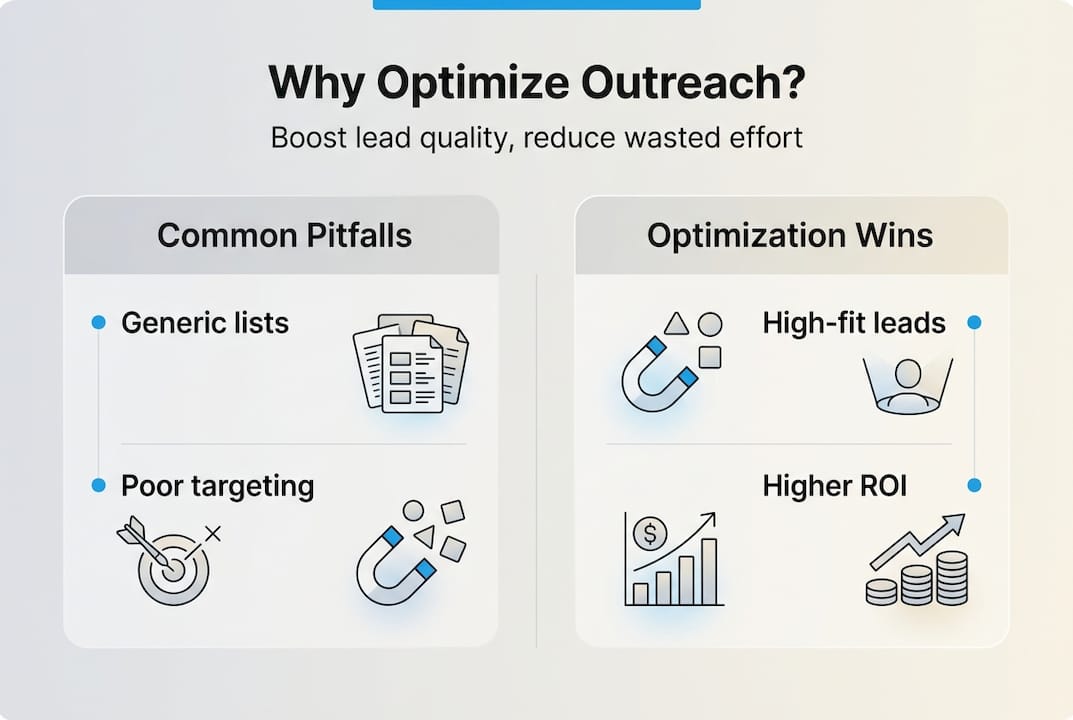
LinkedIn leads cost two to five times more than other platforms, yet they convert at rates two to three times higher. This paradox confuses many marketing leaders who see the premium price tag and hesitate. The real issue isn’t the cost per lead itself but how many campaigns waste budgets on unoptimized approaches that generate low-quality volume instead of qualified prospects. When you optimize your outreach campaigns systematically, you transform expensive clicks into revenue-generating conversations that justify every dollar spent.
Table of Contents
- Key takeaways
- Understanding the cost and value of LinkedIn leads
- Common pitfalls of unoptimized outreach campaigns
- How optimization improves campaign performance and ROI
- Tailoring outreach campaigns to professional services firms
- Discover expert LinkedIn outreach solutions at The Lead Lab
- FAQ
Key Takeaways
| Point | Details |
|---|---|
| Premium lead cost justified | LinkedIn’s higher cost per lead can be justified when campaigns are optimized to prioritize high quality prospects and stronger conversion results. |
| Optimization reduces waste | Systematic optimization prevents spending on unqualified volume and converts expensive clicks into revenue generating conversations. |
| Data driven testing boosts results | Split testing and iterative optimization lift acceptance and reply rates by focusing on what works. |
| Tailored campaigns boost ROI | Professional services firms gain the most when refining outreach to target decision makers and buying committees. |
Understanding the cost and value of LinkedIn leads
LinkedIn’s cost per lead structure operates on two tiers that reflect targeting precision and audience quality. Standard campaigns typically run $75-175 per lead while premium targeting pushes costs to $150-350, making it the most expensive major platform for B2B outreach. These numbers shock marketing leaders accustomed to cheaper alternatives, but the conversion story tells a different tale.
The platform’s professional context creates an environment where decision-makers expect business conversations. Unlike social platforms where users scroll for entertainment, LinkedIn members actively seek industry insights and professional connections. This mindset shift explains why LinkedIn leads convert at rates 2-3 times higher than leads from other channels, despite the steeper acquisition cost. A $200 lead that converts at 15% delivers better ROI than a $50 lead converting at 3%.
Several factors drive these premium costs and superior conversion rates:
- Precise targeting based on job titles, company size, and industry verticals
- Professional intent signals from user behavior and engagement patterns
- Direct access to decision-makers without gatekeepers
- Platform algorithms that prioritize relevant business connections
- Higher quality data validation compared to consumer platforms
The value equation becomes clear when you compare total cost per acquisition across platforms. A professional services firm might spend $150 on a LinkedIn lead that closes at 12%, resulting in a $1,250 customer acquisition cost. The same firm spending $40 per lead elsewhere with 2% conversion pays $2,000 per customer. The Lead Lab works with clients to track these metrics precisely, ensuring that premium lead costs translate into superior business outcomes.
| Platform Type | Cost Per Lead | Conversion Rate | Cost Per Customer |
|---|---|---|---|
| LinkedIn Standard | $75-175 | 10-15% | $750-1,750 |
| LinkedIn Premium | $150-350 | 12-18% | $1,250-2,917 |
| Generic B2B | $30-80 | 3-6% | $1,000-2,667 |
| Social Media | $20-50 | 1-3% | $2,000-5,000 |
Understanding these economics helps marketing leaders make informed decisions about channel investment. The question shifts from whether LinkedIn costs too much to whether your campaigns extract maximum value from each connection request and message sequence.
Common pitfalls of unoptimized outreach campaigns
Most LinkedIn campaigns fail not because the platform doesn’t work but because teams launch without systematic optimization frameworks. The typical scenario involves sending thousands of connection requests with generic messaging, then wondering why acceptance rates hover below 30% and reply rates struggle to reach 20%. This spray and pray approach burns through budgets while delivering minimal qualified conversations.

Low-quality lead volume creates a deceptive sense of progress. A campaign might generate 500 connections in a month, but if only 50 respond and just 5 become qualified opportunities, you’ve wasted resources on 495 dead ends. Each unqualified connection consumes time in follow-up sequences, clogs your CRM with noise, and dilutes your team’s focus from genuine prospects. The hidden cost isn’t just the money spent acquiring worthless leads but the opportunity cost of not pursuing better targets.
Several campaign execution errors consistently undermine performance:
- Sending identical messages to diverse audience segments without personalization
- Ignoring timing patterns that affect when prospects engage with outreach
- Failing to test different value propositions and call-to-action variations
- Neglecting to remove non-responsive prospects from ongoing sequences
- Using overly salesy language that triggers immediate rejection
- Targeting too broadly without clear ideal customer profile criteria
Pro Tip: Track your acceptance and reply rates weekly rather than monthly. This frequency lets you spot problems early and test solutions before burning significant budget. Set alerts when metrics drop below your baseline thresholds.
The compounding effect of poor optimization becomes severe over time. A campaign running for six months without refinement doesn’t just waste six months of budget; it also trains your team to accept subpar results as normal. Sales representatives grow cynical about LinkedIn’s effectiveness, leadership questions the channel investment, and competitors who optimize properly capture the market opportunities you’re missing.
Ignoring optimization in LinkedIn outreach is like running paid ads without ever checking which ones convert. You’re essentially paying premium prices for random outcomes instead of engineered results.
Benchmarking against industry standards reveals how far unoptimized campaigns fall short. Professional services firms should expect acceptance rates around 30% and reply rates between 20-35% when campaigns run properly. Anything significantly below these thresholds signals systematic problems that optimization can fix. The gap between your current performance and these benchmarks represents recoverable revenue sitting on the table.
How optimization improves campaign performance and ROI
Systematic optimization transforms LinkedIn outreach from expensive guesswork into predictable revenue generation. The foundation lies in A/B testing every campaign element to identify what resonates with your specific audience. Start with message variations that test different value propositions, then expand to profile optimization, connection request timing, and follow-up sequence structures.
Implementing effective A/B testing follows a clear progression:
- Establish baseline metrics by running your current approach for two weeks with at least 200 connection requests
- Create variant messages that change one element at a time, such as opening hook, value proposition, or call to action
- Split your target audience randomly between control and test groups to ensure fair comparison
- Run each test for sufficient volume, typically 100-150 requests per variation minimum
- Analyze results focusing on acceptance rate first, then reply rate among accepted connections
- Implement winning variations and create new tests for the next campaign element
This methodical approach reveals surprising insights about what actually works versus what you assumed would work. One professional services firm discovered that leading with a specific client result outperformed thought leadership content by 40% in reply rates, completely contradicting their initial strategy. Another found that connection requests sent Tuesday through Thursday morning generated 25% higher acceptance than Monday or Friday attempts.
Measuring and interpreting your key metrics requires looking beyond surface numbers. An acceptance rate of 30% might seem low until you realize it means 300 new qualified connections from every 1,000 requests. Among those 300, a reply rate of 25% yields 75 active conversations, and if 20% of those convert to meetings, you’ve generated 15 qualified opportunities. The math works when each step improves through optimization.
| Metric | Before Optimization | After Optimization | Improvement |
|---|---|---|---|
| Acceptance Rate | 18% | 32% | +78% |
| Reply Rate | 12% | 28% | +133% |
| Meeting Conversion | 8% | 18% | +125% |
| Cost Per Meeting | $890 | $425 | -52% |
Pro Tip: Create a simple spreadsheet that tracks your weekly metrics alongside the specific changes you tested. This historical record becomes invaluable for understanding which optimizations delivered lasting improvements versus temporary bumps.
The ROI impact of optimization extends beyond immediate campaign metrics. Better targeting reduces wasted outreach to unqualified prospects, freeing your team to focus on genuine opportunities. Improved messaging increases the quality of conversations, leading to shorter sales cycles and higher close rates. Enhanced profile optimization builds credibility that supports all your LinkedIn activities, not just outreach campaigns. These compounding benefits explain why systematic optimization justifies LinkedIn’s premium costs for professional services firms.
Data-driven iteration creates a continuous improvement cycle that separates top performers from average campaigns. Each optimization round builds on previous learnings, creating increasingly refined approaches that extract maximum value from every connection request. Firms that commit to this process see their cost per qualified meeting drop by 40-60% within six months while simultaneously improving lead quality. The platform’s premium pricing becomes an advantage rather than a burden when optimization unlocks its full potential.
Explore proven A/B testing best practices that professional services firms use to double their campaign effectiveness without increasing budget.
Tailoring outreach campaigns to professional services firms
Professional services operate in a unique market environment that demands specialized optimization approaches. Generic B2B tactics fail because buying decisions involve multiple stakeholders, longer consideration cycles, and higher risk aversion. Your prospects aren’t buying products; they’re selecting partners who will influence critical business outcomes. This context requires messaging that builds credibility and demonstrates specific expertise rather than pushing for quick conversions.
The challenges specific to professional services outreach include establishing authority without appearing arrogant, demonstrating value without revealing proprietary methodologies, and nurturing relationships over months rather than days. Traditional sales approaches that work for software or services feel pushy and inappropriate when targeting executives evaluating consulting partners or specialized service providers. Professional services firms must adopt tailored strategies that respect these dynamics while still generating qualified pipeline.
Tailored tactics that work exceptionally well for professional services include:
- Leading with industry-specific insights that demonstrate deep market knowledge
- Referencing mutual connections or shared professional experiences to build rapport
- Offering valuable resources before requesting meetings or calls
- Segmenting messaging by prospect seniority level and decision-making authority
- Timing outreach to align with industry events, fiscal calendars, or planning cycles
- Using case studies from similar firms to establish relevant credibility
Messaging tone matters enormously in professional services outreach. Your communication should sound like a peer reaching out for a professional conversation, not a vendor pitching a product. This means avoiding hype language, focusing on specific business outcomes rather than features, and demonstrating that you understand the prospect’s challenges through your message content itself. The goal is to position yourself as a knowledgeable resource worth connecting with, not another service provider seeking their budget.
| Approach Type | Acceptance Rate | Reply Quality | Meeting Conversion |
|---|---|---|---|
| Generic B2B | 15-20% | Low | 5-8% |
| Tailored Professional | 28-35% | High | 15-22% |
| Industry-Specific | 32-40% | Very High | 20-28% |
Pro Tip: Align your messaging with where prospects sit in their buyer journey. Early-stage contacts need education and insights, while late-stage prospects want specific capability demonstrations and reference checks. Sending the wrong message at the wrong stage kills otherwise promising opportunities.
Personalization extends beyond inserting prospect names into templates. Effective personalization references specific aspects of their business, recent company announcements, shared professional interests, or industry challenges they’re likely facing. This level of customization requires research time but dramatically improves response quality. A message that shows you spent five minutes understanding their situation outperforms 100 generic messages every time.
Continual refinement based on prospect feedback creates increasingly effective campaigns. Pay attention to which messages generate positive responses versus polite declines. Notice which value propositions resonate with different seniority levels. Track which call-to-action approaches lead to actual meetings versus vague interest. This qualitative feedback complements your quantitative metrics, providing insights that pure data analysis misses. Successful professional services firms treat every campaign as a learning opportunity that informs the next iteration.
The business impact of proper optimization in professional services outreach shows up in pipeline quality as much as quantity. Firms report that optimized LinkedIn campaigns generate prospects who are better qualified, more engaged in sales conversations, and more likely to close at premium rates. These prospects already understand your value proposition from the outreach sequence, reducing the education burden on sales teams. The result is shorter sales cycles, higher win rates, and better client relationships that start from a foundation of mutual respect and clear value alignment.
Learn more about prioritizing campaign optimization to maximize your professional services firm’s LinkedIn results.
Discover expert LinkedIn outreach solutions at The Lead Lab
Transforming LinkedIn outreach from an expensive experiment into a predictable revenue channel requires specialized expertise that most marketing teams don’t have in-house. The Lead Lab focuses exclusively on building and optimizing LinkedIn campaigns for professional services firms, combining proven frameworks with continuous testing to maximize lead quality and ROI. Our approach handles everything from prospect targeting and message copywriting to response management and campaign analytics, letting your team focus on closing opportunities rather than managing outreach mechanics.
Our client portfolio demonstrates how systematic optimization delivers measurable results across diverse professional services sectors. We’ve helped consulting firms reduce their cost per qualified meeting by 55% while improving lead quality scores. Law firms have doubled their acceptance rates through refined targeting and messaging. Accounting practices have built predictable pipeline through campaigns that generate consistent meetings with decision-makers at target company sizes. These outcomes stem from applying the optimization principles covered in this article with the discipline and expertise that comes from managing hundreds of campaigns.
Explore our campaign optimization insights to see how data-driven approaches transform LinkedIn outreach performance. Whether you’re launching your first campaign or refining existing efforts, our team brings the specialized knowledge that turns LinkedIn’s premium lead costs into superior business outcomes.
FAQ
How often should LinkedIn outreach campaigns be optimized?
Continuous monitoring with optimization cycles every two to four weeks works best for most professional services firms. This frequency allows sufficient data collection to identify meaningful patterns while enabling quick pivots when campaigns underperform. Larger campaigns with higher daily volume can optimize more frequently, while smaller efforts need longer cycles to reach statistical significance. The key is maintaining consistent testing rather than making random changes based on insufficient data.
What key metrics indicate a LinkedIn outreach campaign is successful?
Acceptance rate around 30% and reply rate between 20-35% serve as primary success indicators for professional services outreach. These metrics measure whether your targeting and messaging resonate with prospects. Beyond these, track cost per lead, meeting conversion rate, and ultimately cost per closed customer to assess full-funnel performance. Successful campaigns show consistent improvement across all metrics over time, not just isolated wins in single areas.
Can small professional services firms benefit from optimizing outreach campaigns on LinkedIn?
Absolutely. Optimization improves lead quality and ROI regardless of firm size, often delivering even greater impact for smaller organizations with limited marketing budgets. Small firms can’t afford to waste resources on unoptimized approaches, making systematic testing and refinement essential rather than optional. Tailored optimization approaches scale to match available budget and goals, ensuring that even modest campaigns generate meaningful pipeline. The key is committing to the optimization process rather than treating LinkedIn as a sporadic activity.
What are the common mistakes to avoid when optimizing LinkedIn outreach?
Neglecting A/B testing ranks as the most damaging mistake, followed closely by ignoring key metrics and failing to personalize messaging beyond basic name insertion. Many teams also overload campaigns by sending too many connection requests without properly segmenting audiences, resulting in diluted targeting and generic messaging. Other critical errors include testing multiple variables simultaneously, which makes it impossible to identify what actually drove results, and abandoning optimization too quickly before sufficient data accumulates. Avoid these campaign execution errors by implementing structured testing frameworks and maintaining discipline in your optimization process.
12 responses