
TL;DR:
- Message copywriting involves translating a brand’s strategic messaging into persuasive, channel-specific text that drives action.
- It bridges the gap between strategic framework and effective writing, ensuring consistent, impactful communication.
Most business owners assume copywriting means writing marketing words. That’s close, but it’s missing something critical. What is message copywriting, really? It’s the disciplined practice of taking a brand’s strategic messaging framework and translating it into persuasive, channel-specific text that moves people to act. The industry typically separates this into two functions: messaging (the strategy) and copywriting (the execution). Message copywriting is where those two functions meet. Get this right, and every headline, email, and outreach sequence pulls in the same direction. Get it wrong, and your brand sounds scattered, no matter how clever the writing.
Key Takeaways
| Point | Details |
|---|---|
| Strategy precedes writing | Define your brand’s core message, audience needs, and value proposition before writing a single line of copy. |
| Messaging and copywriting are distinct | Messaging is the strategic framework; copywriting is how that framework becomes words readers see and respond to. |
| Channel shapes copy format | Effective copy is adapted for each platform, from SMS character limits to LinkedIn’s professional tone. |
| Direct response copy is measurable | Strong message copywriting drives specific, trackable actions like clicks, sign-ups, and booked calls. |
| Customer language converts | Mirroring the words your audience uses to describe their own problems consistently outperforms generic marketing language. |
What message copywriting actually means
The phrase “message copywriting” doesn’t appear in every textbook, but the concept is recognized across the industry. In practice, it describes executing your brand’s messaging into persuasive text across every channel your audience touches. Headlines, product descriptions, email subject lines, CTAs, LinkedIn outreach messages — all of these are message copywriting in action.
Here’s the distinction that matters most for business owners:
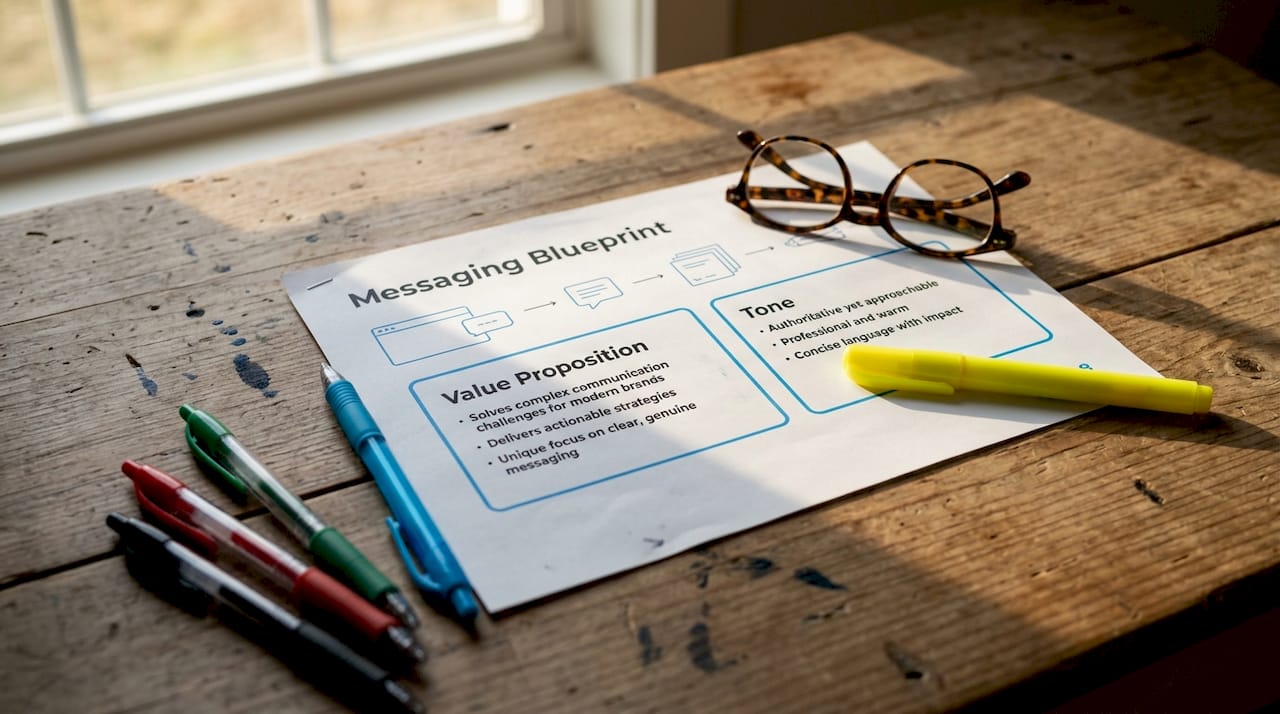
- Messaging is your strategic foundation. It defines your brand’s purpose, your audience’s core problems, your unique value proposition, and the tone you consistently use. Messaging doesn’t change with each campaign. It’s the single source of truth your team returns to repeatedly.
- Copywriting is the craft layer. It’s the sentence structure, the word choice, the psychological hooks, and the format decisions that make your strategic message land with a specific reader in a specific context.
- Message copywriting is what happens when you apply copywriting skill to your messaging strategy. It’s not freeform writing. It’s disciplined, purposeful text that translates strategic talking points into words that generate response.
Think of messaging as the architect’s blueprint and copywriting as the construction. An experienced copywriter working without a messaging strategy is essentially building without a plan. The results may look nice but they won’t hold up under scrutiny. Conversely, a brilliant messaging strategy left in a document serves no one. Connecting what a brand wants to say with how the audience needs to hear it is where real marketing leverage lives.
High-performing teams treat messaging as reusable assets covering value propositions, proof points, and tone. This prevents the all-too-common problem of copy that sounds like it came from three different companies across a single campaign.
Core principles for writing persuasive copy
Understanding message copywriting explained is one thing. Knowing how to apply it is another. These principles separate copy that fills space from copy that drives action.
-
Clarity above all else. Persuasive copy must adapt for skimming readers who make decisions in seconds. If your main point requires re-reading, you’ve already lost most of your audience. Write the way your reader thinks, not the way you want to sound.
-
Start with audience research. The most powerful copywriting technique is using your customer’s exact language. When your copy mirrors the audience’s inner monologue, it creates immediate recognition and trust. Mine review sites, sales call recordings, and support tickets for the specific phrases your buyers use to describe their problems.
-
Use a proven structure. The AIDA framework (Attention, Interest, Desire, Action) remains one of the most reliable structures for persuasive copy. It works because it maps to how people actually make decisions: first you get their attention, then you build interest and desire, then you make the action obvious and easy.
-
Adapt for each channel. A LinkedIn message, a landing page headline, and a text message are three completely different formats with different reader expectations and different stakes. Copywriting for marketing that drives action explicitly targets a specific behavior for each context. What works in a 1,200-word email sequence will fail as a display ad.
-
Anchor every piece of copy to a messaging pillar. Before publishing anything, ask: which core message does this support? If the answer is “none of them,” the copy probably shouldn’t exist. Scattered copy dilutes your brand presence and confuses buyers.
-
Proof elements close the gap. Claims without evidence invite skepticism. Testimonials, case study numbers, client logos, and specific results give your copy the weight it needs to convert skeptical readers.
Pro Tip: Write your messaging document before you brief any copywriter or write any copy yourself. It should include your core value proposition, three to five key messages, your target audience’s primary pain points in their own words, and your brand’s tone guidelines. Every piece of copy you create flows from this document.
SMS copywriting as message copy in action
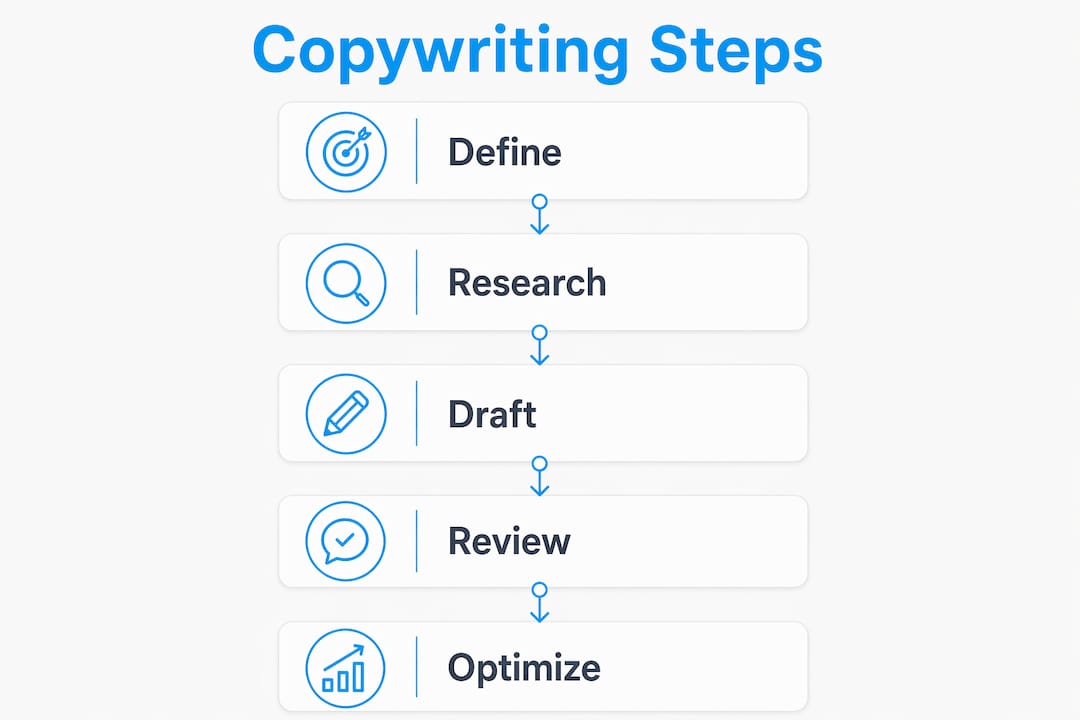
Nothing stress-tests your messaging clarity faster than SMS. SMS copywriting requires precision with short, impactful messages that inspire immediate action. You have fewer than 160 characters, a reader who is almost certainly distracted, and one shot to make the message land.
Here’s what effective SMS copy looks like in practice:
- Treat the first five words like a subject line. Best practice sits at 75 to 115 characters with the opening words acting as the inbox preview. If those words don’t earn the read, nothing else matters.
- One message, one idea, one CTA. Trying to communicate two offers or two actions in a single text is a reliable way to generate zero responses. Pick the single most urgent thing and say that.
- Write in a conversational tone. SMS lives in the same inbox as messages from your reader’s family and friends. Stiff, corporate language creates instant disconnect. Write the way a trusted contact would write, not the way a press release reads.
- Skip the jargon and abbreviations. Excessive abbreviations read as lazy. Jargon reads as inaccessible. Neither builds the trust required for someone to click or reply.
- Use line breaks for readability. A wall of text in an SMS is the fastest way to lose your reader. Short lines and white space make the message feel easier to process.
SMS is a perfect case study for what is persuasive writing at its most constrained: every word must earn its place, the structure must be clear, and the CTA must be obvious. If your team can write effective SMS copy, they understand message copywriting.
How message copy drives sales and direct response results
Here is where copywriting for marketing crosses directly into revenue generation. Direct response copywriting is a specific discipline within message copywriting where the copy is judged by its ability to generate immediate, measurable user actions. Clicks, calls, sign-ups, purchases. Not brand impressions over time. Results now.
The contrast with branding copy is sharp:
| Type | Goal | Measured by | Example |
|---|---|---|---|
| Brand copy | Build awareness and recognition over time | Recall, sentiment, share of voice | “We help ambitious businesses grow.” |
| Direct response copy | Prompt an immediate, specific action | Clicks, conversions, booked calls | “Book your free 20-minute strategy call today.” |
Cold emails focused on customer pain points and actionable CTAs typically run under 150 words. That constraint is a feature, not a limitation. It forces the writer to get to the point, which is exactly what a busy decision-maker needs from an outreach message. If you can’t articulate your value in 100 words, you haven’t defined your messaging clearly enough.
The elements of copywriting that matter most in direct response are specificity (numbers beat adjectives), relevance (speak to a real problem the reader has today), and a single unambiguous CTA. Generic lines like “Learn more” or “Click here” consistently underperform CTAs that name the outcome: “See how we booked 18 meetings in 30 days” or “Get your personalized outreach audit.”
Pro Tip: Before writing any direct response copy, write one sentence that finishes this prompt: “This reader will click because___.” If you can’t complete that sentence with a specific reason tied to a real audience problem, your copy isn’t ready to publish.
For B2B marketers specifically, proven LinkedIn copywriting strategies combine the discipline of direct response with the relationship tone that LinkedIn’s professional audience expects.
My take on what separates good copy from effective copy
I’ve reviewed hundreds of outreach sequences, landing pages, and email campaigns. The single most consistent difference between copy that converts and copy that just sits there is whether the writer started with strategy or started with a blank page.
Most people treat copywriting as a writing problem. It’s actually a thinking problem. The writing is the last 20% of the work. The first 80% is understanding what your audience genuinely wants, what they’re afraid of, and what specific language they use when they talk about both.
What I’ve found is that even experienced marketers confuse creative writing with effective message writing. They optimize for sentences that sound good in a team meeting rather than sentences that land with a skeptical reader at 7pm on a Tuesday. The copy that converts changes what a reader notices by using their language, proving claims, and addressing their objections directly.
The rise of AI writing tools makes this distinction more important, not less. AI can generate grammatically correct, tonally consistent copy in seconds. What it can’t do is know what your specific customers said on their last sales call or why your last campaign underperformed. That strategic layer, the messaging work, remains entirely human. Use AI to produce volume and test variations. Do not use it to skip the strategy.
My honest advice: treat your messaging document as a living asset that your whole team can access. Develop it before layout, before design, before any copy is written. Building messaging hierarchy before layout consistently reduces expensive redesigns and keeps campaigns aligned.
— Toby
Let Theleadlab write copy that actually converts
If you’ve read this far, you understand that effective message copywriting requires more than good writing. It requires a clear strategy, audience insight, and channel-specific execution working together.
Theleadlab specializes in exactly that combination for professional services firms and B2B businesses. From personalized LinkedIn outreach sequences to full campaign messaging frameworks, the team builds copy designed to generate qualified conversations, not just impressions. Explore The Lead Lab’s client work to see how strategic messaging translates into measurable results, or visit Theleadlab directly to discuss a done-for-you outreach campaign built around your business’s specific message.
FAQ
What is message copywriting in simple terms?
Message copywriting is the process of translating a brand’s strategic messaging framework into persuasive, channel-specific text that drives reader action. It combines messaging strategy with copywriting craft to produce headlines, emails, CTAs, and outreach sequences.
How is messaging different from copywriting?
Messaging is the strategic foundation covering your value proposition, audience needs, and brand tone. Copywriting is the execution layer that turns those strategic points into words your audience actually reads and responds to.
What makes copywriting persuasive?
Persuasive copy uses clarity, audience-specific language, proof elements, and a single clear call to action. Structuring copy with frameworks like AIDA (Attention, Interest, Desire, Action) guides the reader through a logical sequence that builds desire and makes action feel obvious.
How long should direct response copy be?
Length depends entirely on the channel and the ask. Cold emails typically perform best under 150 words. SMS works within 75 to 115 characters. Landing pages can run longer when the purchase decision is complex, but every sentence must advance the argument toward the CTA.
Why does message copywriting matter for B2B businesses?
In B2B outreach, copy is often the first impression a decision-maker receives from your business. Copy that speaks directly to a real problem, mirrors the reader’s language, and makes the next step obvious is what converts a cold prospect into a booked meeting.