
TL;DR:
- Effective B2B thought leadership requires disciplined, specific insights on high-value problems to influence decision-makers over time. Success hinges on integrating content creation with sales, legal, and measurement functions, not just producing high-quality material. Building authority through consistent, contrarian positions and targeted distribution shortens sales cycles and shapes buyer preference.
Most B2B marketers treat thought leadership as a branding exercise. Write a few LinkedIn posts, publish a white paper, call it done. The data tells a completely different story. 71% of B2B decision-makers say thought leadership in B2B outperforms traditional marketing for persuasion, and the influence extends well beyond the people you can actually reach through sales outreach. When executed with discipline, thought leadership is one of the few B2B content marketing assets that compounds over time and actively shortens sales cycles. This guide explains exactly how to build one that does.
Table of Contents
- Key takeaways
- What thought leadership in B2B actually means
- Why most B2B thought leadership efforts fail
- Core pillars of a thought leadership program that works
- Measuring thought leadership’s commercial impact
- Building or improving your strategy step by step
- My honest take on why this keeps getting done wrong
- Take your thought leadership further with Theleadlab
- FAQ
Key takeaways
| Point | Details |
|---|---|
| Thought leadership beats traditional ads | 71% of B2B decision-makers find it more persuasive than conventional B2B marketing formats. |
| Hidden buyers are your real audience | 79% of hidden decision-makers advocate for vendors with consistent, high-quality thought leadership. |
| Most programs fail operationally | Poor internal design, weak rights management, and missing measurement are the real killers, not content quality. |
| Sharp points of view win | Evidence-backed, contrarian positions outperform broad industry commentary every time. |
| Measurement must match long cycles | Attribution windows must reflect B2B buying reality, not monthly campaign reports. |
What thought leadership in B2B actually means
The term gets used to describe almost anything. Blog posts, LinkedIn carousels, keynote recaps, and recycled industry news all get filed under thought leadership. None of that is what we are talking about here.
True B2B thought leadership is the disciplined, consistent demonstration of a distinct and defensible point of view on a problem your buyers care about solving. It is not generic content marketing dressed up in expert language. The difference is specificity and courage. Generic content says “here are trends in supply chain.” Thought leadership says “the conventional approach to supply chain resilience is creating a different kind of risk most CFOs haven’t priced in yet” and then proves it with data.
Why does this matter more in 2026 than it did five years ago? A few reasons:
- AI-saturated search: AI tools prioritize original human insights over rephrased content. If your thought leadership does not contain genuine information gain, it will not be recommended or cited.
- Longer buying cycles: More stakeholders, more scrutiny, and more internal debate mean buyers need confidence-building content long before they engage sales.
- The 95:5 reality: 95% of B2B buyers are not actively in the market at any given time. Thought leadership is how you shape their preference before they are ready to buy.
- Hidden decision-makers: 79% of hidden decision-makers advocate for vendors whose content they have consumed, even with zero direct sales contact.
Executive thought leadership also functions as a risk reducer. When a procurement committee is evaluating two comparable vendors, the one whose executives have consistently published well-reasoned B2B industry insights carries an implied credibility that shortens the due diligence process considerably.
Why most B2B thought leadership efforts fail
The failure is almost never about talent. The writers are capable. The subject matter experts have genuine knowledge. The content is technically accurate. So why does most of it fail to move the needle?
The biggest bottleneck is internal operational design. Most programs are treated as a content function, not a shared business function connecting demand generation, legal, sales, and revenue operations. That means the content gets created but never properly amplified, measured, or protected.
Here are the most common failure patterns:
- Mistaking activity for impact. Publishing frequency is not a strategy. A company posting five mediocre LinkedIn updates a week is generating noise, not authority.
- No clear point of view. Thought leadership anchored in a high-cost belief about a market challenge outperforms broad, safe industry commentary. If your content would not upset anyone, it is not sharp enough.
- Weak rights management. When executives create content on behalf of the firm and those rights are not properly contracted, scaling that content becomes a legal and operational headache.
- No measurement framework. Most teams track likes and downloads. Neither tells you whether your thought leadership is accelerating pipeline or warming decision-makers who will never respond to a cold email.
- 55% of B2B buyers abandon content within the first minute if it does not engage immediately. Poor structure and weak openings kill programs before the ideas even land.
Pro Tip: Before you publish another piece of thought leadership, ask: “Would someone share this because it changed how they think about a problem?” If the honest answer is no, it needs a sharper argument or more specific evidence.
Core pillars of a thought leadership program that works
Building brand authority through thought leadership is not a single campaign. It is a program with repeatable operating principles. Here is what separates programs that compound over time from those that stall after a quarter.
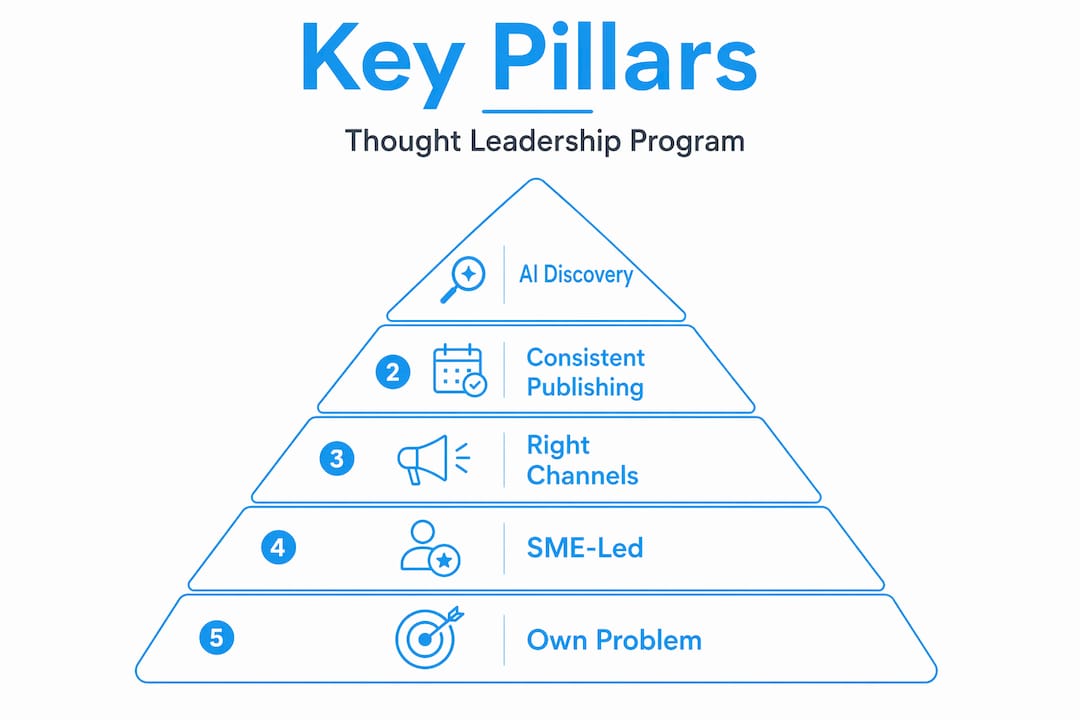
1. Own a specific, high-cost problem
True authority comes from owning a distinct, high-cost problem with a contrarian, evidence-backed perspective. Not “digital transformation.” Not “the future of work.” Something specific enough that buyers facing that problem recognize themselves immediately.
2. Make it SME-led, not brand-led
Buyers trust people more than logos. Shifting content creation to visible subject matter experts within your firm builds deeper credibility, particularly with complex buying committees. SME-led authority consistently outperforms brand-led content in professional services contexts.

3. Distribute through the right channels
Here is a practical framework for content distribution that many B2B marketing best practices guides skip:
| Channel | Best use | Frequency |
|---|---|---|
| LinkedIn (personal profiles) | SME visibility, direct buyer reach | 3-5x per week |
| Long-form articles and guides | Deep authority building, AI discovery | 2-4x per month |
| Email newsletter | Nurturing non-active buyers | Weekly or biweekly |
| Podcast or video series | Trust building with decision-makers | Biweekly |
| Partner and media placements | Third-party credibility | Monthly |
4. Publish consistently enough to compound
Sustained, consistent publishing builds cumulative authority in ways that sporadic campaign bursts simply cannot replicate. The analogy that holds is compound interest: the returns look small at first and then become self-reinforcing. Missing three months to refresh the strategy resets more of that compound effect than most teams realize.
5. Structure content for AI discovery
Clear headings, evidence-based claims, and direct expert positions increase the likelihood that AI search tools recommend your content. In 2026, optimizing for AI citation is as important as optimizing for Google rankings, and the requirements are actually similar: original insight, clear structure, and specific claims over vague generalities.
Pro Tip: Write a one-sentence summary of your core argument at the top of every piece. It forces clarity for you and signals the main position to AI summarization tools that pull that opening framing first.
Measuring thought leadership’s commercial impact
Vanity metrics are the graveyard of otherwise good programs. Impressions, followers, and content downloads feel meaningful but they do not tell you whether your thought leadership is doing anything to revenue. Here is what to track instead:
- Pipeline velocity: Are deals moving faster when prospects have engaged with thought leadership content? Sales teams can flag this in CRM notes, but measurement frameworks must reflect long B2B buying cycles with attribution windows that stretch six to twelve months.
- Brand search growth: Are more people searching your firm’s name or your key executives directly? This is one of the clearest signals that thought leadership is generating pull rather than push.
- Content-assisted pipeline: Tag thought leadership content in your CRM and track which deals involved at least one content touchpoint. Even if you cannot prove causation, the correlation data is persuasive internally.
- Share of voice: Are your executives being cited, quoted, or referenced in third-party publications, podcasts, or analyst reports? Connecting influence to revenue requires tracking these signals alongside deal data.
- Sales cycle length: Compare average cycle length for inbound leads who engaged with thought leadership versus cold outbound leads. The difference is often significant enough to justify the entire program budget.
The honest reality is that attribution in B2B is always imperfect. Thought leadership shapes the preferences of people who will never click a trackable link. The goal of measurement is directional confidence, not exact attribution.
Building or improving your strategy step by step
Knowing what good looks like is one thing. Here is a practical sequence for getting your program from concept to execution.
- Identify your contrarian point of view. What does your firm believe about a major buyer challenge that the market gets wrong? Push past the obvious and find the position that creates productive tension.
- Map high-intent buyer questions. Use tools like your sales team’s call recordings, search data, and customer interviews to find the exact problems your buyers are trying to solve six to twelve months before a purchase decision.
- Create evidence-backed content with clear framing. Lead with the argument. Support it with data, client experience, or original research. Use strategic messaging principles to ensure the content resonates with the specific pain points your prospects face.
- Design your amplification plan before you publish. Decide where each piece lives, who will share it, and through which channels, before it is written. Distribution planned after creation is always underpowered.
- Align legal and internal stakeholders early. Lock down usage rights for executive content, get brand and compliance sign-off on any data claims, and clarify who owns the IP. This sounds dry but it is what allows you to scale.
- Review and iterate quarterly. Which content drove the most qualified engagement? Which formats generated sales conversations? Adjust the point of view, format mix, and distribution based on what the data shows, not internal opinions.
Understanding how to segment prospects by intent makes the mapping step significantly faster because you are writing for defined segments with defined pressures rather than a generic buyer persona.
My honest take on why this keeps getting done wrong
I have seen a lot of B2B firms invest real budget into thought leadership and then quietly abandon it after two quarters because they could not demonstrate ROI. Almost every time, the problem was not the content. It was the internal design.
The programs that fail usually share one structural flaw: they are run by a content team that does not have access to sales data, does not have legal aligned on usage rights, and is being measured on publishing output rather than commercial influence. The content itself is often decent. The operating model around it is broken.
What I have learned is that the sharpest programs treat thought leadership as a shared operational layer, not a marketing sideshow. That means sales leaders are involved in defining the point of view. Revenue operations sets the attribution framework. Legal is briefed on creator agreements before the first piece goes live. When those pieces connect, the program starts working. When they do not, you get polished content that disappears into the void.
The other thing I would push back on: the idea that broad topics build broader audiences. They do not. The more specific and committed your position, the more clearly you signal expertise to the buyers who care about that exact problem. Specificity is the mechanism of trust.
— Toby
Take your thought leadership further with Theleadlab
If you are ready to convert thought leadership into a real pipeline driver, Theleadlab works with professional services firms to do exactly that.
Theleadlab’s done-for-you campaigns combine strategic messaging, targeted LinkedIn outreach, and content amplification to get your firm in front of the right buyers at the right time. Whether you need to sharpen the positioning behind your content, build a distribution system that actually reaches decision-makers, or connect your thought leadership activity to qualified meetings, the team at Theleadlab has the operational experience to make it work. Explore the client results to see how firms like yours have turned authority content into booked conversations, or visit Theleadlab to start a conversation about your program.
FAQ
What is thought leadership in B2B?
Thought leadership in B2B is the disciplined, consistent expression of a distinct and evidence-backed point of view on a problem your buyers care about. It differs from generic content marketing by committing to a specific, often contrarian argument rather than summarizing industry news.
Why does thought leadership matter for B2B buying decisions?
It builds trust and preference with buyers before they engage sales. 79% of hidden decision-makers advocate for vendors they have consumed thought leadership from, even without direct sales contact.
How do you measure the ROI of thought leadership?
Track pipeline velocity, brand search growth, content-assisted pipeline in your CRM, and sales cycle length for inbound versus outbound leads. Use attribution windows that match the length of your actual buying cycles, typically six to twelve months.
How often should B2B companies publish thought leadership?
Consistency matters more than volume. A clear publishing cadence you can sustain across channels builds cumulative authority. Sporadic bursts followed by silence erode the trust that consistent presence builds.
What makes a thought leadership strategy fail?
Poor internal operational design is the primary cause, including lack of measurement frameworks, unclear rights management, and no alignment between marketing, sales, and legal. Content quality is rarely the core issue.
The point about hidden decision-makers resonates deeply. We’ve seen the same pattern play out repeatedly — the stakeholder who advocates for your solution internally often discovered your content months before any sales touch. LinkedIn is where that discovery happens for most B2B teams, and the data on its outsized conversion performance surprised us when we first pulled our own numbers.