
Inbound leads come to you because someone found your content, your site, or a referral and raised their hand. Outbound leads come from you reaching out first, cold, to people who fit your ideal customer profile but haven’t shown intent yet. If you need pipeline fast or you’re selling into a narrow, high-value account list, lean outbound. If search demand already exists for what you sell and you can wait 60 to 180 days to compound it, lean inbound. Most teams that scale past their first few million in revenue run both, using The Lead Lab’s core discipline: routing signals between the two motions instead of picking a side.
TL;DR:
- Outbound lead generation offers faster results and better control but usually costs about 39% more per lead and faces higher rejection rates.
- Inbound channels like SEO and referrals take 60 to 180 days to stabilize lead flow but deliver lower-cost, higher-intent prospects over time.
- Combining inbound and outbound creates a more efficient pipeline by routing signals between channels and matching outreach to buyer behavior.
- Outbound is ideal for high-value, urgent, or niche accounts, while inbound suits broad markets with existing search demand and long-term brand growth.
- Running both motions as a connected system with shared KPIs and target accounts maximizes pipeline growth while managing costs and rejection risks.
Table of Contents
- What Is Inbound Lead Generation?
- What Is Outbound Lead Generation?
- Inbound vs Outbound: A Side-by-Side Comparison
- Weighing the Tradeoffs: Pros, Cons, and Fixes
- How to Choose: A Practical Decision Checklist
- Running Inbound and Outbound Together
- What an Agency-Run Hybrid Motion Actually Looks Like
- The Real Question Isn’t Inbound vs Outbound
- Get a Done-For-You Outbound Motion Running in Weeks
- Sources
What Is Inbound Lead Generation?
Inbound lead generation is when a prospect initiates contact after discovering your business through content, search results, social media, or a referral. Nobody called them. They found a blog post, downloaded a guide, or asked a colleague who to talk to, and now they’re in your funnel on their own terms. That shift in initiative changes everything about how the lead behaves once you’re in touch with them.
The buyer state matters more than people realize. An inbound lead has usually already self-educated on the problem and sometimes on the category of solution before they ever fill out a form. That’s why inbound sales tends to run more cost-efficient per lead, even though it takes longer to build the machine that produces those leads.
Common inbound channels include:
- SEO-driven blog content and resource libraries
- Organic social posts and LinkedIn thought leadership
- Referrals and word-of-mouth from existing clients
- Webinars and gated guides that capture contact details
- Paid search ads, which function as demand capture rather than demand creation
Timelines vary sharply by channel. Organic SEO and content typically need 60 to 180 days before they produce a steady lead flow, since search engines need time to trust and rank new pages. Paid search, by contrast, can generate leads within days of launching a campaign, because you’re buying visibility instead of earning it.
The metrics that matter here are cost per lead (CPL), conversion rate from visitor to lead, and time to sales-qualified lead (SQL). Track these separately by channel. A blog post that ranks well might produce a low CPL but a slow trickle, while a paid search campaign might cost more per click but convert faster once someone lands on your page. Comparison guides, case studies, and detailed pricing pages tend to convert inbound traffic at the highest rate, because they answer the exact question a self-educated buyer is already asking. Building scalable lead generation around these assets means you’re not starting from zero every quarter.
What Is Outbound Lead Generation?
Outbound lead generation flips the initiative: you identify a target account or contact and reach out before they’ve shown any interest in your product. Outbound sales is proactive outreach built to create demand where none currently exists, rather than capture demand that’s already there.
The prospect hasn’t Googled your category yet. They might not even know they have the problem you solve. That’s precisely why outbound works so well for reaching decision-makers who never would have found you through content, especially in industries with small buyer pools or long sales cycles where waiting for inbound interest simply costs too much time.
Modern outbound channels include:
- Cold email sequences with personalized first lines
- LinkedIn outreach, including connection requests and direct messaging
- SDR-led cold calling, often layered on top of email touches
- Account-based marketing (ABM) ads targeted at named accounts
- In-person or virtual events aimed at a specific buyer list
The tradeoff is cost and rejection tolerance. Outbound gives you speed and direct access to decision-makers, but it usually costs more per lead than inbound and comes with a much higher rate of no-response or outright rejection. Once your prospect list and messaging infrastructure are in place, though, outbound can produce meetings within days, not months.
Running outbound well takes real operational discipline: clean, verified contact data, message copy that references something specific about the prospect’s role or company, and a cadence that spaces touches across email, LinkedIn, and phone without overwhelming anyone. Spray-and-pray outbound now underperforms and actively damages deliverability, so precision beats volume every time.

Inbound vs Outbound: A Side-by-Side Comparison
Here’s how the two motions stack up across the dimensions that actually affect your planning.
| Dimension | Inbound | Outbound |
|---|---|---|
| Who initiates contact | Prospect | Seller |
| Typical channels | SEO, content, organic social, referrals, paid search | Cold email, LinkedIn outreach, SDR calls, ABM ads, events |
| Time to first lead | 60 to 180 days organic; days for paid search | Days, once list and messaging infrastructure are ready |
| Cost shape | Lower cost per lead, but requires upfront content investment | Higher cost per lead, concentrated in outreach labor and tools |
| Lead intent/quality | Higher self-selected intent, pre-educated | Variable intent; requires more qualification before it’s sales-ready |
| Best use cases | Broad market with existing search demand, long-term brand building | Enterprise or niche accounts, urgent pipeline needs, new market entry |
Outbound wins on speed and account precision. If you need five meetings with VPs at a specific list of 200 companies next month, no amount of blog content gets you there in time. Inbound wins on efficiency at scale, because once an asset ranks or a referral engine is running, it keeps producing leads with minimal marginal cost.
Measurement differs accordingly. For inbound, track organic traffic growth, form conversion rate, and CPL trends over time. For outbound, track reply rate, meetings booked, and speed-to-contact against your SLA. Combining both under a shared account score keeps sales and marketing looking at the same picture instead of arguing over which channel gets credit.
Weighing the Tradeoffs: Pros, Cons, and Fixes
Neither motion is free of friction. Knowing the specific failure mode ahead of time is what separates teams that get stuck from teams that adjust.
Inbound pros: compounding returns over time, lower cost per lead once assets rank, and built-in trust since the prospect came to you.
Inbound cons: slow ramp, heavy upfront content production, and vulnerability to search algorithm shifts.
Outbound pros: fast pipeline, direct access to decision-makers who’d never find you organically, full control over who you target.
Outbound cons: higher CPL, deliverability risk from poor list hygiene, and higher rejection volume that can wear down a team without the right mindset.
Mitigations exist for both. A/B test subject lines and landing page copy relentlessly. Keep sender reputation clean with warmed-up domains and verified data. Repurpose one strong piece of inbound content into three or four outbound talking points instead of writing everything from scratch.
Pro Tip: *The single most common outbound failure isn’t bad copy, it’s bad data.
How to Choose: A Practical Decision Checklist
Run through this checklist before you commit budget to either motion:
- Total addressable market (TAM) size. Small, well-defined TAM favors outbound precision. Large, fragmented TAM favors inbound scale.
- Average contract value (ACV). High ACV justifies the labor cost of outbound outreach per lead. Low ACV needs inbound’s cheaper unit economics.
- Existing search demand. If buyers are already Googling your category, inbound content has something to capture. If they’re not, outbound has to create the conversation.
- Runway. Teams with 12+ months before they need revenue can invest in inbound’s slow build. Teams needing pipeline in 90 days need outbound now.
- Team capacity. Outbound needs SDR hours and copywriting discipline. Inbound needs content production and SEO patience.
- Follow-up SLA. Neither motion works without a fast, consistent response process once a lead engages.
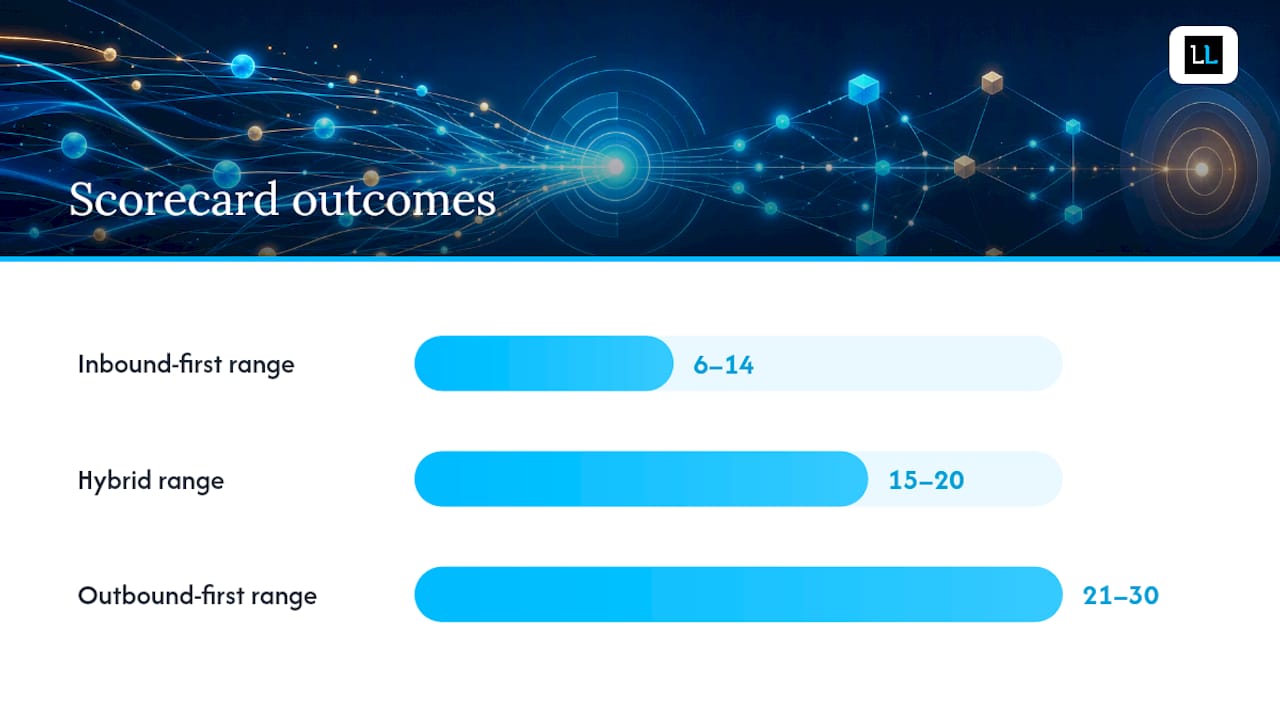
A simple scoring method: rate each of the six criteria 1 to 5 based on how strongly it points toward outbound (5) or inbound (1), then sum the scores. A total above 20 suggests an outbound-first motion. Below 15 suggests inbound-first. In between, you’re a hybrid candidate by default, which is where most B2B services firms actually land.
Watch for red flags regardless of which way you lean: unverified or purchased contact data, no defined SLA for lead follow-up, and total dependence on a single channel with no backup plan. A firm we’ll call a mid-market consultancy scored a 22, small TAM, high ACV, tight runway, so outbound-first with inbound content built in parallel was the right call, not a coin flip between the two.
Understanding what makes a lead qualified before you build this scorecard saves you from optimizing for volume when quality was the actual goal.
Running Inbound and Outbound Together
The teams that get the most out of both motions treat them as one connected system rather than two separate departments competing for credit. Here’s the sequence that works:
- Define your target account list first. Build routing rules so both inbound and outbound touches map to the same accounts, not separate universes.
- Use visitor identification and intent signals as outbound triggers. When a target account visits your pricing page or downloads a guide, that behavior should automatically queue an outbound touch from an SDR within 24 hours.
- Set a speed-to-contact SLA. Five minutes is aggressive but ideal for inbound demo requests. For MQL-to-SDR handoff, 24 hours is the outer limit before conversion rates drop sharply.
- Build a sample play sequence. A prospect downloads a comparison guide (inbound), gets a personalized LinkedIn message referencing that specific guide within a day (outbound), then receives a case study relevant to their industry three days later.
- Track shared KPIs. Meetings booked, opportunity creation rate, and blended CPL across both motions, not siloed dashboards that make one channel look better by ignoring the other’s contribution.
Cost differences between the two are real and worth planning around: outbound leads can cost roughly 39% more than inbound leads in some industry comparisons, though the gap narrows considerably once you’re using inbound signals to make outbound outreach sharper and less wasteful. That’s the whole point of routing: outbound stops being a cold guess and starts being an informed follow-up.
What an Agency-Run Hybrid Motion Actually Looks Like
Running this system in-house takes a dedicated ops person, a data provider, and enough SDR bandwidth to keep cadences moving without gaps. The Lead Lab builds this as a managed LinkedIn outreach model: prospect targeting based on firmographic and role criteria, personalized message copywriting, automated sequencing, and human response management once replies start coming in.
For professional services firms specifically, that structure tends to produce a working outbound motion within the first few weeks, with campaign analytics showing reply rates and booked meetings as the primary output metric rather than vanity impressions.
If you’re evaluating any agency for this kind of work, check for:
- A defined process for personalizing outreach at scale, not templated blasts
- Transparent reporting on reply rate and meetings booked, not just messages sent
- A clear SLA for how fast responses get handled after a prospect replies
- Evidence of past results across similar account sizes and industries
The Real Question Isn’t Inbound vs Outbound
Most teams waste months debating which motion is “better” when the better question is which one matches where their buyer already is. Test both in parallel where budget allows, measure them on their own timelines instead of comparing week-four outbound numbers to month-six inbound numbers, and route the signals between them instead of running two disconnected departments. If you’re unsure where to start, audit your existing search demand this week, then run a focused four-week outbound pilot against a tightly defined account list. The data from that one pilot will tell you more than any framework.
— Toby
Get a Done-For-You Outbound Motion Running in Weeks
The Lead Lab is the alternative to building an in-house SDR team for firms that need outbound pipeline without hiring, training, or managing that function themselves. Instead of spending months assembling a prospect database, writing cadences, and hoping your open rates hold up, you get a campaign built around verified LinkedIn targeting and personalized copy from week one, with a fixed monthly price instead of a growing headcount line.
The service covers prospect targeting, message copywriting, automated scaling, and response management, all reported through campaign analytics so you can see reply rates and booked meetings, not just activity volume. Real outcomes from past campaigns are documented in the portfolio, showing what qualified meeting flow actually looks like for professional services firms running this model. If your team scored outbound-first (or hybrid) on the checklist above, visit The Lead Lab to book a consultation and see what a four-week pilot could look like for your specific account list.
Sources
- Inbound vs Outbound Sales: What’s the Difference and When Do You Use Them? (Pipeline/ZoomInfo)
- Inbound vs Outbound Lead Generation: Complete Guide 2026 (Abmatic AI)
- What is lead generation (Search Engine Land)
- Outbound marketing explainer (Mailchimp)