Lead with a recent, verifiable signal, not your pitch. A message that opens with “I saw you just posted about X” or “Congrats on the new VP role” outperforms a generic template because it proves you did five seconds of homework before hitting send. That single habit separates messages that get ignored from ones that get answered.
Here are four starters you can copy right now, organized by goal:
- Sales prospecting (send right after connecting): “Saw [Company] is hiring three [role] positions this quarter. Curious what’s driving the expansion. Are you the right person to talk to about how teams like yours usually solve [specific pain point]?”
- Job or hiring outreach (send via InMail to a hiring manager): “Noticed the [Company] posting for [role] closed applications but the team seems to still be growing. I’ve spent [X years] doing exactly that work. Worth a 10-minute conversation?”
- Networking (send after they engage with your post): “Thanks for the comment on my post about [topic]. Your take on [specific point they made] stuck with me. Would love to hear how you’re handling that at [Company].”
- Advice or informational outreach (send as a connection note): “Following your posts on [topic] for a while. I’m working through [specific challenge] and would value 15 minutes of your perspective if you have it.”
Use the first two after a fresh trigger event (a job posting, a hire, a funding round). Use the third within 24 hours of a post interaction, while the topic is still warm. Use the fourth cold, but only when you can name something specific from their content history.
Key Takeaways
Signal-first personalization, not message volume, is what separates LinkedIn cold outreach that gets replies from outreach that gets ignored.
| Point | Details |
|---|---|
| Lead with a signal | Reference a specific post, hire, or funding event in the first line, not a generic greeting. |
| Keep it short | First messages run 50 to 125 words; connection notes stay under 200 characters. |
| Personalize connection notes | Notes lift acceptance substantially versus 15% for blank requests. |
| Build a real follow-up sequence | Use 2 to 3 touches with new value each time, then send a breakup message and stop. |
| Outsource when targeting is clear | The Lead Lab runs signal-based prospecting, copywriting, and appointment setting for firms with a defined ideal client. |
Table of Contents
- LinkedIn Cold Message Examples By Use Case
- What Makes a LinkedIn Cold Message Get a Reply
- How to Structure a LinkedIn Follow-Up Sequence
- Why Signal-First Outreach Beats Blasting a List
- Sources
LinkedIn Cold Message Examples By Use Case
Generic templates fail because they’re built to be reused a thousand times without edits. The ones below work because each has exactly one blank you fill with something true about the person you’re messaging. Swap the bracketed token, keep everything else, and you’ve got a message that reads like it took you three minutes instead of three seconds.
Sales prospecting
Send these as InMail or as your first message right after a connection accepts. Keep the note itself under 200 characters and save the pitch for message two.
- Connection note: “Hi [Name], saw [Company] just [signal: raised a round / opened a new office / posted a job for X]. Would like to connect and share how we’ve helped similar [industry] teams.”
- First message (post-connect): “Thanks for connecting. Noticed [Company] is scaling [department/function]. We work with [industry] firms on exactly that bottleneck. Open to a quick chat on what’s working and what’s not for you right now?”
- Signal: job posting. “Saw the opening for [role] on your team. Usually that means [related pain point] is on your radar too. We’ve helped a few firms in [industry] fix that without adding headcount. Worth 15 minutes?”
- Signal: recent funding. “Congrats on the [round name] raise. Teams at this stage usually hit [specific operational pain] around month three or four. Happy to share what’s worked for others in your position, no pitch attached.”
- Signal: competitor mention in a post. “Read your take on [competitor/industry trend]. We’ve seen similar shifts play out with [industry] clients. Curious how you’re thinking about [specific angle] internally.”
Personalization line to swap: replace “[specific operational pain]” with the actual function they’re hiring for. A recruiter posting three sales roles is telling you their pain point is sales capacity, not marketing.
Hiring and job outreach
These work whether you’re a recruiter sourcing candidates or a job seeker reaching a hiring manager directly. Keep them shorter than sales messages. Nobody wants a sales pitch about their own career.
- To a candidate (recruiter): “Hi [Name], your background in [specific skill] caught my eye, especially the work on [specific project from their profile]. We have a [role] open at [Company] that lines up closely. Open to a short conversation?”
- To a hiring manager (job seeker): “Saw [Company] posted for [role]. I’ve done [specific relevant work] for [X years], most recently [one concrete result]. Happy to send more detail if useful.”
- Referencing a mutual connection: “[Mutual connection]’s name came up when I was researching [Company]’s [team/department]. I’m exploring opportunities in [field] and would value even 10 minutes of your perspective on the team.”
- Passive candidate outreach: “Not sure if you’re looking, but your work on [specific achievement] is exactly the kind of experience we need for a [role] we’re building out. No pressure, just wanted to flag it in case the timing’s right.”
For recruiter-to-client communication once a candidate moves forward, the tone shifts toward transparency and expectation-setting. A useful reference for that handoff comes from recruitment agencies that document client communication standards, which applies just as well to how you brief a hiring manager after an initial LinkedIn conversation.
Partnership outreach
Partnership messages need one more ingredient than sales messages: proof the collaboration benefits both sides, not just you.
- “Noticed [Company] serves [audience type] and we work with [complementary audience]. There might be a natural overlap worth a quick conversation about.”
- “Your recent post on [topic] lines up with something we’re building for [related use case]. Open to trading notes?”
- “We’ve referred a few clients to firms doing [their specialty] and it’s worked well both directions. Would you be open to a short call to see if there’s a fit?”
Networking
Networking messages skip the CTA almost entirely. The goal is a conversation, not a conversion.
- “Enjoyed your post on [topic], particularly the point about [specific detail]. I’ve been thinking about the same problem from a [different angle]. Would love to compare notes sometime.”
- “We’re both in [industry/niche] and I don’t think we’ve connected yet. Following your content on [topic] for a while now.”
- “Saw you spoke at [event]. Wish I’d caught it live. Any chance you’d share the key takeaway for someone who missed it?”
Event and post-engagement follow-up
This is the highest-intent category because the prospect already showed interest before you said a word. Signal-first templates that reference a specific post or event consistently beat cold openers, and the window to act is short.
- After they liked or commented on your post: “Thanks for engaging with my post on [topic]. Curious what your experience has been with [related challenge] at [Company]?”
- After meeting at an event: “Good talking at [event]. You mentioned [specific detail they said]. Wanted to follow up and see if it’s still something you’re working through.”
- After they attended a webinar you hosted: “Thanks for joining the session on [topic]. Was there a part that was most relevant to what you’re dealing with right now?”
Pro Tip: Send post-engagement messages within 24 hours. Interest fades fast on LinkedIn, and a message that references a post from two weeks ago reads as an afterthought instead of a reaction.
What Makes a LinkedIn Cold Message Get a Reply
Every high-performing message follows the same three-part shape: a signal-based opener, a one-line bridge that shows relevance, and a single low-friction call to action. Skip any one of the three and reply rates drop.
The opener should reference something specific and recent: a post, a hire, a funding announcement, a job change. Never open with “I came across your profile” or “I hope this finds you well.” Those phrases signal a template, and prospects skim past them instantly.
The bridge connects the signal to a reason you’re reaching out, in one sentence. “That kind of growth usually means X is becoming a priority” does more work than three sentences explaining your service.
The call to action should require almost no effort to answer. “Worth a quick chat?” beats “Can we schedule 30 minutes next Tuesday to discuss a proposal?” The lower the friction, the higher the response.
Length matters more than most people think. Recommended guidance puts first messages at 50 to 125 words, with connection notes staying under 200 characters, ideally closer to 100 for readability on mobile. Follow-ups should run shorter still, 40 to 75 words, since the prospect already has context from your first touch.
By the numbers: Personalized connection requests see substantially higher acceptance than generic ones. That gap alone explains why a two-minute customization step is worth the friction.
Do this before you send anything:
- Check their profile for a recent post, job change, or shared connection you can reference by name.
- Confirm their current title and company; nothing kills credibility faster than addressing an outdated role.
- Keep the message to one clear ask. Two questions in a cold message usually gets zero answers.
Avoid these mistakes:
- Opening with a merge-field greeting that obviously wasn’t customized (“Hi [First Name], I noticed your impressive background”).
- Pitching your product or service in the very first message before any rapport exists.
- Sending a connection request with zero note attached to a cold prospect. It works fine for warm, mutual-network requests; it rarely works for strangers.
- Using the same template on every prospect in a list without adjusting at least one line.
A checklist built specifically for LinkedIn prospecting covers the pre-send steps in more depth if you want a repeatable process rather than a mental checklist each time.
How to Structure a LinkedIn Follow-Up Sequence
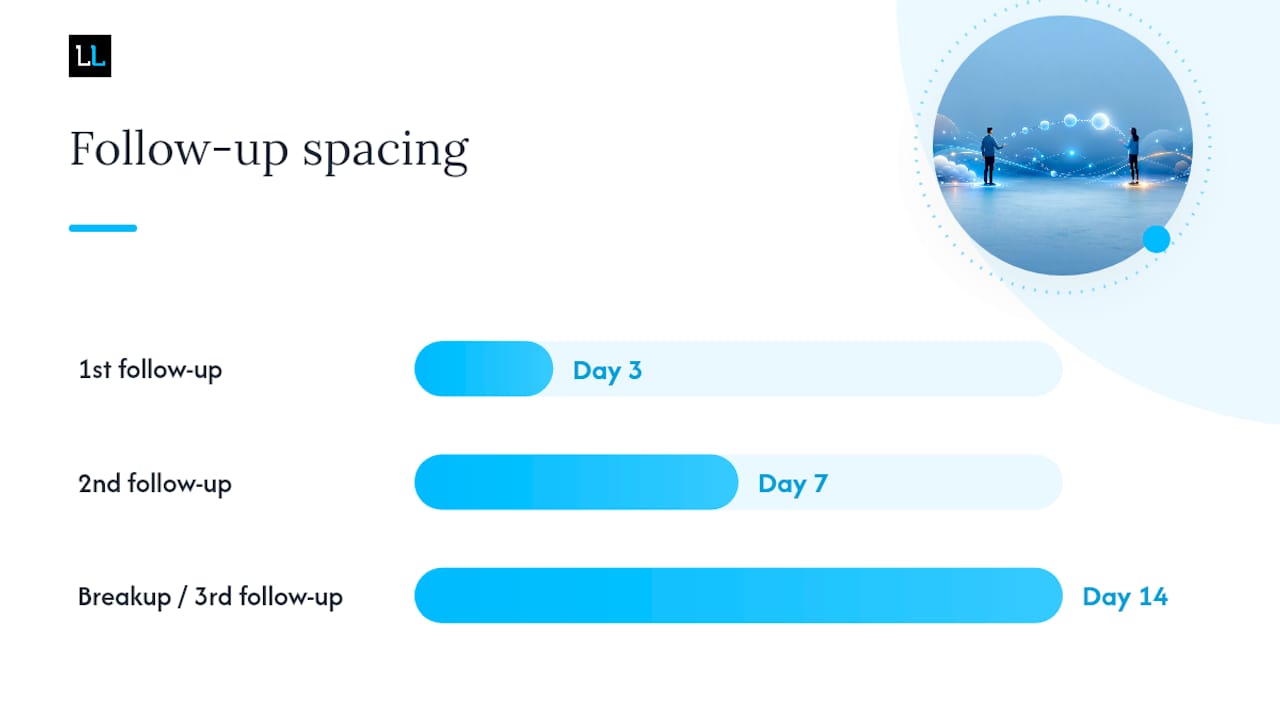
Two follow-up sequences cover almost every situation: the short reframe for prospects who saw your message but didn’t respond, and the value-first follow-up for higher-value targets worth more patience.
Short reframe sequence (for volume outreach):
- Day 3: “Following up in case this got buried. Still curious whether [specific pain point] is on your radar this quarter.”
- Day 7: “One more try. If the timing’s off, no worries. Happy to check back in a few months instead.”
- Day 14 (breakup message): “I’ll leave this here so I’m not cluttering your inbox. If [pain point] becomes relevant later, feel free to reach back out.”
Value-first sequence (for high-priority targets):
- Day 3: “Wanted to share this in case it’s useful, even if the timing isn’t right for a chat: [relevant article, stat, or resource].”
- Day 7: “Circling back with one more thought. We recently helped a [similar company type] solve [specific problem] in about [timeframe]. Happy to share how if useful.”
- Day 14: “Last note from me. If priorities shift, my door’s open. Wishing you luck with [specific thing they mentioned].”
Each touch needs a distinct purpose. Follow-ups that repeat the same ask without adding new information consistently underperform compared to sequences where each message brings something the prospect hasn’t seen yet, whether that’s a data point, a resource, or a sharper angle on the original ask.
Pro Tip: A breakup message often outperforms a third generic follow-up because it removes pressure. Prospects reply to “I’ll stop reaching out” far more often than to “just checking in again.”
Stop the sequence after three touches with zero response. Beyond that point, you’re not persisting, you’re spamming, and it shows up in acceptance rates for your future outreach. For a broader look at pacing multi-touch outreach beyond LinkedIn specifically, general follow-up strategy for stalled conversations applies the same logic to sales cycles that stretch across channels.
Why Signal-First Outreach Beats Blasting a List
The reply-rate gap between personalized and generic outreach isn’t small, it’s the difference between a channel that works and one that wastes your time. Warm messages built on a specific signal report reply rates around 12.2%, while cold connect-then-message sequences without personalization land closer to 7.9%. That’s nearly double the response just from choosing relevance over volume.
The highest-value signals to build outreach around, ranked roughly by how strongly they predict a reply:
- Post engagement (they liked, commented, or shared content related to your offer): send within 24 hours, while the topic is still fresh in their mind.
- Job change or promotion: send within the first two weeks, when new hires are actively evaluating vendors and tools.
- Company hiring signal (open roles that hint at a pain point): send while the posting is still active.
- Funding announcement: send within the first month, when budget conversations are most likely to be open.
The action rule is simple: a list of 50 prospects matched to a real signal will outperform a list of 500 sent the same generic pitch. Building a smaller, signal-matched list takes more upfront research, but personalization consistently drives both acceptance and reply rates higher than raw send volume ever does.
What running these campaigns actually teaches you
The most common mistake isn’t a bad opening line, it’s sending the same message to everyone on a list regardless of what triggered the outreach in the first place. The one tweak that consistently moves reply rates is forcing a single sentence of research into every message, even when it slows down your send rate. That sentence doesn’t need to be clever. It just needs to be true and specific to that person.
Firms with a defined ideal client (a specific industry, a specific revenue band, a specific job title) get the biggest lift from outsourcing this work, because the targeting criteria are already clear enough for someone else to execute consistently. Firms still figuring out who their buyer is tend to see weaker results no matter who’s sending the messages.
How The Lead Lab Turns These Templates Into Booked Meetings
Writing one good message is easy. Writing, sending, tracking, and following up on hundreds of signal-matched messages every week without it becoming a full-time job is where most in-house efforts stall. The Lead Lab runs that entire process for professional services firms, from finding the right signals to booking the call.
The service covers the full cycle: accurate prospect targeting based on the signals that actually predict a reply, message copywriting built around the same signal-first structure covered above, response management so leads don’t go cold waiting for a reply, and campaign analytics that show which templates and signals are converting. Appointment setting closes the loop, delivering qualified meetings straight to your calendar instead of a list of maybe-interested names.
This fits best for consulting firms, agencies, and B2B service providers who know their ideal client but don’t have the bandwidth to research signals and personalize outreach at scale every day. If that’s your situation, book a demo with The Lead Lab to see how a campaign would be built for your specific market, or look through past campaign results to see what qualified meetings from this approach actually look like.
Sources
- LinkedIn Networking Strategies That Actually Work: 12 Proven Methods (2026) | Writio Blog | Writio
- LinkedIn Cold Message Guide: Templates & Examples | Taplio
- LinkedIn cold message template: 7 signal-first scripts | BeReach
- How to Network on LinkedIn: 10 Proven Strategies (2026) – Expandi