
The fastest way to turn LinkedIn into a predictable source of booked B2B meetings is to hire a managed, done-for-you outreach retainer. Not a tool. Not a course. A team that handles ICP targeting, personalized sequences, verified account operation, and inbox management on your behalf. Expect 2–4 weeks to launch, 30–60 days to meaningful meeting volume, and 90 days before you can reliably judge whether the program fits your pipeline.
Here is what that looks like in practice:
- Operator time: A dedicated team runs the campaign so your sales director is not burning hours on connection requests.
- Tested sequences: Proven message frameworks adapted to your vertical, not generic templates.
- Target lists: ICP-driven prospect data, enriched with verified contact details.
- Inbox management: Replies qualified and meetings booked directly to your calendar.
Key Takeaways
Done-for-you LinkedIn outreach works when the ICP is tight, the tooling is safe, and the qualified-meeting definition is written into the contract before launch.
| Point | Details |
|---|---|
| Timeline to expect | Onboarding takes 2–4 weeks; first meaningful meeting volume arrives at days 30–60; judge fit at day 90. |
| Benchmark metrics | Target 25–40% connection acceptance, 5–15% reply rate, and 2–5% positive-reply-to-call conversion. |
| Pricing range | Mid-range retainers run $3,000–$10,000 per month; data-only delivery costs less for teams with existing SDRs. |
| Contract non-negotiables | Require data ownership on exit, live dashboard access, API-backed tooling disclosure, and a four-part qualified-meeting definition tied to billing. |
| The Lead Lab | Offers full-service DFY LinkedIn outreach for professional services firms, from list build through calendar booking, with data ownership and live reporting included. |
Table of Contents
- What does a high-performing LinkedIn outreach campaign include?
- How do you evaluate and choose a LinkedIn outreach provider?
- What does real proof look like from a LinkedIn outreach provider?
- When does outsourcing beat running LinkedIn in-house?
- The Lead Lab delivers booked meetings, not just outreach activity
- Sources
What does a high-performing LinkedIn outreach campaign include?
A LinkedIn lead generation service bundles three layers: data, outreach, and conversion. Buyers who already run outreach internally may only need the data layer. Everyone else should expect all three.
Data and prospecting is where campaigns win or lose before a single message is sent. The provider builds ICP-driven lists, enriches them with mobile numbers and verified emails, and segments by firmographic criteria. A usable ICP brief goes beyond title and industry: it specifies company shape, the buying role, the blocking role, and a timing trigger. That specificity is what separates a list of 500 relevant prospects from a list of 5,000 noise.
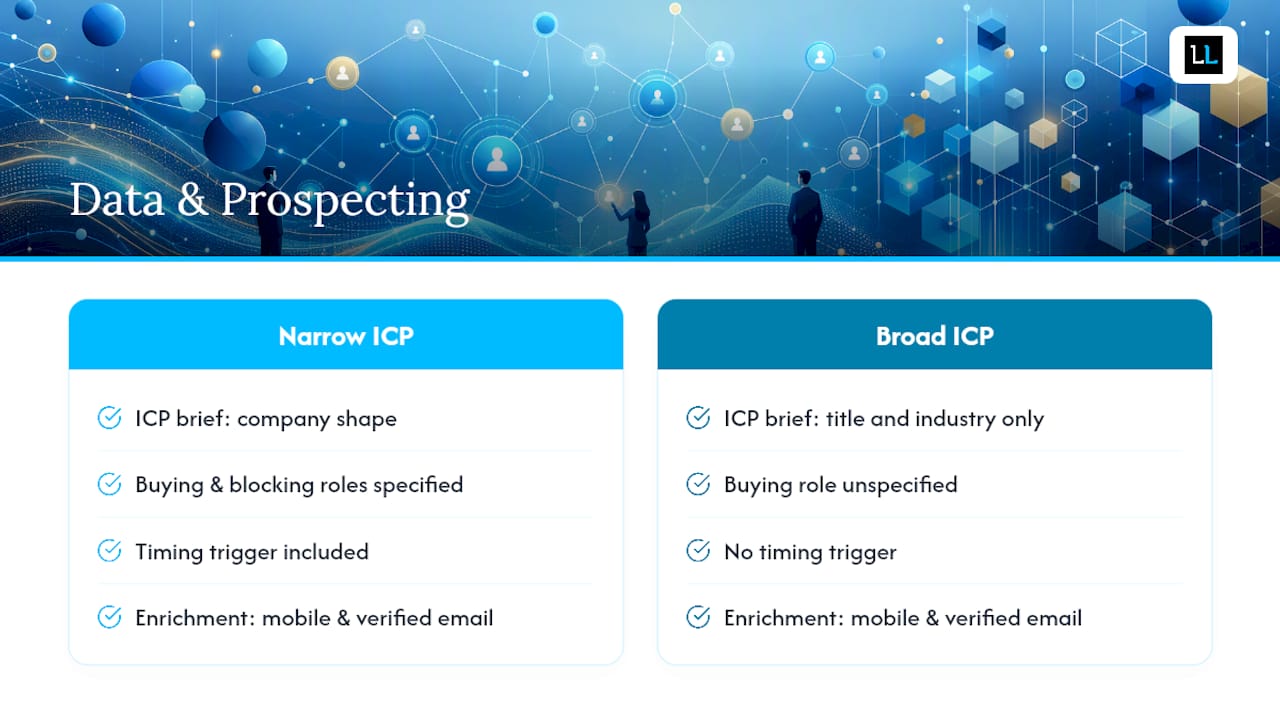
Outreach covers profile optimization, connection request copy, and a sequenced follow-up cadence. The operational backbone matters here. Ask whether the provider uses a verified LinkedIn API integration or browser automation. A verified API avoids account-exposure risk and keeps you inside LinkedIn’s terms of service. Daily sending limits should be tuned to account history, not pushed to maximum. High-volume sending does not reliably increase acceptance rates; it increases restriction risk.
Conversion is where most agencies underdeliver. A qualified provider qualifies replies before booking, applying a BANT-like standard: does this person fit the ICP, do they have the authority, and have they confirmed the meeting topic? Outsourced appointment setting at this level may even offer pay-per-approved-appointment models that shift qualification risk to the provider.
Deliverables you should receive: dashboard access showing requests sent, connection acceptance rate, reply rate, and positive-reply-to-meeting conversion; sample sequences in your vertical; and full ownership of lists and campaign copy if you exit.
Benchmark ranges to hold providers to: well-run B2B campaigns typically achieve 25–40% connection acceptance, 5–15% reply rates among accepted connections, and 2–5% positive-reply-to-call conversion.
A short sample message that works in professional services looks like this: “Hi [First Name], I noticed you’re scaling [function] at [Company]. We help [ICP role] at firms like yours book [specific outcome] without [common friction]. Worth a 20-minute call?” Short, specific, no pitch in the first touch.
Pro Tip: Define “qualified meeting” before you sign anything. A four-part standard works best: ICP-fit role and seniority, firmographic fit, confirmed meeting topic, and attendance. Tie this definition to billing and remediation in the SLA.
How do you evaluate and choose a LinkedIn outreach provider?
Non-negotiable checklist
- Tooling: verified API or safety-first automation, not raw browser scraping
- Sample sequence in your specific vertical, not a generic template
- Dashboard access with live metrics, not summary PDFs
- Data ownership on exit, written into the contract
- Credential control: you hold the LinkedIn login, not the agency
- Minimum commitment and clear cancellation terms
Questions to ask in the RFP
- What exact tool do you run on, and can you show documentation?
- Can I see a redacted client sequence from a similar vertical?
- What are your daily sending limits and account-health monitoring protocols?
- Who owns the prospect lists and message copy if we cancel?
- What is your cancellation policy and minimum term?
- Do you offer any meeting guarantees or pay-per-approved-appointment options?
For professional services and regulated industries, also ask for exportable activity logs and evidence of compliance-aware execution. These are often decisive procurement requirements, not nice-to-haves.
Pricing benchmarks
Mid-range LinkedIn outreach retainers typically run $3,000–$10,000 per month. Enterprise and multi-channel programs run higher. Data-only delivery costs a fraction of a full retainer and suits buyers who already have SDRs and a sequencer integrated into their CRM. Full-service appointment setting sits at the top of the range and includes inbox management, reply qualification, and calendar booking.
Timeline from onboarding to first meetings
| Milestone | Typical timeframe |
|---|---|
| Intake and brief completion | Week 1 |
| List build and enrichment | Weeks 1–2 |
| Profile optimization and QA | Week 2–3 |
| Campaign launch | Week 3–4 |
| First replies and qualified leads | Days 30–60 |
| Reliable read on program fit | Day 90 |
Red flags to walk away from
- Vague or evasive answers about tooling (“we use proprietary software”)
- Requiring your LinkedIn login credentials
- Contracts that claim ownership of your prospect lists or copy
- No live dashboard access, only monthly PDF reports
- Promised daily volumes that exceed LinkedIn’s safe operating thresholds
- Avoid common outreach mistakes that signal an inexperienced provider
What does real proof look like from a LinkedIn outreach provider?
A consulting firm targeting CFOs at mid-market manufacturing companies ran a 90-day campaign with a DFY provider. The ICP was tight: 200–1,000 employees, US-based, CFO or VP Finance title, companies showing signs of ERP migration. The campaign generated 14 qualified meetings in the first 60 days at a cost-per-meeting well inside the firm’s CAC target.
A professional services firm in HR advisory used a sequenced three-touch approach: a personalized connection request referencing a recent industry report, a follow-up offering a specific benchmark, and a third message with a direct ask. Reply rates ran at 11% among accepted connections, consistent with the benchmark range of 5–15%.
An IT consultancy expanding into a new vertical used the campaign’s first 30 days as market research: which sub-segments replied, which ignored, and which asked for more information before agreeing to a call. That data shaped the ICP refinement at the 30-day checkpoint.
When evaluating any provider, request: a redacted dashboard screenshot showing live campaign metrics, inbox access or a recorded walkthrough, the actual sequence copy running in your name, and a sample meeting-handover sheet. A provider that hesitates on any of these is telling you something.
When does outsourcing beat running LinkedIn in-house?
Outsourcing wins when you need pipeline now and do not have a trained SDR, a tested sequence, or the time to build one. It also wins when you are entering a new ICP or market segment where you lack the data and messaging to know what works. Compliance-aware execution matters too: a managed provider with exportable logs and API-backed delivery is a lower-risk operation than a sales rep running browser automation on a personal account.

In-house makes sense when you already have verified prospect data, a sequencer integrated into your CRM, and a dedicated SDR who owns the channel. In that case, data-only delivery from a specialist list-builder is often the better spend.
One thing the market consistently underestimates: a vendor marketing itself as “software plus setup” is selling a different product than a managed retainer. If you are paying agency rates, you should receive strategy, copywriting, and inbox management, not just a dashboard login. Clarify this before you sign. You can also explore LinkedIn lead generation strategies to understand what a well-run program looks like before you brief a provider.
The Lead Lab delivers booked meetings, not just outreach activity
The Lead Lab runs done-for-you LinkedIn outreach campaigns built specifically for professional services firms. The service covers ICP research and brief creation, list build and enrichment, personalized sequence copywriting, inbox management and booking, live dashboard access, and full data ownership on exit. Campaigns typically launch within 3–4 weeks and reach meaningful meeting volume by day 60. Pricing sits within the mid-market retainer range, with tiers matched to campaign scope and seat count.
If you want qualified meetings on your calendar without rebuilding your outreach operation from scratch, request a demo at The Lead Lab and come prepared with your ICP, your exclusion list, and your calendar availability rules. That is all the onboarding brief needs to get started.
Sources
The findings below informed the benchmarks, evaluation criteria, and timeline guidance in this article. When briefing any provider, request the same categories of evidence from them directly.
- How Do You Choose a LinkedIn Lead Generation Agency? | LinkedInsider
- LinkedIn Lead Generation Service: What You’re Actually Paying For in 2026
Request from any vendor before signing: