
The best Leadsmachine.co.uk alternatives depend entirely on one question: does your team have the capacity to run outreach, or do you need someone to do it for you? For self-service, Leadfeeder, UpLead, HubSpot Sales Hub, Hunter.io, and LeadFuze cover most in-house needs. For teams that want qualified meetings delivered without hiring SDRs, The Lead Lab is the recommended done-for-you option. The table below maps each to the buyer it fits best.
| Alternative | Who it fits best |
|---|---|
| The Lead Lab | Professional services firms wanting guaranteed LinkedIn meetings, no SDR hire |
| Leadfeeder | Teams that want to identify anonymous website visitors and route them to CRM |
| HubSpot Sales/Marketing Hub | Inbound-heavy teams already on HubSpot CRM |
| UpLead | SMBs needing verified B2B contact data with real-time email verification |
| LeadFuze | Sales reps building targeted prospect lists with AI-assisted filtering |
| Hunter.io | Marketers and recruiters doing email prospecting at low cost |
| OptinMonster | Content-driven sites capturing leads via on-site forms and pop-ups |
| Pipedrive | Small sales teams wanting a CRM with built-in lead management |
| RollWorks | B2B marketing teams running account-based advertising campaigns |
| Intercom | SaaS and e-commerce teams capturing and qualifying leads via chat |
Table of Contents
- Which Leadsmachine.co.uk alternative fits your team?
- Detailed profiles: what each alternative actually delivers
- How to choose the right alternative for your team
- When does a done-for-you service beat a platform?
- How we evaluated these options
- Key Takeaways
- What’s actually working in B2B lead gen right now
- The Lead Lab: done-for-you LinkedIn outreach that delivers meetings
- Authoritative sources and further reading
Which Leadsmachine.co.uk alternative fits your team?
The comparison below covers the ten alternatives most commonly shortlisted by UK decision-makers evaluating lead generation tools. Each row reflects the platform’s primary strength, not its full feature list.
| Alternative | Best for | Key features | Pricing model | CRM integrations | Lead/data quality | Setup time | Support model |
|---|---|---|---|---|---|---|---|
| The Lead Lab | Professional services, no SDR team | LinkedIn outreach, copywriting, reply mgmt, enrichment, analytics | Monthly tiered packages + startup fee | Delivered to your CRM/calendar | Verified LinkedIn + enriched mobile/email | 1–2 weeks onboarding | Fully managed |
| Leadfeeder | Visitor ID, inbound follow-up | Website visitor tracking, company ID, CRM push | Free tier; paid from ~$99/mo | HubSpot, Pipedrive, Salesforce | Company-level (not contact-level) | Hours | Self-serve + chat |
| HubSpot Sales Hub | Inbound teams on HubSpot CRM | Sequences, meeting scheduling, deal pipeline | Free CRM; paid from ~$15/seat/mo | Native HubSpot ecosystem | Moderate (relies on your data) | Days | Tiered support |
| UpLead | SMBs needing verified contacts | 95%+ email accuracy claim, real-time verification, intent data | From ~$99/mo (5 credits trial) | Salesforce, HubSpot, Pipedrive | High (real-time verification) | Hours | Self-serve + email |
| LeadFuze | SDRs building targeted lists | AI list building (Fuzebot), job/tech filters | From ~$147/mo | Zapier, CRM via Zapier | Good (aggregated sources) | Hours | Self-serve + chat |
| Hunter.io | Email prospecting, small teams | Domain search, email finder, verifier, campaigns | Free tier; paid from ~$49/mo | HubSpot, Salesforce, Pipedrive | Email-focused, solid verification | Minutes | Self-serve |
| OptinMonster | On-site lead capture, content sites | Exit-intent pop-ups, A/B testing, segmentation | From ~$9/mo | Mailchimp, HubSpot, Salesforce | Inbound quality (user-submitted) | Hours | Self-serve + docs |
| Pipedrive | Small sales teams, CRM-first | Pipeline mgmt, lead inbox, web forms, chatbot | From ~$14/seat/mo | 400+ via marketplace | Dependent on input data | Hours | Self-serve + chat |
| RollWorks | ABM advertising, mid-market | Account targeting, intent signals, display/social ads | Custom pricing | HubSpot, Salesforce, Marketo | Intent-based, account-level | Days | Managed onboarding |
| Intercom | SaaS/e-commerce chat capture | Live chat, bots, product tours, inbox | From ~$39/mo | Salesforce, HubSpot, Stripe | Inbound quality | Hours | Self-serve + support |
On US and UK availability: all ten platforms operate in both markets. UK buyers should note that GDPR compliance obligations apply to any tool processing EU/UK personal data. Platforms like Leadfeeder (now part of Dealfront) and Hunter.io have explicit GDPR documentation. RollWorks is US-headquartered and primarily optimized for North American ad inventory, so UK ABM campaigns may see narrower reach.
B2B lead generation costs in the UK range from roughly £150 to £1,100+ per qualified lead depending on industry, channel, and provider model. That range matters when comparing a £49/month self-service tool against a managed campaign that delivers pre-qualified meetings.
Detailed profiles: what each alternative actually delivers
The Lead Lab
The Lead Lab runs done-for-you LinkedIn outreach campaigns for professional services firms. You get prospect targeting, personalized message copywriting, response management, lead enrichment (mobile numbers and verified emails), and qualified meetings booked directly into your calendar. There is no SDR to hire, no tool to configure, and no sequence to write.
Service tiers scale from a starter outreach package to a full appointment-setting service with verified LinkedIn account rental. Onboarding typically takes one to two weeks. The Lead Lab suits founders, sales directors, and marketing managers at consulting, legal, financial, and professional services firms who need a predictable pipeline without building an internal outreach function.
Pros: fully managed, verified data, calendar meetings delivered, no technical setup.
Cons: not a self-service tool; requires a monthly commitment.
Demo/consultation available at theleadlab.com/.
Leadfeeder (Dealfront)
Leadfeeder identifies the companies visiting your website and pushes that data to your CRM. It does not give you contact names or emails out of the box. The value is in surfacing warm accounts that already know you exist, then letting your sales team follow up.
The free tier is genuinely useful for small teams. Paid plans start around $99/month and unlock deeper filtering, CRM sync, and longer data retention. Integrations with HubSpot, Pipedrive, and Salesforce are native and well-documented. Setup takes a few hours: install the tracking script, connect your CRM, and set filters.
Pros: free tier, strong CRM integrations, GDPR-aware architecture.
Cons: company-level data only; you still need to find the right contact.
HubSpot Sales Hub
HubSpot’s Sales Hub works best for teams already inside the HubSpot ecosystem. The meeting scheduling feature alone, which syncs with Google Calendar and Outlook and removes the back-and-forth from booking demos, is worth the entry price for inbound-heavy teams. HubSpot’s meeting scheduling integrates natively with the CRM, so every booked call logs automatically.
Pricing starts at $15/seat/month for the Starter tier. The free CRM is a genuine entry point. Where HubSpot struggles is outbound: it is not a prospecting database, so you need to bring your own contact data.
Pros: best-in-class inbound workflow, free CRM, deep marketing-sales alignment.
Cons: expensive at scale; weak for cold outbound without a separate data source.
UpLead
UpLead is a B2B contact database with real-time email verification. The platform claims 95%+ email accuracy, which it achieves by verifying addresses at the point of export rather than relying on a static database. You get intent data, technographic filters, and direct dial numbers on higher tiers.
Plans start around $99/month. A five-credit free trial lets you test data quality before committing. UpLead integrates with Salesforce, HubSpot, and Pipedrive. It fits SMBs that need clean lists fast without a full sales intelligence suite.
Pros: real-time verification, affordable entry point, quick setup.
Cons: smaller database than enterprise alternatives; intent data is a paid add-on.
LeadFuze
LeadFuze’s main draw is Fuzebot, an AI list-building tool that continuously adds contacts matching your defined criteria. You set filters (job title, industry, company size, tech stack), and Fuzebot populates a list automatically. That removes the manual prospecting step for SDRs who need a steady flow of new contacts.
Pricing starts around $147/month. CRM integrations run primarily through Zapier, which adds a layer of setup complexity. LeadFuze suits sales reps and small outbound teams who want automated list building without a full enterprise platform.
Pros: automated list building, good filtering depth, no manual prospecting.
Cons: Zapier-dependent integrations; data freshness varies.
Hunter.io
Hunter.io does one thing well: it finds and verifies professional email addresses. Enter a company domain and it surfaces the email pattern and known contacts. The email campaign feature lets you send cold sequences directly from the platform.
The free tier covers 25 searches per month. Paid plans start at $49/month. Hunter integrates with HubSpot, Salesforce, and Pipedrive. It is the lowest-friction entry point for email prospecting, particularly for marketers and recruiters who need occasional lookups rather than a full outbound stack.
Pros: extremely easy to use, free tier, solid verification.
Cons: email-only; no phone data, no intent signals, limited sequencing.
OptinMonster
OptinMonster is an on-site lead capture tool, not an outbound platform. It converts existing website traffic into leads using exit-intent pop-ups, embedded forms, countdown timers, and behavioral targeting. If your site gets meaningful traffic but converts poorly, OptinMonster addresses that gap.
Plans start at $9/month (billed annually). It integrates with Mailchimp, HubSpot, Salesforce, and most major email platforms. Setup is fast: install a WordPress plugin or add a script tag, then build campaigns in the visual editor.
Pros: affordable, fast setup, strong A/B testing.
Cons: only works on existing traffic; useless for cold outbound.
Pipedrive
Pipedrive is a sales CRM with a lead inbox, web forms, and a basic chatbot. It is not a prospecting database, but it manages leads well once they arrive. The visual pipeline is one of the cleaner interfaces in the CRM market, and the 400+ marketplace integrations cover most common sales tools.
Pricing starts at $14/seat/month. Pipedrive suits small sales teams that want a CRM-first approach and do not need a separate prospecting tool. Pair it with Hunter.io or UpLead for a complete outbound stack.
Pros: clean UI, strong pipeline management, affordable.
Cons: not a lead source; requires external data tools for outbound.
RollWorks
RollWorks is an account-based marketing platform that runs targeted display and social ads to named accounts. It uses intent data to identify in-market buyers and serves ads across LinkedIn, display networks, and connected TV. Mid-market B2B marketing teams use it to warm up accounts before sales outreach.
Pricing is custom and typically starts in the thousands per month. Integrations with HubSpot, Salesforce, and Marketo are strong. RollWorks is overkill for small teams but genuinely powerful for ABM programs with a defined target account list.
Pros: strong ABM capabilities, intent data, good CRM integrations.
Cons: expensive, US-optimized ad inventory, requires marketing ops maturity.
Intercom
Intercom captures and qualifies leads through live chat, bots, and in-app messaging. It is primarily a customer communication platform, but its lead qualification workflows make it a real option for SaaS and e-commerce teams that want to convert site visitors in real time.
Pricing starts at $39/month. Integrations with Salesforce, HubSpot, and Stripe are native. Intercom does not generate outbound leads; it converts inbound ones. If your acquisition model relies on paid traffic or content, it fills the conversion gap.
Pros: strong chat and bot workflows, good integrations, real-time qualification.
Cons: not an outbound tool; pricing scales quickly with seat count.
Pro Tip: Before committing to any platform, export a sample of 20–30 contacts and verify them manually against LinkedIn. Data quality claims vary widely, and a 10-minute spot check will tell you more than any vendor’s accuracy percentage.
How to choose the right alternative for your team
Prioritized selection checklist
Work through these in order. The first criterion that eliminates an option saves you the rest of the evaluation.
- Primary acquisition channel — Outbound email (Hunter.io, UpLead), LinkedIn outreach (The Lead Lab), website visitor ID (Leadfeeder), on-site capture (OptinMonster), or ABM advertising (RollWorks) are fundamentally different motions. Pick the channel first, then the tool.
- CRM compatibility. If your team lives in HubSpot, prioritize tools with native HubSpot connectors. Zapier-dependent integrations add friction and failure points. The CRM integration depth is often the deciding factor for UK buyers evaluating total cost of ownership.
- Time to value — If you need pipeline in 30 days, a platform with a two-week onboarding and a three-month ramp is not the answer. Managed services that deliver meetings on a fixed timeline are faster for teams under pressure.
- Budget shape — A $49/month tool that your team never uses costs more than a managed campaign that delivers five qualified meetings. Factor in the cost of internal time, not just the subscription fee.
Questions to ask on vendor demos
- Where does your contact data come from, and how often is it refreshed?
- What is your email bounce rate, and do you offer credits or refunds for bad data?
- Which CRMs do you integrate with natively (not via Zapier)?
- What does onboarding look like, and who owns it on your side?
- What is your SLA for support, and what channel does it run through?
- Can I see a case study from a company in my industry and size range?
- What are the contract terms, and what is the cancellation policy?
Red flags to watch for
- Pricing that requires a sales call to access basic tier information.
- No verifiable case studies or G2/Capterra reviews with named companies. G2’s competitor listings surface buyer patterns and review signals that help validate shortlists before you commit.
- CRM integrations listed as “coming soon” or routed exclusively through Zapier.
- No data residency documentation for UK/EU buyers.
- Contracts longer than 12 months with no performance-based exit clause.
- Guaranteed lead volumes with no definition of what “qualified” means.
When does a done-for-you service beat a platform?
The honest answer: more often than most buyers expect. Teams without dedicated SDR capacity consistently see faster returns from a managed service that delivers meetings than from a self-service platform that requires internal resources to operate.
Three situations where a managed service wins clearly:
- No SDR on the team — A platform license does not come with a person to write sequences, manage replies, or book meetings. If that person does not exist internally, the tool produces nothing.
When a platform makes more sense: your team already has SDRs running sequences, you need visitor ID data to feed an existing sales motion, or you are running ABM advertising alongside a mature content program.
The Lead Lab’s service tiers cover the full outreach cycle: prospect targeting, message copywriting, automated outreach, reply management, lead enrichment, and calendar meetings delivered. Onboarding runs one to two weeks. For professional services firms that want scalable lead generation without building an internal function, that model removes the biggest friction point: execution.
Pro Tip: Ask any managed service provider to show you the exact message sequences they plan to use for your campaign before you sign. The quality of the copy is the single biggest variable in LinkedIn outreach performance.
How we evaluated these options
Every alternative in this article was assessed against six dimensions: feature depth, data quality and verification approach, CRM integration breadth, support and onboarding model, pricing transparency, and evidence of measurable outcomes (case studies, review signals, or published metrics).
Data sources used:
- Vendor documentation and published pricing pages
- Industry rankings and category analysis covering UK-specific market segmentation and local vendor fit
- User review signals from G2 and Capterra (aggregate ratings and review themes, not individual reviews)
- Published B2B lead generation cost benchmarks
- Salesforce’s lead generation tool categories for comparison framework validation
Scoring approach: no single weighted score was applied. Instead, each tool was mapped to the buyer scenario where it performs best, which reflects how real purchasing decisions work. A tool that scores “average” across all dimensions but excels at one specific use case is more useful to the right buyer than a generalist platform that does everything adequately.
Exclusions: platforms that lack verifiable pricing, have no documented CRM integrations, or operate primarily outside the UK and US markets were excluded. Direct competitors to The Lead Lab in the done-for-you LinkedIn outreach category were not featured.
Evaluating lead generation tools without anchoring to your internal capacity and primary acquisition channel produces a shortlist that looks good on paper but fails in practice. The most common mistake is choosing the platform with the most features rather than the one that fits the team’s actual workflow.
Key Takeaways
The right lead generation alternative depends on your team’s capacity, channel, and timeline — not on feature count alone.
| Point | Details |
|---|---|
| Match tool to channel | Outbound email, LinkedIn, visitor ID, and ABM advertising are different motions; pick the channel before the tool. |
| Internal capacity decides | Teams without SDRs get faster results from a managed service than from a self-service platform they cannot staff. |
| Verify data before committing | Real-time email verification (UpLead) and GDPR-compliant data sourcing matter more than database size for UK buyers. |
| Cost range is wide | B2B lead costs in the UK run from roughly £150 to £1,100+ per qualified lead; factor in internal time, not just subscription fees. |
| The Lead Lab for managed outreach | Professional services firms wanting qualified LinkedIn meetings without hiring SDRs should evaluate The Lead Lab’s done-for-you tiers. |
What’s actually working in B2B lead gen right now
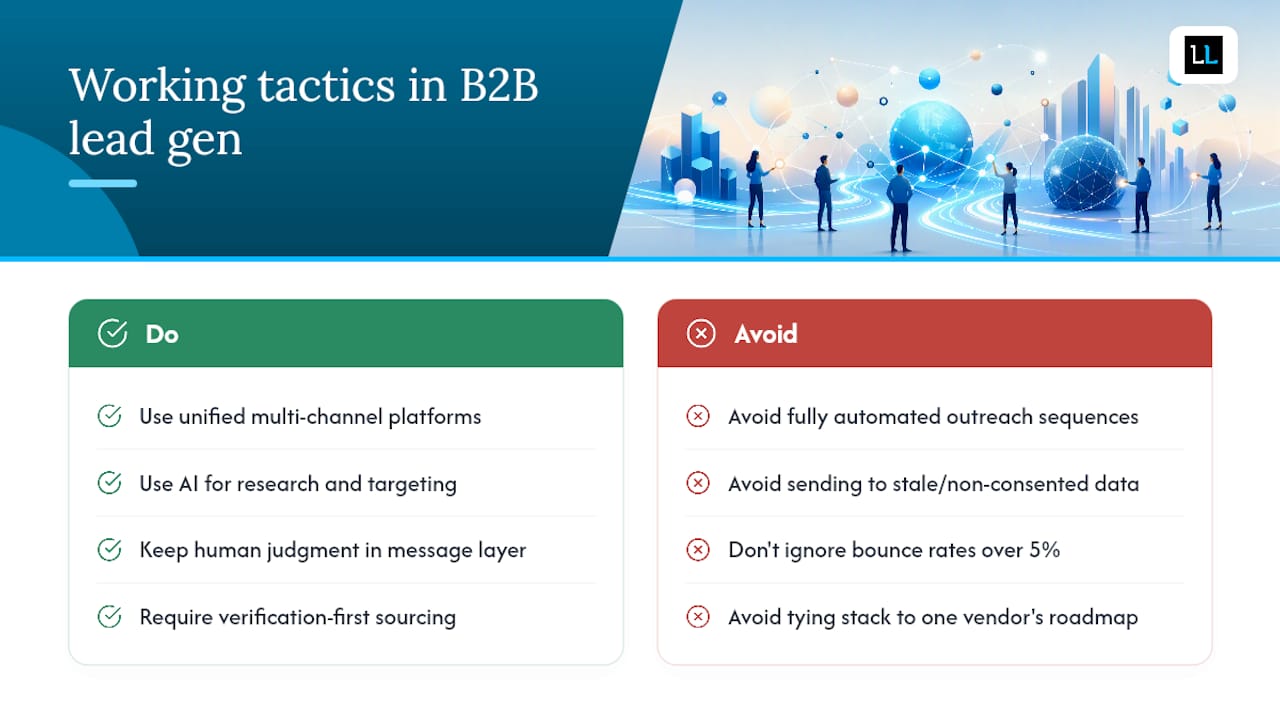
The platforms that are gaining ground in 2026 share one trait: they combine data sourcing, outreach execution, and reply handling in a single workflow rather than forcing teams to stitch together three separate tools. Multi-channel AI outbound platforms that unify LinkedIn, email, and social prospecting into one workspace are compressing the time between list building and first reply.
That said, AI-generated outreach has a ceiling. Personalization at scale still produces better results than fully automated sequences, because buyers have become adept at recognizing templated messages. The teams seeing the strongest conversion rates are using AI for research and targeting while keeping human judgment in the message layer.
On data: verification-first sourcing is no longer optional for UK outbound teams. GDPR enforcement has sharpened, and the reputational cost of sending to stale or non-consented data is higher than the cost of paying for cleaner lists. Expect more platforms to move toward real-time verification as a default rather than a premium feature.
Near-term, expect consolidation. The gap between point solutions (Hunter.io for email, Leadfeeder for visitor ID) and full-suite platforms (HubSpot, RollWorks) will narrow as suites acquire point solutions and point solutions add adjacent features. For most SMBs, the practical implication is that the tool you pick today will look different in 18 months. Build your stack around your CRM and your channel, not around any single vendor’s current roadmap.
One practical step worth taking this week: audit your current contact database for bounce rate. If more than 5% of your outbound emails are bouncing, your data quality problem is costing you deliverability and sender reputation before any other fix matters. Clean the list first, then optimize the sequence.
The Lead Lab: done-for-you LinkedIn outreach that delivers meetings
Most of the platforms in this comparison require your team to do the work. The Lead Lab does it for you.
For professional services firms that need qualified pipeline without hiring an SDR, The Lead Lab’s done-for-you LinkedIn outreach service covers every step: prospect targeting, personalized message copywriting, automated outreach, reply management, lead enrichment with verified mobile and email data, and calendar meetings delivered directly to you. Service tiers scale from focused outreach campaigns to full appointment-setting programs with verified LinkedIn account rental and campaign analytics.
Onboarding takes one to two weeks. You do not need a CRM configured, a sequence written, or a LinkedIn strategy in place before you start. The Lead Lab handles the execution; you handle the conversations.
If you want to see what a campaign looks like for your specific market and ICP, book a consultation at theleadlab.com/ and get a proposal built around your firm’s goals.
Authoritative sources and further reading
The following sources were used to compile and validate the shortlist, pricing references, and evaluation framework in this article. Last reviewed: June 2026.
- Best Lead Generation Companies for 2026
- Top 10 Lead Machine+ Alternatives & Competitors in 2026
- Best lead generation tools
- Top 10 Lead Generation Software in the United Kingdom for 2026
- Optareach — Multi-Channel AI Sales Agent for Outreach & Lead Generation
- meetings.hubspot.com