
TL;DR:
- Data-driven marketing uses real customer data to improve targeting, personalization, and campaign performance. Organizations adopting it see significantly higher ROI, better customer retention, and faster decision cycles. Success depends on cultural shifts, unified data infrastructure, and leadership commitment to evidence-based decision-making.
Data-driven marketing is the practice of using real customer data to guide every marketing decision, replacing guesswork with measurable evidence. Organizations that make this shift are 23 times more likely to acquire customers and 6 times more likely to retain them, with 5–8x higher marketing ROI. That is not a marginal gain. It is a structural competitive advantage. Yet the industry term you will hear most often is “data-driven decision-making,” a broader discipline that marketing now sits squarely inside. This guide breaks down why data-driven marketing matters, where most teams fail, and how to build the discipline that actually moves numbers.
Why data-driven marketing outperforms intuition-based strategy
The core advantage of data-driven marketing is precision. Instead of targeting broad demographic buckets, you act on individual-level behavioral signals, purchase history, and real-time engagement data. The result is better personalization, less wasted spend, and faster learning cycles.
The benefits stack up quickly:
- Higher ROI. Companies that successfully transition to data-driven marketing report 5–8x returns on marketing investment. That multiplier comes from eliminating low-performing spend and doubling down on what works.
- Customer acquisition at scale. Data-driven teams identify which channels, messages, and offers convert best. They replicate those patterns systematically rather than relying on a single campaign that happened to work.
- Stronger retention. Personalization built on behavioral data keeps customers engaged. When you know what a customer bought last quarter and what they browsed last week, your next message is relevant rather than generic.
- Faster decision cycles. Real-time analytics replace quarterly gut-check reviews. You spot a campaign underperforming within days, not months, and reallocate budget before the damage compounds.
- Reduced risk. Combining quantitative data with qualitative judgment minimizes uncertainty in volatile markets. You still use human judgment. You just ground it in evidence first.
The importance of data-driven strategies becomes clearest when you compare teams that use them against those that do not. The gap in customer acquisition efficiency alone justifies the investment.
Pro Tip: Start measuring what you already have before buying new tools. Most teams sit on underused CRM data, email engagement logs, and website analytics that can drive better decisions immediately.

How does data-driven marketing differ from traditional marketing?
Traditional marketing relies on intuition, broad audience segments, and campaigns evaluated after the fact. Data-driven marketing uses individual-level data, continuous measurement, and rapid experimentation to guide decisions in real time.
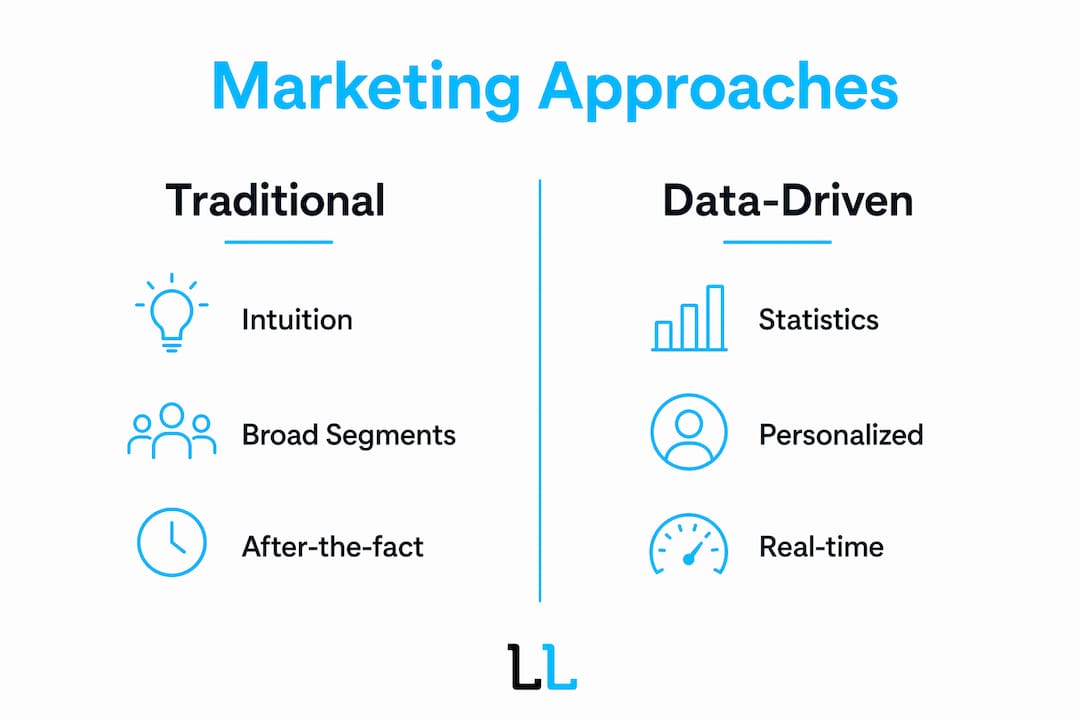
The table below captures the sharpest distinctions:
| Feature | Traditional marketing | Data-driven marketing |
|---|---|---|
| Decision basis | Intuition and experience | Behavioral and transactional data |
| Audience targeting | Broad demographic segments | Individual-level profiles |
| Campaign measurement | Post-campaign review | Real-time analytics and attribution |
| Optimization speed | Quarterly or annual | Weekly or continuous |
| Experimentation | Occasional A/B tests | Hundreds of concurrent experiments |
| Risk management | Gut-check adjustments | Evidence-based budget reallocation |
Booking.com is the clearest example of data-driven marketing at scale. The company runs hundreds of concurrent experiments at any given time, testing copy, layout, pricing displays, and offer structures simultaneously. No single campaign is treated as a fixed plan. Every decision is a hypothesis waiting for data to confirm or reject it.
Multi-touch attribution is another dividing line. Traditional marketing often credits the last touchpoint before conversion. Data-driven teams use attribution models that map the full customer journey, from first LinkedIn impression to signed contract. That visibility changes where budgets go.
Data-driven decision-making has moved from competitive advantage to a foundational requirement for business survival. Teams still running on intuition are not just leaving ROI on the table. They are ceding ground to competitors who already know what works.
Pro Tip: If your team still waits for end-of-quarter reports to evaluate campaigns, that lag is costing you budget. Set up weekly performance dashboards in Google Looker Studio or HubSpot so decisions happen on current data, not historical snapshots.
What are the key challenges in implementing data-driven marketing?
Fewer than 30% of enterprises successfully translate data insights into actionable marketing strategies. The bottleneck is rarely technology. It is people and culture.
The most common barriers are:
- Organizational resistance. Teams accustomed to intuition-based decisions push back when data contradicts their instincts. This is especially common when senior leaders override dashboards with personal preferences.
- Data silos. CRM data lives in one system, ad platform data in another, and website analytics in a third. Without integration, you cannot build a complete customer picture. The primary barrier to data-driven marketing is this human and organizational friction, not missing software.
- Lack of analytical talent. Many marketing teams can collect data but lack the skills to interpret it. Hiring or developing analysts who understand both marketing and statistics is a real constraint for mid-size firms.
- Leadership that ignores inconvenient data. Data dashboards become decorative when leadership overrides findings with gut instinct. If the CEO dismisses a test result because it contradicts their preferred narrative, the culture never shifts.
- Weak data infrastructure. Without unified customer profiles and identity resolution, personalization is impossible. You cannot personalize at scale if your data lives in disconnected spreadsheets.
Overcoming these barriers requires a phased approach. Start with one channel, build a small win, and use that result to earn organizational trust. A phased roadmap that builds a lasting culture of evidence-based decision-making outperforms any single technology purchase.
Pro Tip: Assign a “data champion” inside your marketing team. This person does not need to be a data scientist. They need to be the one who asks “what does the data say?” in every campaign review meeting. That habit, repeated consistently, shifts culture faster than any training program.
How can marketing teams practically adopt data-driven practices?
Building a data-driven marketing operation requires four concrete moves, executed in sequence.
-
Build unified customer profiles. Infrastructure and unified customer profiles are the foundation. Use a Customer Data Platform (CDP) like Segment or Salesforce Data Cloud to consolidate CRM records, behavioral data, and transaction history into a single view. Without this, every downstream effort is fragmented.
-
Run hypothesis-driven experiments. Elite marketing teams treat decisions as hypotheses tested rapidly rather than fixed plans. Before launching a campaign, write a formal hypothesis: “If we change the subject line from benefit-focused to curiosity-driven, open rates will increase by 15%.” Then test it, measure it, and act on the result within weeks, not quarters.
-
Apply multi-touch attribution. Single-touch attribution models (first click or last click) distort where budget should go. Tools like Rockerbox, Northbeam, or Google Analytics 4 with custom attribution models show which touchpoints actually drive conversion. This matters especially for data-driven marketing across channels, where a LinkedIn ad may warm a prospect who converts via email three weeks later.
-
Model leadership behavior. The fastest way to build a data-driven culture is for senior leaders to visibly use data in decisions. When a CMO says “the test showed X, so we are shifting budget to Y,” the team learns that data has real authority. When leaders override data with opinion, the opposite lesson lands.
Prospect segmentation is one of the highest-leverage applications of this approach. Segmenting prospects with data lets professional services firms target the right contacts with the right message at the right time, cutting wasted outreach and improving conversion rates. Pairing segmentation with marketing automation compounds the effect, turning individual insights into scalable, repeatable campaigns.
Data-driven marketing is not about eliminating human judgment. It is about grounding judgment in evidence so that experience and instinct work with the data, not against it. The best marketing leaders combine pattern recognition from years of experience with the discipline to test assumptions before acting on them.
Key takeaways
Data-driven marketing delivers measurable competitive advantage only when organizational discipline and leadership commitment match the quality of the data infrastructure.
| Point | Details |
|---|---|
| ROI multiplier is real | Companies report 5–8x marketing ROI after successfully adopting data-driven practices. |
| Culture beats technology | Fewer than 30% of enterprises execute on data insights, proving the barrier is organizational, not technical. |
| Unified data is non-negotiable | A CDP or integrated data stack is required before personalization or attribution can work at scale. |
| Hypothesis testing drives agility | Treating campaigns as experiments lets teams reallocate budgets within weeks, not quarters. |
| Leadership sets the standard | When senior leaders visibly use data to make decisions, the entire team follows the same discipline. |
The uncomfortable truth about data-driven marketing adoption
I have watched dozens of marketing teams invest in analytics platforms, CDPs, and attribution tools, then wonder why nothing changed. The technology worked. The culture did not.
The pattern is consistent. A team buys a new tool, builds dashboards, and runs a few tests. Then a senior leader looks at a result that contradicts their preferred campaign direction and overrides it. The team learns that data is optional. Within six months, the dashboards are ignored and decisions revert to whoever speaks loudest in the room.
What actually works is starting smaller than you think you need to. Pick one campaign, one channel, one hypothesis. Run the test. Share the result publicly, even if it is uncomfortable. Make the data the hero of that story, not the person who had the idea. Repeat that cycle until the team starts asking for data before making decisions rather than after.
The other thing I would push back on is the idea that data-driven marketing is primarily a digital discipline. I have seen TV and print campaigns run with genuine rigor when the measurement framework is set up correctly. The medium is not the constraint. The mindset is.
The teams that win in 2026 are not the ones with the most data. They are the ones with the discipline to act on it consistently, even when it contradicts what feels right.
— Toby
How The Lead Lab helps you act on your data
If you recognize the gap between having data and actually using it to drive qualified leads, The Lead Lab was built for exactly that problem.
The Lead Lab runs done-for-you LinkedIn outreach campaigns for professional services firms, built on targeted prospect segmentation, personalized messaging, and campaign analytics that show what is working in real time. Every campaign is treated as a test. Every result feeds the next iteration. You can see the outcomes across client campaigns in the portfolio, where data-driven outreach has consistently delivered qualified meetings for consulting and professional services firms. If you are ready to build a lead generation system grounded in evidence rather than guesswork, start with The Lead Lab.
FAQ
What is data-driven marketing?
Data-driven marketing is the practice of using customer behavioral, transactional, and demographic data to guide marketing decisions. It replaces intuition-based strategy with measurable, evidence-based approaches to improve ROI and campaign performance.
Why do so many companies fail at data-driven marketing?
Fewer than 30% of enterprises successfully translate data insights into marketing action, primarily because of organizational resistance, data silos, and leadership that overrides data with intuition. Technology is rarely the limiting factor.
What tools support data-driven marketing?
Customer Data Platforms like Segment and Salesforce Data Cloud unify customer profiles. Attribution tools like Rockerbox, Northbeam, and Google Analytics 4 track campaign performance across channels. A/B testing platforms and real-time dashboards in HubSpot or Google Looker Studio complete the core stack.
How does data-driven marketing improve customer retention?
Personalization built on behavioral data keeps messaging relevant to individual customers. When your outreach reflects what a customer has done and what they care about, engagement and loyalty follow naturally.
Is data-driven marketing only for digital channels?
No. Data-driven marketing applies to any channel where decisions are grounded in evidence rather than guesswork. TV and print campaigns can be data-driven when measurement frameworks are set up to track outcomes rigorously.