
TL;DR:
- A B2B pipeline is a visual system that monitors active deals from initial contact to closed revenue, showing deal status, actions needed, and revenue at risk. Management of this pipeline ensures predictable revenue, helps track deal progression, and improves forecasting accuracy; neglecting it can distort forecasts and waste sales resources. Building an effective pipeline requires aligning stages with buyer decision milestones, maintaining hygiene, and leveraging CRM automation to ensure deal health and pipeline reliability.
A B2B pipeline is a visual, stage-based system that tracks every active deal from first contact to closed revenue. Unlike a general sales overview, it shows exactly where each prospect sits in the buying process, what action is required next, and how much revenue is at risk at any given moment. Most professional services firms manage their pipelines inside CRM platforms like Salesforce, HubSpot, or Monday.com. Average B2B pipelines convert 15–25% of opportunities into wins, while top performers exceed 40%. That gap is almost always explained by pipeline discipline, not product quality.

What is a b2b pipeline and why does it matter?
A B2B sales pipeline is the operational backbone for predictable revenue, connecting marketing spend directly to closed deals. It gives sales leaders a real-time view of deal volume, deal health, and the actions needed to move prospects forward. Without it, revenue planning becomes guesswork.
Most B2B sales cycles run one to three months or longer. That length makes stage-by-stage tracking non-negotiable. A deal that stalls undetected for six weeks does not just slow revenue. It distorts your forecast and wastes rep time that could go toward winnable opportunities.
The B2B lead management process also depends on a well-structured pipeline. Marketing generates leads, but without defined handoff stages and qualification criteria, those leads either pile up or get dropped. A pipeline creates the shared language between marketing and sales that prevents both outcomes.
Understanding the B2B pipeline also means recognizing what it is not. It is not a forecast, and it is not a funnel. Those distinctions matter enough to deserve their own section.
What are the stages of a b2b sales pipeline?
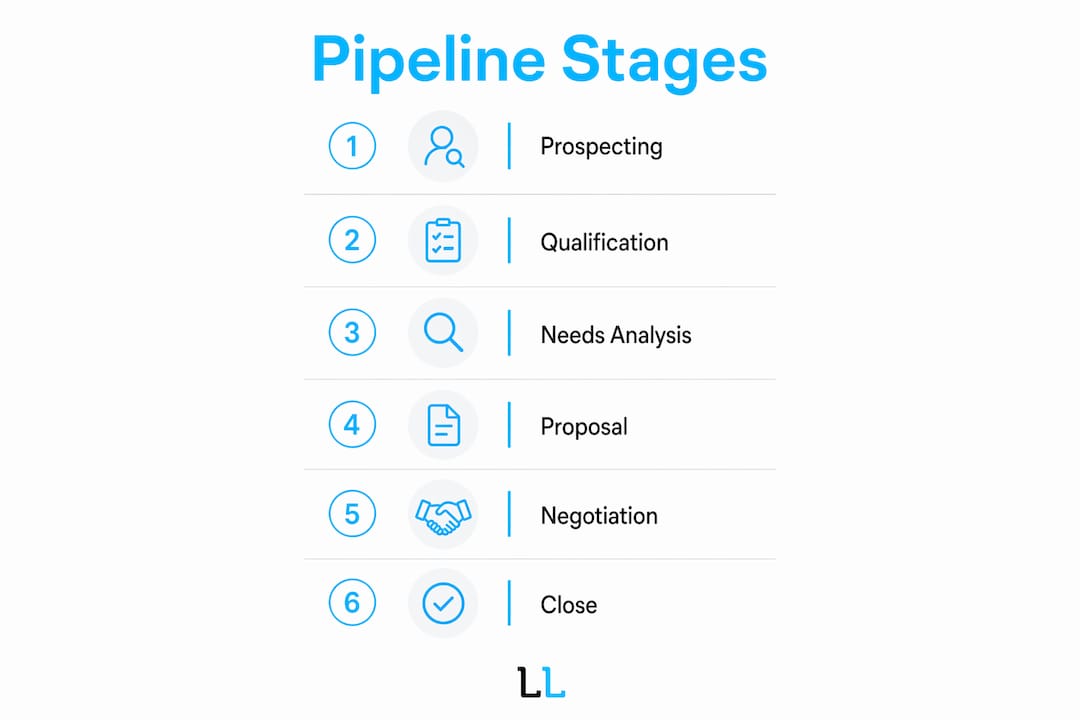
Typical B2B pipelines consist of 5–7 stages tailored to deal complexity. The most widely used framework moves through Prospecting, Qualification, Needs Analysis, Proposal, Negotiation, and Closing. Each stage represents a buyer milestone, not just a sales activity.
Here is how each stage functions in practice:
- Prospecting: Identifying target accounts and initiating outreach through LinkedIn, email, or referrals.
- Qualification: Confirming the prospect has budget, authority, need, and timeline (the BANT framework).
- Needs Analysis: Running discovery calls to map the buyer’s specific pain points and decision criteria.
- Proposal: Delivering a tailored solution document or pitch deck aligned to the buyer’s stated needs.
- Negotiation: Addressing pricing, scope, legal terms, and stakeholder objections.
- Closing: Securing signatures, processing contracts, and transitioning to onboarding.
Stage exit criteria are what separate high-performing pipelines from chaotic ones. An exit criterion is a specific condition that must be met before a deal advances. For example, a deal should not move from Qualification to Needs Analysis unless a decision-maker is confirmed on the call. Clear stage definitions with exit criteria improve forecasting accuracy significantly.
Complex enterprise deals often require additional stages. B2B deals involving multiple stakeholders need pipeline stages that incorporate champion building, technical validation, procurement review, legal sign-off, and executive approval. Compressing these into a single “Negotiation” stage creates blind spots.
| Pipeline Stage | Typical Conversion Rate |
|---|---|
| Prospecting to Qualification | 20–25% |
| Qualification to Needs Analysis | 50–60% |
| Needs Analysis to Proposal | 60–70% |
| Proposal to Negotiation | 40–50% |
| Negotiation to Close | 29% average |
Pro Tip: Design your pipeline stages around how your buyer makes decisions, not around how your sales team prefers to work. If your buyer requires a technical proof-of-concept before approving a proposal, that step belongs in your pipeline as its own stage.
How does a b2b pipeline differ from a funnel or forecast?
A sales pipeline tracks individual deals, a sales funnel shows aggregate conversion rates across all leads, and a sales forecast predicts revenue within a defined timeframe. These three tools serve different functions and should never be used interchangeably.
| Concept | What It Tracks | Primary User | Key Risk |
|---|---|---|---|
| Pipeline | Individual deal progress and volume | Sales reps and managers | Stalled deals and poor hygiene |
| Funnel | Aggregate lead-to-close conversion rates | Marketing and demand gen | Misleading volume metrics |
| Forecast | Predicted revenue within a period | Sales leadership and finance | Over-commitment to targets |
Confusing a pipeline with a sales forecast is one of the most costly mistakes a sales organization can make. When reps treat every deal in the pipeline as probable revenue, leadership over-commits to quotas. The pipeline shows what is possible. The forecast shows what is probable, based on stage, deal age, and historical win rates.
A practical example: a pipeline showing $2 million in active deals does not mean $2 million in revenue is coming. If your average win rate is 20%, that pipeline realistically yields $400,000. A forecast built on that math is credible. A forecast built on the full $2 million is a liability.
The funnel sits upstream of both. It measures how efficiently your marketing and top-of-funnel activities convert raw leads into qualified pipeline. Marketing teams at firms like Gartner and Forrester use funnel metrics to justify spend and adjust channel mix. Sales teams use the pipeline to manage deals. Finance uses the forecast to plan headcount and cash flow.
What key metrics drive b2b pipeline management?
Effective B2B pipeline management strategies depend on four core metrics: pipeline coverage ratio, pipeline velocity, stage conversion rates, and deal age. Each one reveals a different dimension of pipeline health.
Pipeline Coverage Ratio measures total pipeline value against quota. Coverage ratios should sit at 3–4x quota to absorb normal win rate slippage. If your quarterly quota is $500,000, you need $1.5 million to $2 million in active pipeline to hit it reliably.
Pipeline Velocity calculates how fast deals move through the pipeline. The formula is: (number of opportunities × average deal value × win rate) divided by average sales cycle length. A drop in velocity signals either fewer deals, smaller deals, lower win rates, or longer cycles. You need to know which one.
Stage Conversion Rates tell you where deals stall. Lead-to-MQL conversion averages 20–25%, and negotiation-to-close rates average 29%. If your proposal-to-negotiation rate drops below 30%, your proposals are not landing. That is a messaging problem, not a pipeline problem.
Deal Age flags opportunities that have sat in a stage too long without movement. Stale deals inflate pipeline value without contributing to revenue. They also distort your forecast. Removing or re-qualifying aged deals is called pipeline hygiene, and it is a weekly discipline for high-performing teams.
Pro Tip: Use your CRM’s automation rules to flag deals that have not advanced in 14 days. CRM automation in outreach lets you set stage-age alerts so reps act before deals go cold, not after.
How to build a b2b pipeline that actually converts
Building a B2B pipeline that converts requires more than listing stages in a CRM. It requires mapping those stages to the actual decisions your buyer makes, not the activities your sales team prefers to track.
- Start with the buyer journey. Interview recent wins and losses to identify the real decision milestones. Most buyers go through problem recognition, solution exploration, vendor evaluation, and approval before signing. Your pipeline stages should mirror those steps.
- Set entry and exit criteria for every stage. Entry criteria define what qualifies a deal to enter a stage. Exit criteria define what must be true before it advances. Without both, reps move deals forward based on optimism rather than evidence.
- Account for multi-stakeholder complexity. Failing to adapt pipelines to actual buyer journeys yields inaccurate health metrics. Enterprise deals often involve procurement, legal, IT security, and executive sponsors. Each stakeholder group has its own concerns and timeline. Your pipeline needs to reflect that reality.
- Use CRM tools to automate tracking. Platforms like Salesforce, HubSpot, and Monday.com allow you to automate stage progression reminders, deal health scores, and activity logging. B2B automation transforms pipeline visibility by removing manual data entry and surfacing at-risk deals automatically.
- Audit your pipeline weekly. Remove deals that have no activity in 30 days unless there is a documented reason for the pause. A clean pipeline is a credible pipeline.
The most common mistake is building a pipeline that reflects your sales process rather than your buyer’s decision process. Those two things are not the same. A buyer does not care that your internal process requires a demo before a proposal. They care about solving their problem on their timeline.
Key takeaways
A well-managed B2B pipeline is the single most reliable predictor of revenue outcomes for professional services firms.
| Point | Details |
|---|---|
| Pipeline vs. forecast | A pipeline tracks deal volume and health; a forecast predicts probable revenue within a period. |
| Stage design matters | Build stages around buyer decision milestones, not internal sales preferences, to get accurate health data. |
| Coverage ratio target | Maintain 3–4x quota in active pipeline value to absorb normal win rate slippage. |
| Hygiene is non-negotiable | Remove or re-qualify stale deals weekly to keep your pipeline credible and your forecast accurate. |
| AI and CRM are table stakes | Automated deal health alerts and stage-age flags prevent revenue leakage before it happens. |
The pipeline is your scoreboard, not your safety net
I have worked with professional services firms that had $3 million in their pipeline and missed quota by 40%. The pipeline looked healthy. The forecast looked strong. But nobody had audited deal age, and nobody had confirmed that decision-makers were still engaged. The pipeline was a graveyard dressed up as a growth engine.
The shift I have seen work is treating the pipeline as a live operating system, not a static report. AI-driven real-time visibility is making that easier in 2026. Tools now flag deals that show disengagement signals, like no email opens in two weeks or a champion who has gone quiet. That kind of intelligence used to require a very attentive sales manager. Now it is automated.
What I keep coming back to is this: the pipeline is only as honest as the people maintaining it. If your culture rewards reps for adding deals rather than closing them, your pipeline will always look better than your revenue. Fix the culture first. Then fix the CRM.
The firms I respect most treat pipeline reviews as a team discipline, not a management inspection. Every rep owns their pipeline health. Every manager owns the aggregate. That shared accountability is what turns a pipeline from a tracking tool into a revenue engine.
— Toby
Build a pipeline that fills itself
Understanding your B2B pipeline is one thing. Keeping it full of qualified, sales-ready opportunities is another challenge entirely.
The Lead Lab specializes in LinkedIn outreach campaigns that feed your pipeline with decision-maker conversations, not just contact lists. From targeted prospect identification and personalized message sequences to response management and CRM integration, The Lead Lab handles the top-of-funnel work that most sales teams either skip or do inconsistently. If your pipeline coverage ratio is below 3x quota right now, that is a lead generation problem as much as a sales problem. Explore how The Lead Lab’s pipeline solutions can put qualified meetings on your calendar every week.
FAQ
What is a b2b pipeline in simple terms?
A B2B pipeline is a stage-based visual system that tracks every active sales deal from first contact to close. It shows deal volume, deal health, and the actions needed to move each opportunity forward.
How many stages should a b2b sales pipeline have?
Most B2B pipelines use 5–7 stages, but the right number depends on deal complexity. Enterprise deals with multiple stakeholders often require additional stages for technical validation, procurement, and legal review.
What is the difference between a pipeline and a sales forecast?
A pipeline tracks the current volume and status of active deals. A forecast predicts how much revenue those deals will generate within a specific timeframe, based on win rates and stage probabilities.
What is a healthy b2b pipeline coverage ratio?
A coverage ratio of 3–4x your sales quota is the standard benchmark. If your quarterly quota is $500,000, you need $1.5 million to $2 million in active pipeline to hit it reliably given normal win rate slippage.
How do you keep a b2b pipeline accurate?
Run weekly pipeline hygiene reviews to remove or re-qualify deals with no recent activity. Use CRM automation to flag stale opportunities and set stage-age alerts so your pipeline reflects real deal health, not wishful thinking.