
TL;DR:
- Most lead scoring systems are oversimplified point tallies that fail within a year. Building an effective model requires understanding signals, collaboration between marketing and sales, and regular recalibration to maintain accuracy. Trust in lead scoring emerges from simplicity, ongoing governance, and focusing on quality signals like recency, content progression, and relational data.
Most marketing teams treat lead scoring like a basic point tally. Add ten points for an email open, subtract five for a bounce, hand off the highest number to sales. That oversimplification is exactly why so many scoring systems quietly fail within a year of launch. Explaining lead scoring properly means going well past the checklist. It means understanding how the right model, built on the right signals, can transform your conversion rate and give your sales team a reason to actually trust what marketing sends over. This guide covers everything from foundational concepts to advanced techniques.
Table of Contents
- Key takeaways
- Explaining lead scoring: what it is and why it matters
- Lead scoring models compared
- How to build an effective lead scoring model
- Advanced signals that sharpen scoring accuracy
- Measuring and optimizing your scoring model
- What actually makes lead scoring succeed
- Ready to turn better scoring into real meetings?
- FAQ
Key takeaways
| Point | Details |
|---|---|
| Lead scoring is not just point counting | It is a predictive system that ranks leads by conversion likelihood using behavioral and demographic signals. |
| Model choice drives results | Manual point systems work for small pipelines; predictive and relational ML models outperform them significantly at scale. |
| Negative scoring is non-negotiable | Score decay and disengagement penalties prevent database inflation and keep sales focused on real buyers. |
| Alignment beats technology | Marketing and sales must agree on thresholds together, or the model loses credibility fast. |
| Quarterly recalibration is required | Outdated models actively degrade conversion performance and must be reviewed regularly to stay useful. |
Explaining lead scoring: what it is and why it matters
Lead scoring is the process of ranking prospects based on how likely they are to convert, using a combination of behavioral signals and profile attributes. A score is not a grade for effort. It is a prediction of intent.
The data used falls into three main categories. Demographic data covers who the person is: job title, seniority, company size, and industry. Firmographic data covers the company they work for: revenue, growth stage, and vertical. Behavioral data covers what they actually do: pages visited, content downloaded, emails clicked, and product demos requested.
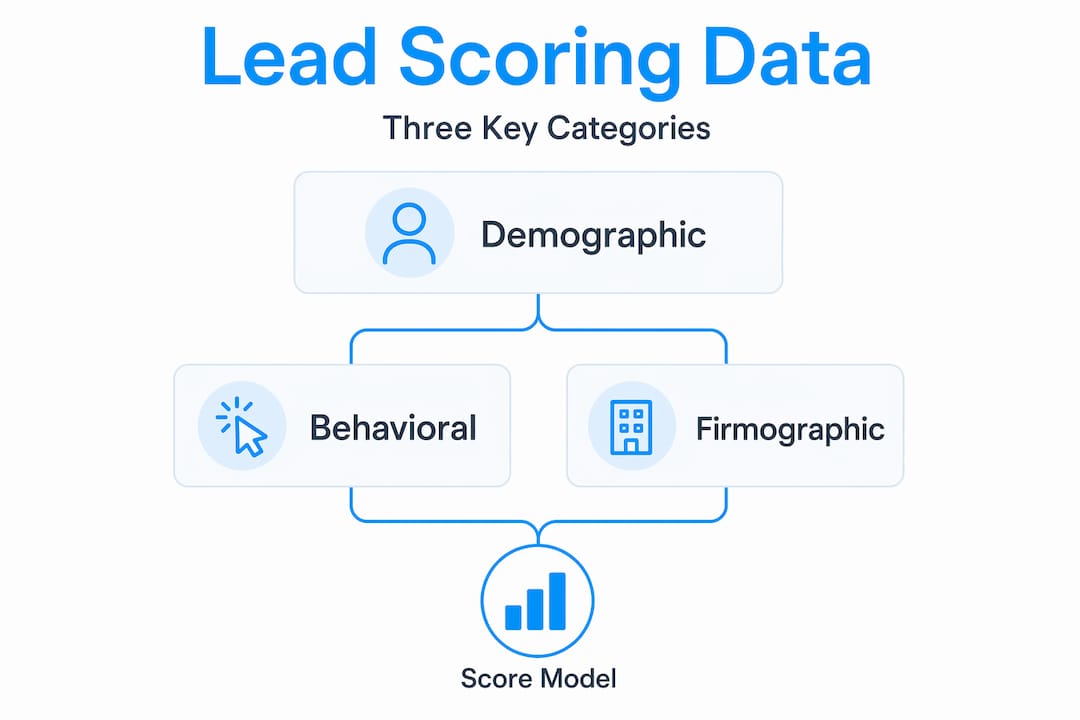
These three data types feed into a scoring model that translates activity and fit into a number your sales team can act on. The output is a ranked list of leads, sorted by how ready they appear to buy.
Understanding lead scoring also means knowing the terminology. A Marketing Qualified Lead (MQL) is a contact who has crossed a score threshold indicating marketing readiness. A Sales Qualified Lead (SQL) is one that sales has reviewed and agreed is worth pursuing. The gap between those two definitions is where alignment either happens or breaks down.
The importance of lead scoring goes beyond simple prioritization. It shortens sales cycles by surfacing the right conversations at the right time. It reduces wasted effort on leads who are browsing rather than buying. And it gives marketing concrete feedback on which prospect segments actually convert, closing the loop on campaign effectiveness. When scoring works, conversion rates improve, average deal size tends to rise, and the relationship between marketing and sales becomes less adversarial.
Lead scoring models compared
There is no single correct way to score leads. The right approach depends on the volume of data you have, the complexity of your buyer journey, and how much technical infrastructure you can support. Here is how the main models stack up:
| Model type | Data needed | Complexity | Expected accuracy |
|---|---|---|---|
| Manual point system | Basic CRM data | Low | Low to moderate |
| Rules-based | CRM + behavioral triggers | Low to medium | Moderate |
| Predictive ML | Historical conversion data | High | High |
| Intent-based | Third-party intent signals | Medium | Medium to high |
| Relational ML | Network and graph data | Very high | Very high |
Manual point systems are the starting point for most teams. You assign fixed values to attributes and actions, tally them up, and apply a threshold. The problem is that these weights are based on assumption, not evidence.

Rules-based scoring adds conditional logic. A lead who visits the pricing page three times and works at a company with more than 200 employees might trigger an automatic escalation. This approach is more responsive than static points but still relies on human-defined rules that can go stale quickly.
Predictive ML models learn weights from historical conversion data, which means they identify patterns that no human analyst would think to code manually. They consistently outperform rules-based systems in accuracy as data volume grows.
Intent-based scoring layers in third-party signals, such as what content a prospect is consuming across the web outside your own properties. This adds useful context but depends on the quality of your data vendor.
The most sophisticated approach is relational ML. This model maps relationships between contacts and accounts as a network. One of its most powerful outputs is the “colleague signal,” where employees convert 3-5x more often when a peer at their company has already converted. Flat point systems cannot capture that dynamic at all.
Pro Tip: Start with a rules-based model and collect 12 months of conversion data before moving to predictive ML. Jumping straight to machine learning without sufficient historical data produces unreliable outputs that will erode sales trust quickly.
How to build an effective lead scoring model
Building a model that your sales team will actually use requires a structured process. Here is how to approach it from scratch or rebuild one that has gone off the rails.
-
Analyze past conversions. Pull the last 12 months of closed-won data and identify what those contacts had in common before they converted. Behavioral signals from recent data give you the most accurate basis for assigning point weights. Look for patterns in job title, company size, content consumed, and engagement timeline.
-
Define your Ideal Customer Profile (ICP). Every attribute in your scoring model should map back to the ICP. If a CFO at a 50-person professional services firm is your best buyer, give those attributes the highest positive weight.
-
Select a minimal set of criteria. Resist the urge to score everything. Bloated models reduce trust and become impossible to maintain. Start with five to eight well-validated attributes and behaviors.
-
Assign weights based on evidence, not opinion. A pricing page visit might be worth 25 points. A single email open might be worth 3. The difference reflects actual purchase intent correlation, not guesswork.
-
Add negative scoring. Score decay for inactivity and explicit deductions for unsubscribes, wrong job titles, or competitor company domains prevent score inflation. Without negative scoring, old leads accumulate points and clog your pipeline.
-
Set thresholds with your sales team. The MQL threshold is not a marketing decision. It is a joint agreement. Without that collaboration, scoring systems lose credibility and fail to improve conversions over time.
-
Embed scoring into your CRM workflows. A score that exists only in a spreadsheet is not a system. Trigger automated follow-up sequences, route leads to the right reps, and surface scores inside the tools your team already uses.
-
Launch simply and iterate. Initial implementation takes 4-8 weeks before you see enough data to refine your model. Expect to recalibrate after the first 90 days.
Pro Tip: When presenting your scoring model to sales for the first time, bring examples: three real leads that scored high and why, and three that scored low and why. Concrete examples build buy-in faster than any slide deck.
Advanced signals that sharpen scoring accuracy
Once your foundational model is running, the biggest performance gains come from rethinking which signals actually correlate with conversion and which ones just create noise.
The most important shift is moving away from volume-based thinking. Legacy scoring systems prioritize activity volume over true intent quality, which produces misleading results. A contact who opened your newsletter fourteen times but never visited a product page is not further along the buyer journey than someone who spent eight minutes on your pricing page once.
Here are the signals worth prioritizing when refining your model:
- Recency weighting: A content download from last week means far more than one from eight months ago. Apply time decay so recent behavior carries more weight.
- Content progression: A lead who moves from a top-of-funnel blog post to a case study to a pricing comparison is signaling intent through content sequencing, not just volume.
- Product usage signals: If your platform has a freemium tier or trial, feature adoption depth predicts conversion better than almost any marketing behavior. Time-in-app, feature activations, and integration setups all belong in your model.
- Relational data: The colleague signal in relational ML is among the most underused signals in B2B scoring. When one person at a firm converts, the conversion probability of their colleagues rises dramatically. Flat point systems miss this entirely.
“Lead scoring must be a collaborative effort between marketing and sales to build and maintain trust.” — How to Build a Lead Scoring System
Score drift is also a real threat. If your model lacks negative scoring and decay rules, contacts who were active six months ago and have since gone silent continue to appear at the top of the queue. Your sales team stops trusting the list. That is when the entire system starts to fail. Embedding lead nurturing sequences alongside your scoring model helps re-engage lapsed contacts before their scores decay completely.
Measuring and optimizing your scoring model
Launching a lead scoring system is the beginning, not the finish line. The model needs active governance to stay accurate and relevant.
These are the metrics worth tracking from day one:
- MQL-to-SQL conversion rate: If only 20% of your MQLs become SQLs, your threshold is too low or your criteria are off.
- Time from score threshold to closed deal: A shorter timeline after reaching your MQL threshold indicates the model is surfacing leads at the right moment.
- Score distribution: A healthy model produces a spread. If 80% of your database is clustered near your threshold, your criteria lack discrimination.
- Revenue influence: Track the percentage of closed-won revenue that came from scored leads versus unscored ones.
Quarterly recalibration is the baseline expectation. Buyer behavior shifts. Your product evolves. A new competitor enters the market and changes the research patterns of your prospects. A model built on last year’s conversion data will drift out of alignment with this year’s buyers without regular review.
Governance also matters in a less obvious way. The main cause of scoring failure is not bad technology. It is the absence of a defined process for maintaining and updating the model. Assign ownership, schedule quarterly reviews, and document every change you make.
What actually makes lead scoring succeed
I have watched a lot of lead scoring implementations land and a lot of them quietly get abandoned. The difference rarely comes down to the sophistication of the model.
In my experience, the teams that succeed treat the initial scoring model as a hypothesis, not a solution. They launch with five clean criteria, get sales to agree on what an MQL actually looks like, and then spend the first quarter listening. What signals are showing up in the leads that closed? What signals were present in the leads that went quiet? That iterative mindset changes everything.
What I have seen fail consistently is the opposite: a marketing team spending two months building an elaborate 40-criterion model that no one from sales was consulted on. The scores look impressive in a dashboard. But when a sales rep opens a contact record and sees a score of 87 on someone who submitted a form two years ago and never responded to a follow-up, they stop looking at the scores at all. Trust evaporates fast and is slow to rebuild.
I also think the colleague signal is one of the most underappreciated concepts in B2B scoring right now. The idea that someone is three to five times more likely to convert simply because a colleague already has. That is not a small lift. That is a fundamentally different way of thinking about account-level behavior, and most teams are not capturing it at all.
The practical advice I give every team I work with: do not try to build the most sophisticated model possible on day one. Build the most trusted one. Simplicity with sales buy-in outperforms complexity every time.
— Toby
Ready to turn better scoring into real meetings?
Understanding lead scoring theory is one thing. Applying it to a live pipeline with a real ICP is where most teams need support.
At Theleadlab, we work specifically with professional services firms and B2B consultancies to build outreach strategies that feed your scoring model with genuinely qualified prospects. From targeted LinkedIn prospecting to personalized message sequences and response management, our campaigns are designed to surface leads who match your best buyer profile from the first touchpoint. Browse the Theleadlab services to see how we approach lead qualification, or explore our client portfolio to see what results look like in practice. If you want your scoring model to work, start with better leads going in.
FAQ
What is lead scoring in simple terms?
Lead scoring is a method for ranking prospects by their likelihood to convert, using a combination of demographic fit and behavioral signals like page visits, content downloads, and email engagement.
How do you score leads effectively?
Effective lead scoring starts with analyzing past conversion data to identify the attributes and behaviors that correlate with closed deals, then assigning weighted point values to those signals and incorporating negative scoring for disengagement. The thresholds should be set jointly with your sales team.
How often should a lead scoring model be updated?
Models should be recalibrated quarterly to account for shifts in buyer behavior, product changes, and market conditions. Outdated models degrade conversion performance over time.
What is the difference between MQL and SQL?
An MQL (Marketing Qualified Lead) has crossed a score threshold set by marketing, indicating readiness for sales outreach. An SQL (Sales Qualified Lead) has been reviewed and accepted by sales as worth pursuing. The threshold between these two is best defined collaboratively.
Why do most lead scoring systems fail?
The primary cause of failure is lack of ongoing governance, not poor technology. Without regular reviews, ownership, and sales alignment, even well-built models drift out of accuracy and lose the trust of the teams they were built to serve.