
Most professional services firms assume LinkedIn lead generation depends on volume, blasting connection requests to hundreds of prospects weekly. Yet personalized messaging doubles reply rates compared to generic pitches, revealing that quality trumps quantity. The real challenge isn’t reaching more people but crafting messages that resonate, build trust, and move prospects into meaningful conversations. This guide clarifies how strategic messaging transforms LinkedIn outreach from noise into pipeline growth, showing B2B marketing leaders exactly how to leverage personalized, value-first communication for superior lead generation results.
Table of Contents
- Key takeaways
- Why messaging is central to LinkedIn lead generation success
- Balancing inbound and outbound: the hybrid approach to messaging and content
- Crafting effective LinkedIn messages: best practices for professional services firms
- Measuring messaging impact: tracking pipeline influence over simple reply rates
- Boost your lead generation with expert messaging strategies
- FAQ
Key Takeaways
| Point | Details |
|---|---|
| Personalized messaging boosts replies | Tailored value driven messages substantially increase response rates versus generic outreach. |
| Quality over quantity | Focusing on message relevance and trust leads to warmer conversations and faster progression through the sales cycle. |
| Hybrid inbound outbound yields conversions | A balanced mix of inbound content and outbound outreach delivers the highest lead conversion rates. |
| Measure pipeline influence | Measuring pipeline influence is more valuable than tracking replies alone. |
Why messaging is central to LinkedIn lead generation success
LinkedIn has become the primary channel for B2B lead generation in professional services, with decision makers actively using the platform to research solutions and connect with potential partners. Yet most firms struggle to convert this opportunity into actual pipeline because they misunderstand how messaging drives engagement.
Generic connection requests produce dismal results. Industry data shows typical cold outreach on LinkedIn generates reply rates around 5.44%, meaning 19 out of 20 prospects ignore your message entirely. This low engagement stems from one core problem: prospects receive dozens of identical, self-serving pitches weekly and have learned to tune them out completely.
Adding personalized, value-driven messages boosts replies to over 9%, nearly doubling engagement by demonstrating genuine interest in the prospect’s specific challenges. When you reference a recent company announcement, acknowledge an industry challenge they face, or share a relevant insight before asking for anything, you immediately differentiate yourself from the noise.
Value-first messaging builds trust by leading with how you can help rather than what you want to sell. This approach positions you as a knowledgeable resource instead of another vendor chasing a quota. Prospects respond because the conversation feels relevant to their current priorities rather than an interruption.
Messaging quality directly impacts pipeline development and lead quality in ways that volume never can. Consider this reality:
- Personalized messages create warmer initial conversations that progress faster through the sales cycle
- Generic outreach attracts tire kickers who respond out of curiosity but lack genuine buying intent
- Value-driven communication filters for prospects who recognize your expertise and see potential fit
- Thoughtful follow-up sequences maintain engagement without feeling pushy or desperate
“The difference between effective and ineffective LinkedIn messaging isn’t creativity or clever copywriting. It’s whether you’ve done enough research to make your outreach genuinely relevant to that specific person at that specific moment.”
This fundamental shift from broadcast messaging to targeted, personalized communication requires more upfront effort per prospect but generates dramatically better results. Our LinkedIn outreach messaging guidelines detail how professional services firms can implement this approach systematically without sacrificing scale.
Balancing inbound and outbound: the hybrid approach to messaging and content
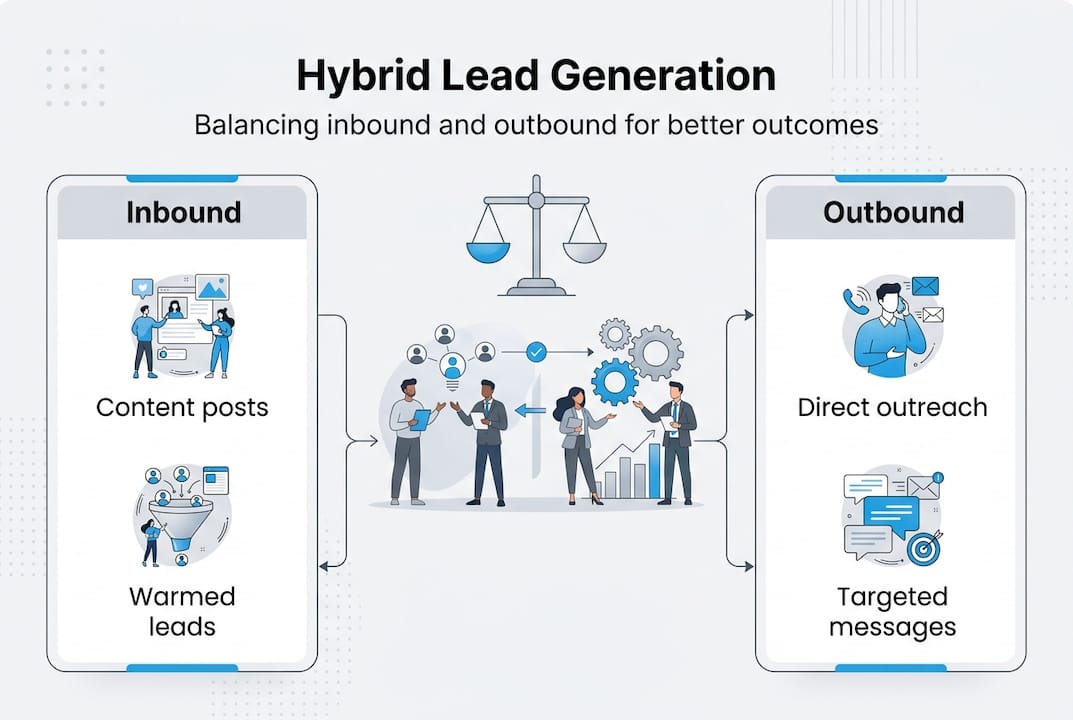
The debate between inbound marketing and outbound prospecting has polarized B2B marketers for years, with advocates on both sides claiming their approach delivers superior results. The truth is more nuanced and reveals why the most successful professional services firms embrace both strategies in concert.
Inbound marketing via content creation warms prospects organically and reduces lead acquisition costs significantly. When you publish valuable articles, host webinars, or share insights on LinkedIn, interested prospects discover you naturally and arrive pre-qualified with awareness of your expertise. Inbound lead generation converts leads 3x more efficiently at 62% lower cost compared to cold outbound, making it incredibly attractive from a cost-per-lead perspective.
Outbound messaging drives direct engagement but typically produces lower conversion rates when used in isolation. Cold outreach requires more touches to build trust and often faces skepticism from prospects who didn’t seek you out. However, outbound excels at reaching specific high-value targets who may never discover you organically, allowing you to proactively pursue ideal clients rather than waiting for them to find you.

The magic happens when you combine both methods strategically. Hybrid outbound messaging doubles revenue by creating multiple touchpoints that reinforce your expertise and build familiarity over time. A prospect might see your LinkedIn post about solving a specific challenge, receive a personalized connection request referencing that content, and then engage with a follow-up message offering additional relevant insights.
| Approach | Primary Strength | Typical Conversion Rate | Best Use Case |
|---|---|---|---|
| Inbound Only | Cost efficiency and warm leads | 14.6% average | Building long-term brand awareness and attracting active buyers |
| Outbound Only | Targeting precision and speed | 5.44% average | Reaching specific accounts or decision makers proactively |
| Hybrid Strategy | Synergistic touchpoints and trust | 24.4% average | Maximizing both reach and conversion quality simultaneously |
Hybrid approaches measure pipeline influence rather than focusing solely on quick replies or immediate conversions. This longer-term perspective recognizes that B2B buying cycles in professional services often span months, with multiple stakeholders involved in decisions. Your messaging might plant seeds that germinate weeks later when budget gets approved or priorities shift.
Successful hybrid strategies follow this pattern:
- Publish thought leadership content that demonstrates expertise on specific challenges your prospects face
- Use that content to identify engaged prospects who comment, share, or view your profile after reading
- Send personalized outreach messages that reference the content and offer additional value specific to their situation
- Continue nurturing with a mix of valuable content shares and direct communication until timing aligns
Pro Tip: Track which content topics generate the most profile views and engagement, then customize your outbound messaging to reference those specific themes when reaching out to similar prospects.
Our integrated content and messaging strategies help professional services firms orchestrate this hybrid approach without overwhelming internal teams or creating disjointed prospect experiences.
Crafting effective LinkedIn messages: best practices for professional services firms
Understanding why personalized messaging works matters less than knowing how to execute it consistently across your outreach campaigns. These proven practices help professional services firms create LinkedIn messages that generate replies, build relationships, and drive pipeline growth.
-
Research each prospect before writing a single word. Review their recent posts, company news, shared connections, and profile details to identify relevant conversation starters. This investment takes three to five minutes per prospect but transforms generic outreach into genuinely personalized communication.
-
Lead with clear value by explaining how you can help solve a specific challenge rather than listing your services. Your first message should answer the prospect’s immediate question: “Why should I care about this message right now?” Focus on their priorities, not your capabilities.
-
Keep messages concise and conversational, aiming for 75 to 100 words maximum in initial outreach. Busy executives scan messages quickly and ignore anything that looks like a lengthy sales pitch. Write like you’re talking to a colleague, not delivering a formal presentation.
-
Avoid sales jargon and industry buzzwords that trigger skepticism. Phrases like “innovative solution” or “game-changing platform” sound like every other vendor pitch prospects receive daily. Use specific, concrete language that describes actual outcomes instead.
-
Ask relevant questions that invite dialogue rather than making requests that feel transactional. “Would you be open to a 15-minute call?” puts pressure on the prospect, while “What’s your current approach to solving X challenge?” invites them to share their perspective and engage naturally.
-
Follow up intelligently with additional value, not reminder messages. If a prospect doesn’t respond to your initial outreach, send a follow-up that shares a relevant article, insight, or resource rather than asking “Did you see my last message?” This approach gives them another reason to engage.
-
Test different messaging approaches and track which variations generate better response rates. A/B test your opening lines, value propositions, and calls to action across similar prospect segments to identify what resonates most effectively.
Pro Tip: Review reply rates and meeting conversion metrics weekly to catch messaging fatigue early. If your response rates drop below your baseline, refresh your approach before burning through more prospects with ineffective outreach.
Value-driven, personalized LinkedIn messages outperform generic outreach by 2x in reply rates, but only when you maintain authenticity and avoid automation that feels robotic. Prospects can immediately detect templated messages with merge fields awkwardly inserted, which destroys trust faster than no outreach at all.
The best messaging feels like genuine human communication because it is. While you can systematize your research process and create frameworks for common scenarios, each message should read like you wrote it specifically for that individual prospect. This attention to personalization separates professional services firms that generate consistent pipeline from those that waste time on ineffective spray-and-pray tactics.
Explore our high-performing outreach messaging tactics to see real examples of messages that converted cold prospects into qualified pipeline for professional services clients.
Measuring messaging impact: tracking pipeline influence over simple reply rates
Most marketing teams celebrate high reply rates as proof their LinkedIn messaging works, but this surface-level metric often masks deeper problems with lead quality and conversion effectiveness. Smart measurement focuses on pipeline contribution and revenue attribution instead.
Reply rates show initial engagement but reveal nothing about pipeline quality or business outcomes. A 15% reply rate sounds impressive until you discover that 80% of those replies are polite brush-offs or prospects who lack budget, authority, or genuine need. Conversely, a 6% reply rate might generate exceptional results if those conversations convert to qualified opportunities at high rates.
Tracking marketing-sourced pipeline reveals true messaging ROI by connecting your outreach efforts to actual revenue opportunities. This requires integrating your LinkedIn messaging campaigns with CRM systems that attribute deals back to their original source, allowing you to calculate cost per qualified lead and cost per closed deal rather than just cost per reply.
Hybrid inbound-outbound strategies should measure pipeline influence, not just message replies, because B2B buying journeys involve multiple touchpoints over extended timeframes. The LinkedIn message that starts a conversation might be the seventh interaction a prospect has with your brand, following content downloads, webinar attendance, and profile views. Attribution modeling helps you understand which combination of activities drives conversions.
Use CRM analytics and marketing automation platforms to connect messaging campaigns to revenue by tracking these essential metrics:
- Reply rate: percentage of prospects who respond to initial outreach messages
- Meeting conversion rate: percentage of replies that result in scheduled discovery calls or demos
- Qualified lead rate: percentage of meetings that meet your ideal customer profile criteria
- Opportunity creation rate: percentage of qualified leads that enter your sales pipeline
- Close rate: percentage of opportunities that convert to closed-won deals
- Average deal size: revenue per closed deal from messaging-sourced opportunities
- Sales cycle length: time from first message to closed deal
This comprehensive view shows whether your messaging attracts the right prospects and moves them efficiently through your sales process. You might discover that certain message types generate fewer replies but higher-quality conversations that close faster and at larger deal sizes.
| Metric | Inbound Only | Outbound Only | Hybrid Approach |
|---|---|---|---|
| Initial Engagement Rate | 8.2% | 5.44% | 9.1% |
| Meeting Conversion | 18% | 12% | 22% |
| Qualified Lead Rate | 62% | 38% | 58% |
| Opportunity Creation | 45% | 28% | 52% |
| Close Rate | 32% | 19% | 38% |
These comparative benchmarks illustrate why hybrid strategies consistently outperform single-channel approaches across the entire funnel, not just at the top where reply rates get measured. The compounding effect of higher conversion rates at each stage produces dramatically better pipeline outcomes even when initial engagement rates differ only slightly.
Professional services firms that implement rigorous measurement discover insights that transform their lead generation effectiveness. You might learn that prospects from certain industries convert at 3x rates compared to others, allowing you to focus messaging efforts on the highest-value segments. Or you might find that messages referencing specific pain points generate meetings that close 40% faster than generic value propositions.
Our lead generation measurement techniques help clients build attribution models that connect LinkedIn messaging to revenue outcomes, enabling data-driven optimization of targeting, messaging, and follow-up strategies.
Boost your lead generation with expert messaging strategies
Implementing the strategic messaging approaches outlined in this guide requires dedicated expertise, consistent execution, and ongoing optimization that most professional services firms struggle to maintain alongside client delivery responsibilities. That’s where The Lead Lab creates immediate value.
We specialize in tailored LinkedIn messaging strategies designed specifically for professional services firms seeking to generate qualified pipeline without distracting internal teams from billable work. Our proven approach integrates personalized outreach with strategic content to maximize lead generation results through the hybrid methodology that data shows produces superior conversion rates.
Every campaign we design starts with deep research into your ideal client profiles, competitive positioning, and unique value propositions that resonate with decision makers in your target markets. We craft messaging that sounds authentically like your firm while incorporating the personalization and value-first communication that doubles reply rates compared to generic outreach.
Explore our success stories to see real case studies demonstrating how we’ve helped professional services clients generate consistent qualified meetings and measurable pipeline growth through strategic LinkedIn messaging. Partner with The Lead Lab to leverage expert integrated messaging solutions that drive results while you focus on serving clients.
FAQ
What is the main role of messaging in LinkedIn lead generation?
Messaging initiates personalized conversations that build trust and move prospects into your sales pipeline by demonstrating genuine interest in their specific challenges. Effective messaging differentiates your outreach from the generic pitches prospects ignore, creating meaningful engagement that leads to qualified opportunities.
How does personalized messaging improve lead generation results?
Personalized messages double reply rates compared to generic ones because they resonate more deeply with prospects and convey genuine interest rather than automated sales pitches. This relevance enhances trust and dramatically increases the likelihood that prospects will respond and engage in substantive conversations about their needs.
Why combine inbound content with outbound messaging in B2B lead gen?
Inbound content nurtures brand awareness and establishes expertise that warms prospects before direct outreach, while outbound messaging targets specific high-value prospects proactively for faster engagement. Combining both approaches leads to 67% higher conversion rates by creating multiple reinforcing touchpoints that build trust and familiarity throughout extended B2B buying cycles.
What metrics should professional services firms track for LinkedIn messaging campaigns?
Track pipeline influence metrics including reply rates, meeting conversion rates, qualified lead percentages, opportunity creation rates, close rates, average deal sizes, and sales cycle length rather than focusing solely on initial engagement. These comprehensive measurements reveal true ROI by connecting messaging efforts to actual revenue outcomes and business growth.
How can firms maintain personalization at scale in LinkedIn outreach?
Systematize your research process using frameworks that identify relevant personalization points quickly, then craft message templates with flexible sections that you customize for each prospect based on their specific situation. Balance efficiency with authenticity by investing research time proportional to prospect value and avoiding automation tools that produce obviously templated messages that destroy trust.
6 responses