
Most B2B marketers pour hours into LinkedIn posts that vanish into the void, generating likes but zero qualified leads. The disconnect lies not in effort but in strategy. This guide walks you through a proven framework for LinkedIn content creation that transforms engagement into pipeline, covering preparation tactics, execution methods, and verification processes designed specifically for marketing leaders and consultants targeting qualified B2B prospects in 2026.
Table of Contents
- Preparing Your LinkedIn Content Strategy For Lead Generation
- Executing LinkedIn Content Creation: Formats, Messaging, And Posting Tactics
- Verifying And Optimizing Your LinkedIn Content For Sustained Qualified Leads
- Enhance Your LinkedIn Content Strategy With Expert Guidance
- Frequently Asked Questions
Key takeaways
| Point | Details |
|---|---|
| Strategic preparation | Define your ideal client personas and set measurable lead generation goals before creating any content. |
| Format diversification | Mix LinkedIn post types strategically to maximize engagement and demonstrate thought leadership effectively. |
| Performance tracking | Monitor KPIs through LinkedIn analytics integrated with CRM systems to identify what drives qualified leads. |
| Continuous optimization | Conduct monthly content audits and adjust tactics based on audience feedback and conversion data. |
| Common pitfall avoidance | Eliminate inconsistent posting, weak calls to action, and failure to analyze performance metrics. |
Preparing your LinkedIn content strategy for lead generation
Successful LinkedIn content starts long before you write your first post. Setting clear goals and audience targeting significantly improves LinkedIn lead generation outcomes, yet many marketers skip this foundation and wonder why their content fails to convert. Your preparation phase determines whether your content attracts tire kickers or decision makers.
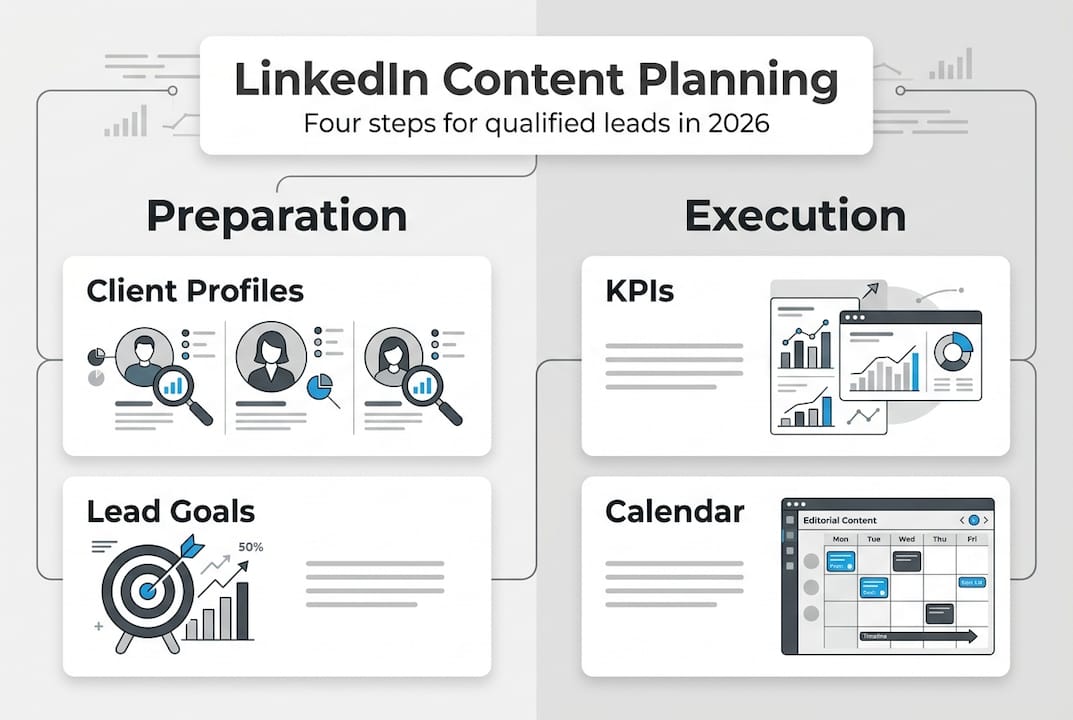
Start by building detailed profiles of your ideal B2B clients on LinkedIn. Go beyond basic demographics like job titles and company size. What challenges keep them awake at night? Which industry trends threaten their quarterly targets? What language do they use when describing their pain points? Mine your CRM data, interview your sales team, and analyze your best existing clients to create personas that feel like real people, not abstract categories.
Next, define specific lead generation goals tied directly to business outcomes. Vague aspirations like “increase engagement” mean nothing to your bottom line. Instead, set concrete targets such as generating 25 qualified discovery calls per quarter or adding 150 decision makers to your pipeline monthly. These numbers give you a benchmark for measuring success and justify your content investment to leadership.
Select KPIs that actually predict lead quality, not vanity metrics. Connection acceptance rates tell you if your targeting works. Content engagement rates reveal which topics resonate with your audience. Inbound message volume indicates whether your thought leadership builds credibility. Most importantly, track how many engaged connections convert to qualified opportunities in your CRM. This closed loop measurement separates content that looks good from content that generates revenue.
Create a content calendar aligned with your prospects’ buying cycles and online behavior patterns. If you target CFOs, recognize they face quarterly closing pressures and year end planning cycles. Schedule content addressing these pain points when they’re most acute. Use LinkedIn analytics to identify when your audience is most active, then batch create content for consistent delivery during those windows.
Pro Tip: Connect your LinkedIn Campaign Manager data directly to your CRM platform to track which content pieces generate not just clicks but actual sales conversations. This integration reveals your true content ROI and identifies which topics deserve more investment versus which ones waste your time.
Your preparation work creates a strategic foundation that guides every content decision. Without it, you’re essentially throwing spaghetti at the wall and hoping something sticks. With it, you build a systematic approach to turning LinkedIn connections into qualified pipeline.
Executing LinkedIn content creation: formats, messaging, and posting tactics
Once your strategy is set, execution determines whether your content cuts through LinkedIn’s noise or gets ignored. The platform rewards diverse content formats, so relying solely on text posts limits your reach and impact. Smart marketers in 2026 deploy a strategic mix that showcases expertise while meeting audiences where their attention lives.
Your format selection should match your message and audience preferences. Native videos build personal connection and demonstrate authenticity, making them ideal for sharing insights or client success stories. Long form articles establish thought leadership on complex topics and boost your profile’s search visibility. Image posts with compelling visuals stop scrollers mid feed and work well for data visualization or quote cards. Polls generate engagement and provide audience research while keeping your name visible. LinkedIn newsletters build a subscriber base you own, creating recurring touchpoints with your best prospects.
| Format | Primary Strength | Best Use Case | Typical Engagement |
|---|---|---|---|
| Native Video | Personal connection and authenticity | Client testimonials, behind the scenes insights, quick tips | High shares, moderate comments |
| Long Form Articles | Thought leadership depth | Complex problem solving, industry analysis, frameworks | High profile views, quality leads |
| Image Posts | Visual impact and scroll stopping power | Data visualization, quote cards, infographics | High likes, moderate shares |
| Polls | Direct engagement and audience research | Gather insights, spark discussion, maintain visibility | High votes, quality comments |
| Newsletters | Owned audience and recurring touchpoints | Regular updates, curated insights, relationship building | Subscriber growth, direct messages |
Craft messages that prioritize audience value over self promotion. Your prospects face real challenges that threaten their success. Address those pain points directly with insights they can implement immediately. Share frameworks, templates, or mental models that make their jobs easier. Position your content as a helpful resource, not a sales pitch disguised as thought leadership.
Every piece of content needs a clear call to action aligned with your lead generation goals. Don’t leave readers wondering what to do next. Invite them to download a resource, book a consultation, or share their biggest challenge in the comments. Make your CTA specific and low friction. “Drop a comment with your biggest LinkedIn challenge” generates more responses than “Let me know your thoughts.”
Follow these steps to create high impact LinkedIn posts:
- Open with a pattern interrupt that stops the scroll, such as a surprising statistic or counterintuitive statement that challenges conventional wisdom.
- Develop your core insight with specific examples or mini case studies that prove your point and build credibility through demonstrated expertise.
- Break up text with white space, bullet points, or numbered lists to improve readability and keep attention on mobile devices.
- Close with a clear call to action that moves prospects one step closer to a sales conversation without feeling pushy or salesy.
- Include relevant hashtags strategically, focusing on 3 to 5 terms your target audience actually follows rather than spamming with dozens of irrelevant tags.
Timing matters more than most marketers realize. Diverse LinkedIn post formats and optimized messaging improve professional engagement and lead conversion, but posting at 2 AM when your audience is asleep wastes that effort. Analyze your LinkedIn analytics to identify when your connections are most active, then schedule posts for those windows. For most B2B audiences, Tuesday through Thursday mornings generate peak engagement, though your specific audience may differ.
Consistency trumps perfection. Posting three solid pieces weekly beats publishing one “perfect” post monthly. Your audience needs regular touchpoints to remember you exist and recognize your expertise. Build a sustainable content rhythm you can maintain long term rather than burning out with an unsustainable sprint.
Pro Tip: Repurpose your top performing content into multiple formats to extend its reach and lifespan. Turn a popular article into a video summary, extract key points into an infographic, or expand insights into a newsletter series. This approach maximizes ROI on your best ideas while serving different audience consumption preferences.
Explore The Lead Lab’s portfolio of LinkedIn content formats to see how strategic content mix drives measurable results. Study proven LinkedIn content strategies that convert engagement into qualified pipeline.
Verifying and optimizing your LinkedIn content for sustained qualified leads
Creating great content means nothing if you can’t measure its impact and improve over time. Regular performance analysis and correction of content missteps greatly enhance LinkedIn lead generation. The verification phase separates marketers who generate consistent results from those who wonder why their efforts fail to produce pipeline.

Monitor your KPIs weekly using LinkedIn’s native analytics dashboard integrated with your CRM system. Track which content pieces generate the most profile views, connection requests, and direct messages from qualified prospects. Identify patterns in your top performers. Do certain topics consistently outperform others? Does one format drive more qualified conversations than alternatives? Use these insights to double down on what works and eliminate what doesn’t.
Many marketers sabotage their LinkedIn success through easily avoidable mistakes. Inconsistent posting trains your audience to forget you exist. Weak or missing calls to action leave engaged readers with nowhere to go. Ignoring comments and messages signals you’re not interested in real conversations. Failing to analyze performance means you repeat mistakes instead of learning from them. Each error costs you qualified leads and wastes your content investment.
| Common Mistake | Why It Fails | Optimized Approach |
|---|---|---|
| Sporadic posting schedule | Audience forgets you exist between posts | Maintain consistent 3 to 5 posts weekly |
| Generic, vague messaging | Fails to address specific pain points | Target precise challenges with actionable solutions |
| No clear call to action | Engaged readers don’t know next steps | Include specific, low friction CTA in every post |
| Ignoring engagement signals | Misses opportunities to build relationships | Respond to all comments within 24 hours |
| Publishing without analysis | Repeats failures instead of learning | Review metrics weekly and adjust strategy monthly |
Troubleshoot underperforming content systematically:
- Low impressions suggest your posting time misses your audience’s active hours or your network needs expansion through strategic connection building.
- High impressions but low engagement indicate your hook fails to stop the scroll or your content doesn’t deliver on the promise your opening makes.
- Strong engagement but few qualified leads means your audience targeting is off or your call to action doesn’t align with your lead generation goals.
- Qualified conversations that don’t convert suggest a disconnect between your content promises and your actual service delivery or sales process.
Schedule monthly content audits to maintain strategic alignment. Review your top and bottom performing posts from the past 30 days. What patterns emerge? Which topics generated the most qualified conversations? Did format changes impact results? Use these insights to refine your content calendar and messaging for the next month.
Analyze audience sentiment beyond simple engagement metrics. Read comments carefully to understand what resonates and what confuses your prospects. Track the language they use when describing their challenges. This qualitative feedback often reveals opportunities that quantitative data misses.
Pro Tip: Create a simple spreadsheet tracking each post’s topic, format, publish time, and key metrics alongside any qualified leads it generated. This database becomes invaluable for identifying your unique content formula and training team members on what actually works for your specific audience.
“Content optimization isn’t about chasing viral posts. It’s about systematically identifying which topics and formats move your specific target accounts closer to sales conversations, then doing more of that and less of everything else.”
Integrate LinkedIn optimization techniques into your monthly review process to ensure continuous improvement. The marketers who win on LinkedIn in 2026 aren’t necessarily the most creative. They’re the most systematic about measuring what matters and adjusting based on data.
Enhance your LinkedIn content strategy with expert guidance
Mastering LinkedIn content creation takes time, testing, and expertise most marketing teams lack internally. The Lead Lab specializes in building LinkedIn content strategies that generate qualified pipeline for B2B professional services firms. Our team handles everything from audience research and content creation to performance analysis and optimization, letting you focus on closing deals instead of crafting posts.
Explore our LinkedIn content portfolio to see real campaigns driving measurable results for clients like yours. We’ve helped hundreds of B2B marketers transform their LinkedIn presence from occasional posting into a systematic lead generation engine. Our done for you approach combines strategic planning, consistent execution, and data driven optimization to deliver qualified conversations at scale. Partner with experts who understand the nuances of LinkedIn’s 2026 algorithm and know how to position your firm as the obvious choice for your ideal clients.
Frequently asked questions
How often should I post LinkedIn content to maximize lead generation?
Posting three to five times per week maintains visibility without overwhelming your audience or burning out your content team. Consistency matters more than volume, so choose a sustainable rhythm aligned with your audience’s engagement patterns. Use LinkedIn analytics to identify when your connections are most active, then schedule posts for those windows to maximize initial engagement and algorithmic distribution.
What LinkedIn post format tends to generate the most qualified leads?
Native videos and long form articles typically yield the highest quality leads because they allow deeper demonstration of expertise and build stronger personal connections. Videos showcase your personality and communication style, helping prospects determine if they want to work with you before reaching out. Articles position you as a thought leader on complex topics, attracting prospects who value strategic thinking and are willing to invest in premium solutions.
How can I measure if my LinkedIn content is generating qualified leads?
Track engagement metrics coupled with lead conversion rates using LinkedIn analytics integrated with your CRM system. Monitor connection requests from target accounts, direct message inquiries about your services, and pipeline velocity for leads who engaged with your content before converting. The most valuable metric is qualified opportunities created per content piece, which requires tagging leads in your CRM based on their LinkedIn interaction history.
What common mistakes should I avoid when creating LinkedIn content for leads?
Avoid inconsistent posting schedules that train your audience to forget you, weak or missing calls to action that leave engaged readers with no next step, ignoring comments and messages that signal disinterest in real conversations, and failing to analyze performance data that would reveal what works. Additionally, ensure your content addresses your target audience’s specific pain points rather than generic industry observations that could apply to anyone. Every post should deliver immediate value that makes prospects think you understand their world better than competitors.
3 responses