
Most marketing professionals believe personalized messaging means inserting a prospect’s first name into a LinkedIn template. This misconception costs professional services firms countless qualified leads every day. True personalized messaging goes far beyond superficial customization, it requires understanding prospect pain points, industry context, and strategic timing to drive meaningful engagement. This guide reveals what personalized messaging actually entails and delivers proven frameworks to transform your LinkedIn outreach into a consistent lead generation engine for your professional services firm.
Table of Contents
- Understanding Personalized Messaging In B2B LinkedIn Outreach
- Techniques And Frameworks For Crafting Effective Personalized Messages
- Comparing Personalized Messaging Types And Their Impact On Lead Generation
- Implementing Personalized Messaging On LinkedIn For Professional Services Firms
- Leverage The Lead Lab For Expert Personalized Messaging Solutions
- What Is Personalized Messaging?
Key takeaways
| Point | Details |
|---|---|
| Beyond basic personalization | Effective personalized messaging requires contextual relevance and addresses specific prospect challenges, not just name insertion |
| Measurable impact on engagement | Tailored LinkedIn outreach increases response rates and builds stronger client relationships in professional services |
| Strategic frameworks matter | Clear methodologies for research, relevance, value delivery, and calls to action drive successful personalized campaigns |
| Platform-specific techniques | LinkedIn offers unique tools and features that enable sophisticated personalization for B2B professional services outreach |
| Implementation roadmap | Practical steps, metrics, and best practices help firms deploy personalized messaging strategies that generate qualified leads |
Understanding personalized messaging in B2B LinkedIn outreach
Personalized messaging represents a strategic communication approach that tailors every element of your outreach to match the specific needs, challenges, and context of individual prospects. Unlike generic templates that swap in basic details, genuine personalization demonstrates deep understanding of your prospect’s business situation, industry pressures, and professional goals. For professional services firms competing on LinkedIn, this distinction separates campaigns that generate qualified meetings from those that get ignored or deleted.
LinkedIn serves as the premier platform for B2B professional services outreach because decision makers actively use it to research solutions, evaluate partners, and engage with industry content. When you craft messages that reference a prospect’s recent company announcement, acknowledge their specific market challenges, or connect your expertise to their stated priorities, you signal that this isn’t mass outreach. You’ve invested time to understand their situation, which immediately elevates your credibility and personalized messaging client relationships become the foundation for trust.
Effective personalized messaging incorporates multiple data points beyond basic demographics. Research your prospect’s company trajectory, recent LinkedIn activity, shared connections, industry trends affecting their business, and competitive pressures they face. This intelligence enables you to craft opening lines that resonate, position your services as solutions to their actual problems, and demonstrate expertise in their specific context. Response rates improve dramatically when prospects recognize you understand their world.
Consider these essential elements of meaningful personalization:
- Prospect research that uncovers genuine business challenges and recent company developments
- Industry context showing awareness of market dynamics affecting their firm
- Relevance signals connecting your expertise directly to their stated needs or goals
- Timing aligned with their buying cycle, fiscal calendar, or organizational changes
Pro Tip: Create a prospect research checklist covering company news, LinkedIn posts, shared connections, and industry trends. Spend three minutes per prospect gathering these insights before crafting your message. This small investment yields response rates that justify the effort many times over.
The difference between basic and strategic personalization becomes clear in results. Messages using only names achieve response rates similar to generic outreach. Messages demonstrating contextual understanding and offering relevant value generate qualified conversations that convert to discovery calls and client relationships. For professional services firms where each new client represents significant revenue, this distinction matters enormously.

Techniques and frameworks for crafting effective personalized messages
Successful personalized messaging follows a proven framework that balances research depth with scalable execution. This four-step methodology ensures every message delivers value while maintaining efficiency across your outreach campaigns. Professional services firms using this approach consistently outperform competitors relying on generic templates or superficial customization.
Follow this framework for personalized messaging strategies that convert prospects into qualified leads:
Research your prospect thoroughly using LinkedIn profile analysis, company website review, recent news mentions, and industry publications. Identify specific challenges they likely face based on role, company stage, and market conditions.
Establish relevance by connecting one specific insight from your research to your opening line. Reference a recent post they shared, a company milestone, or an industry challenge affecting their firm. This proves you’ve done homework.
Deliver clear value by explaining how your expertise addresses the specific challenge you’ve identified. Avoid generic service descriptions. Instead, position your solution in the context of their situation with concrete examples or brief case mentions.
Include a focused call to action that requests a specific next step, typically a brief exploratory conversation. Make scheduling easy and respect their time by suggesting a 15-minute call rather than an open-ended meeting.
This framework works because it mirrors how professionals evaluate potential partners. They want to know you understand their business, can solve relevant problems, and respect their time. Messages following this structure feel consultative rather than sales-driven, which aligns perfectly with how professional services relationships begin.
Common personalization mistakes undermine otherwise solid outreach campaigns. Avoid inserting irrelevant personal details that feel intrusive or creepy, like mentioning family information or non-professional interests unless clearly relevant. Don’t overload messages with excessive flattery or multiple personalization attempts that make the message feel forced. Keep your tone professional and consultative, focusing on business value rather than relationship building in initial outreach.
Pro Tip: Test the balance between automation and genuine personalization by creating message templates with clear bracketed sections for custom research insights. This maintains consistency in structure while ensuring each message includes authentic, prospect-specific content that can’t be automated.
Another critical technique involves matching your message length and complexity to your prospect’s seniority and likely time constraints. Senior executives appreciate brevity and directness. Mid-level managers may engage with slightly longer messages that demonstrate deeper understanding. Adjust your approach based on who you’re reaching and what their typical day looks like.
The most effective personalized messages feel like the start of a professional conversation, not a sales pitch. Write as if you’re introducing yourself at an industry conference where you’ve done background research on attendees. Your goal is sparking interest in a follow-up discussion, not closing a deal in the first message. This mindset shift transforms how you craft every element of your outreach.
Comparing personalized messaging types and their impact on lead generation
Different personalization approaches deliver varying results depending on your target audience, service offering, and campaign goals. Understanding these distinctions helps you select the right strategy for your professional services firm’s LinkedIn outreach. Personalized messaging approaches comparison reveals that sophisticated tactics consistently outperform basic methods in generating qualified leads.
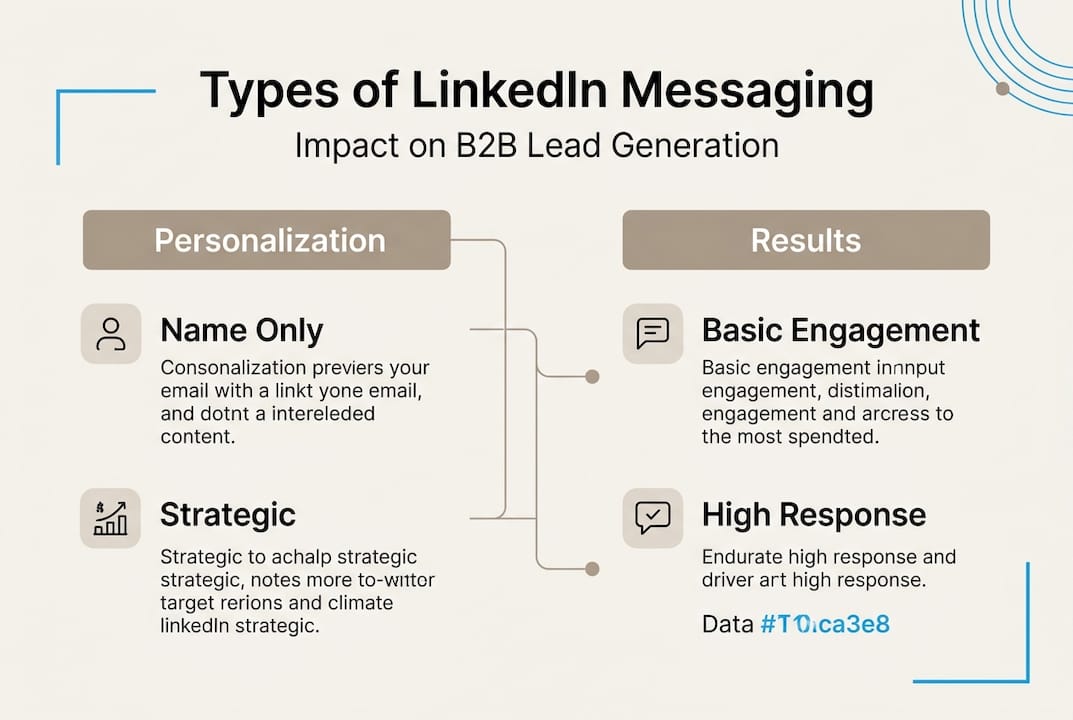
| Personalization Type | Key Benefits | Main Challenges | Best Use Cases |
|---|---|---|---|
| Name-only insertion | Easy to scale, minimal research required | Feels generic, low differentiation from competitors | High-volume campaigns with less qualified targeting |
| Role-based targeting | Addresses common pain points by position | May miss company-specific nuances | Initial outreach to standardized roles across industries |
| Pain-point focused | Demonstrates understanding of specific challenges | Requires deeper prospect research | High-value prospects where conversion justifies research time |
| Data-driven insights | Leverages company metrics or industry benchmarks | Needs access to quality data sources | Consultative services where quantifiable impact matters |
| Hybrid approach | Combines multiple personalization layers | More complex to execute at scale | Strategic accounts and key prospect segments |
Several factors determine which personalization approach works best for your specific situation. Consider your average deal size, sales cycle length, prospect seniority, competitive intensity, and available research resources. Higher-value opportunities justify more intensive personalization, while broader campaigns may require more scalable approaches that still outperform generic outreach.
Key elements influencing personalized messaging effectiveness include:
- Prospect seniority and typical responsiveness to different message styles
- Industry norms around communication formality and expected research depth
- Your firm’s unique value proposition and how easily it connects to prospect situations
- Campaign volume and resources available for prospect research
- Sales cycle stage and whether this is initial contact or follow-up
The most successful professional services firms often employ tiered personalization strategies. They identify top-tier prospects deserving maximum customization effort, mid-tier targets receiving solid role and pain-point personalization, and broader audiences getting well-crafted role-based messages. This allocation optimizes resource investment against expected return.
Timing also affects personalization impact significantly. Messages referencing very recent developments like funding announcements, executive changes, or company expansions demonstrate superior relevance compared to generic industry observations. Set up alerts for key prospect triggers so you can reach out when your message carries maximum contextual weight.
Testing different personalization levels across similar prospect segments reveals what actually drives response rates in your specific market. Track metrics by personalization type to identify your optimal balance between research investment and conversion results. What works for one professional services niche may differ from another, so let data guide your approach rather than assumptions.
Implementing personalized messaging on LinkedIn for professional services firms
Successful implementation requires systematic processes that maintain personalization quality while achieving the scale necessary for consistent LinkedIn lead generation strategies. Professional services firms that treat LinkedIn outreach as a strategic discipline rather than sporadic activity generate predictable lead flow that supports growth targets.
Start by optimizing your LinkedIn profile to support personalized outreach. Your profile should immediately communicate expertise, showcase relevant client results, and include clear messaging about who you help and how. When prospects receive your personalized message and check your profile, they should find consistent professionalism that reinforces your credibility. Incomplete or generic profiles undermine even the best personalized messages.
Establish a sustainable outreach cadence that balances volume with quality. Most professional services firms find success with 20 to 30 highly personalized connection requests weekly, followed by strategic follow-up sequences for accepted connections. This volume allows thorough research per prospect while maintaining enough activity to generate consistent qualified conversations.
Leverage these LinkedIn features to enhance your personalized messaging:
- Sales Navigator for advanced prospect filtering and lead recommendations
- Saved searches to monitor target accounts for trigger events
- LinkedIn posts and articles to establish expertise before outreach
- Profile views to identify prospects already researching your firm
- Shared connections for warm introduction opportunities
Engagement metrics vary significantly based on personalization depth and message quality. This data illustrates typical performance across personalization levels:
| Personalization Level | Connection Accept Rate | Message Response Rate | Qualified Conversation Rate |
|---|---|---|---|
| Generic template | 12% | 3% | 0.5% |
| Name and role only | 18% | 6% | 1.2% |
| Role plus pain point | 28% | 14% | 4.1% |
| Deep research insights | 41% | 26% | 8.7% |
These benchmarks demonstrate why investment in genuine personalization delivers superior returns. Even modest improvements in research quality translate to dramatically higher qualified conversation rates, which directly impact pipeline and revenue for professional services firms.
Timing your outreach strategically improves results. Tuesday through Thursday mornings typically see higher engagement rates as professionals check LinkedIn during work hours. Avoid Monday mornings when inboxes overflow and Friday afternoons when attention shifts to weekend plans. Test send times for your specific audience, as patterns may vary by industry and seniority level.
Develop message templates that maintain structural consistency while requiring custom research insertion. This approach combines efficiency with authenticity. Your templates should include clear brackets or placeholders for prospect-specific insights, ensuring you never send a message without genuine personalization even when scaling campaigns.
Monitor campaign performance weekly to identify trends and optimize approach. Track connection accept rates, message response rates, conversation quality, and conversion to discovery calls. When metrics decline, audit recent messages to identify whether research depth has slipped or messaging has become repetitive. Continuous improvement separates effective LinkedIn lead generation from inconsistent results.
Leverage The Lead Lab for expert personalized messaging solutions
Implementing sophisticated personalized messaging strategies requires expertise, time, and systematic execution that many professional services firms struggle to maintain consistently. The Lead Lab specializes in delivering done-for-you LinkedIn outreach campaigns that combine strategic targeting, expert message crafting, and proven personalization frameworks tailored specifically for professional services firms seeking qualified leads.
Our team handles prospect research, message customization, response management, and campaign optimization so you focus on closing opportunities rather than managing outreach logistics. We’ve helped dozens of professional services firms transform LinkedIn from an underutilized platform into their most productive lead generation channel. The Lead Lab homepage details our service tiers, committed timelines, and transparent pricing designed for firms serious about scaling their client acquisition.
Explore The Lead Lab portfolio to see real client results and case studies demonstrating how personalized messaging drives qualified meetings and new client relationships. Our proven methodologies remove the guesswork from LinkedIn lead generation, delivering consistent pipeline growth you can forecast and scale.
What is personalized messaging?
What distinguishes personalized messaging from generic messaging?
Personalized messaging demonstrates specific knowledge about the prospect’s business situation, challenges, or recent developments, while generic messaging uses templates with minimal customization beyond basic details. True personalization requires research and contextual understanding that makes each message feel individually crafted. The distinction appears immediately in response rates, with personalized approaches generating significantly higher engagement.
How personalized should LinkedIn outreach messages be?
Effective LinkedIn messages should include at least one genuinely researched insight specific to that prospect or their company, referenced naturally in your opening or value proposition. Avoid over-personalizing with excessive details that feel intrusive or irrelevant to business context. The goal is demonstrating you’ve done homework without making the prospect uncomfortable or wasting their time with unnecessary information.
Can automated LinkedIn tools deliver effective personalized messaging?
Automation tools help with targeting and scheduling but cannot replace human research and strategic message crafting for truly effective personalization. The best approach combines automation for efficiency with manual customization of key message elements based on prospect research. Fully automated messages without human oversight typically generate poor results and risk account restrictions for violating LinkedIn terms.
What metrics best measure success of personalized messaging campaigns?
Track connection acceptance rates, message response rates, qualified conversation rates, and conversion to discovery calls as your primary success metrics. Also monitor time from initial message to qualified meeting and overall cost per qualified lead. These metrics reveal whether your personalization efforts translate to actual business outcomes rather than just activity volume.
How can professional services firms start using personalized messaging on LinkedIn?
Begin by identifying your ideal client profile and creating a targeted prospect list using LinkedIn Sales Navigator or advanced search filters. Research each prospect to identify specific business challenges, recent company developments, or relevant industry trends affecting their firm. Craft initial messages that reference these insights while clearly connecting your expertise to their likely needs. Start with a manageable volume like 15 to 20 prospects weekly to maintain research quality.
What common mistakes should be avoided in personalized messaging?
Avoid copying templates that only swap names without adding genuine prospect-specific insights, as these feel generic despite surface personalization. Don’t reference irrelevant personal information or overload messages with excessive flattery that undermines professional credibility. Never send messages without verifying the personalized elements are accurate and appropriate. Balance efficiency with authenticity by ensuring every message includes at least one element that required actual research about that specific prospect.
How do you measure the success of personalized LinkedIn messages?
Monitor response rates within 48 hours of sending messages, as most engaged prospects reply quickly to relevant outreach. Track what percentage of responses convert into scheduled discovery calls or qualified conversations versus polite declines. Analyze messaging patterns in successful conversations to identify which personalization approaches resonate most with your target audience. Compare performance across different personalization levels to optimize your research investment against conversion results.