
Verified direct dials cut through the switchboard and put a rep straight through to a decision-maker, often doubling or more the connect rate of a generic office line. The immediate move: pull a small sample from a vendor or manual research, verify it against a control list, and slot working numbers into the direct-dial step of your multi-channel cadence before spending on a bulk contract.
TL;DR:
- Verifying and sourcing direct dials within 60 days improves contact reliability, as numbers tend to change over time due to role or company shifts.
- Manual research through LinkedIn, email signatures, and press releases is effective for high-value accounts, while bulk enrichment tools support large-scale outreach.
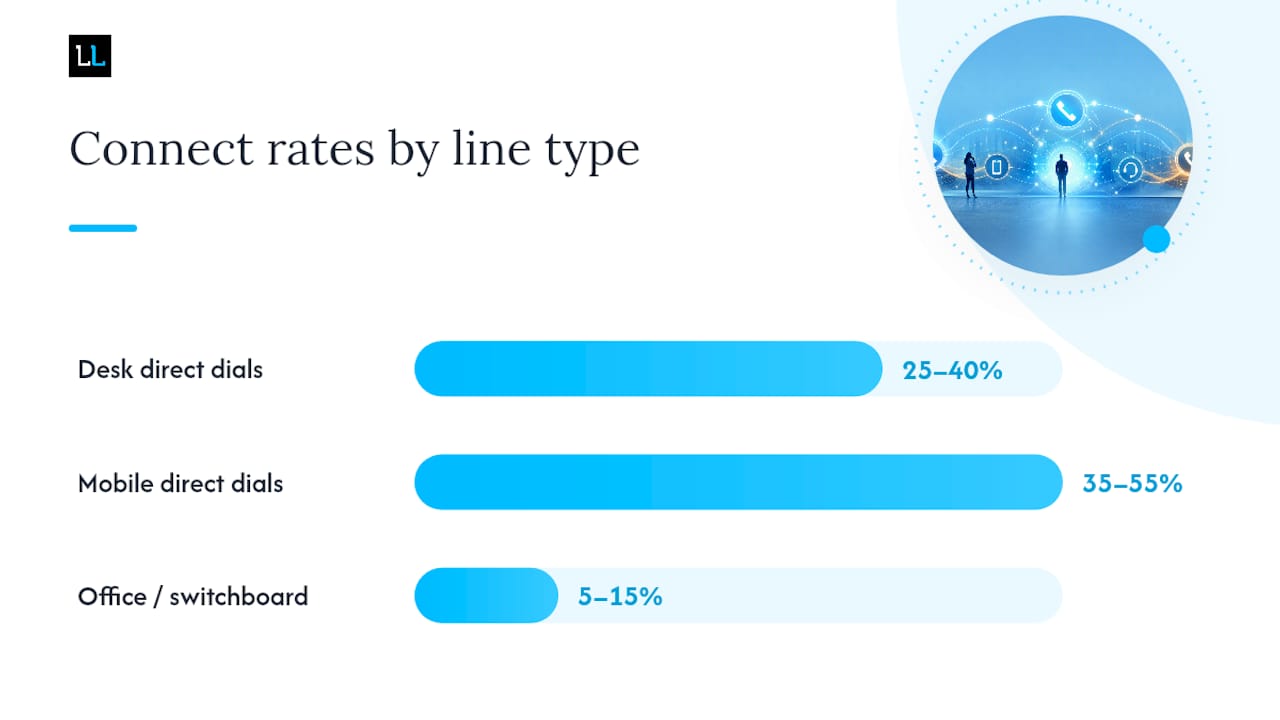
- A typical direct dial converts at 25% to 40% for desk phones, whereas office or switchboard lines only achieve 5% to 15%, making verification crucial.
- An in-house pilot of 50-100 manually verified numbers can establish a baseline before investing in larger data purchases or vendor services.
- Sequencing direct dials after two or three LinkedIn touches consistently yields better results than dialing cold on day one.
Table of Contents
- What Is a B2B Direct Dial, and How Does It Differ from Mobile or Office Numbers?
- Why Direct Dials Matter: The Connect-Rate Math Behind Pipeline Growth
- How to Find Direct Dials: Manual Research and Scalable Tools
- How to Evaluate Direct-Dial Data Quality Before You Buy
- Best Practices for Working Direct Dials into a Multi-Channel Cadence
- Storing and Maintaining Direct Dials Inside Your CRM
- How The Lead Lab Tests and Deploys Direct Dials in Live Campaigns
- What Actually Moves the Needle: A Prioritization Take
- A Faster Path to Verified Contacts and Booked Meetings
- Sources
What Is a B2B Direct Dial, and How Does It Differ from Mobile or Office Numbers?
A direct dial, technically a Direct Inward Dialing (DID) number, connects a caller straight to one person’s desk phone without routing through a receptionist or an automated menu. The technical mechanics of DID and PBX routing explain why this matters: every extra step between a dial and a live voice costs you a chance at contact.
The three number types behave very differently in the field. Desk direct dials typically land connect rates between 25% and 40%, since they skip the gatekeeper entirely.
Which number to prioritize depends on the role and the size of the company. At a startup or small firm, the “office number” might ring directly to the founder’s desk anyway, so the distinction barely matters. At an enterprise account, a VP’s desk DDI is worth pursuing hard, but treat a personal mobile number with more care. Mobile numbers carry a personal, off-the-clock quality that a badly timed cold call can burn quickly. For most first-touch B2B outreach, a verified desk direct dial is the safer default, with mobile reserved for warmer, more qualified contacts.
Why Direct Dials Matter: The Connect-Rate Math Behind Pipeline Growth
Reaching a prospect through a standard business line typically takes 8 to 18 dials before you get a live conversation. That number alone explains why so many outbound teams burn out on activity metrics without booking meetings. Every dial that goes to a switchboard, gets forwarded to a wrong extension, or drops into voicemail is a dial that produced zero information and zero progress.
Run the arithmetic on a five-person SDR team. Over a month, that difference compounds into dozens of extra qualified conversations, and a meaningful chunk of those become booked meetings.
Connect Rate Snapshot:
*Desk direct dials convert at 25% to 40%, mobile direct dials at 35% to 55%, and general office or switchboard lines at just 5% to 15%.
The scale effect matters more as team size grows. A ten-rep team wasting half its dial volume on unreachable switchboard numbers is effectively running with five reps’ worth of productive output. Set your own targets against these ranges rather than an arbitrary “calls per day” quota. A rep who makes fewer dials but hits a higher percentage against verified direct numbers will consistently outproduce a rep grinding through a stale contact list. The math rewards accuracy over volume, every time.
How to Find Direct Dials: Manual Research and Scalable Tools
Sourcing direct dials splits into two broad approaches: manual digging for a handful of high-value accounts, and tool-assisted enrichment when you need coverage across hundreds or thousands of contacts. Most experienced teams use both, depending on deal size.
Manual methods work well for your top-tier target accounts:
- Search LinkedIn profiles and the “Contact Info” section, where some professionals list a direct number.
- Scan email signatures from any prior correspondence, newsletter sign-ups, or press mentions; direct lines often appear there even when the main website hides them.
- Check company “leadership” or “team” pages, which sometimes list department extensions or direct numbers for senior staff.
- Review press releases and conference speaker bios, where PR teams sometimes include a direct media contact line that traces back to the right department.
When you need faster coverage, on-demand enrichment tools fill the gap. These accept a name and company, or a LinkedIn URL, and return a verified number in seconds. Enrichment platforms that support name and company or LinkedIn URL inputs work well for single-record lookups when a rep is prepping for one specific call, and many run as browser extensions that pull data directly from a LinkedIn profile page without leaving the tab.
For teams that need hundreds or thousands of records at once, bulk data providers become the more efficient route. The trade-off is coverage versus verification: a provider promising huge database size may have thinner phone-number accuracy than a smaller, more rigorously verified dataset. Before committing budget, ask exactly how a provider verifies its numbers and how recently.
A practical sourcing workflow looks like this:
- Build your target account list and pull contacts through LinkedIn Sales Navigator, filtering by title, seniority, and company size.
- Feed each contact into an enrichment tool or vendor API to return a verified direct dial and mobile number where available.
- Push the enriched record straight into your CRM with the source and verification date attached as custom fields.
- Flag any contact where enrichment returns no result for manual research, rather than leaving the field blank and losing track of it.
- Route verified numbers into your outreach sequence tool so reps see the correct number type without hunting for it themselves.
This kind of layered approach, matching sourcing effort to account value, keeps cost proportional to opportunity. A $2 million enterprise deal justifies ten minutes of manual digging on LinkedIn; a $5,000 self-serve deal does not. Building a properly segmented prospecting list before you enrich a single record saves you from paying to verify contacts you were never going to call anyway.
How to Evaluate Direct-Dial Data Quality Before You Buy
Not all “verified” phone data means the same thing, and that single word hides a lot of variation in method. Some vendors verify numbers through database cross-matching against public records. Others run live call verification, where a human researcher actually dials the number to confirm it rings through to the named contact. The second method costs more to maintain but produces meaningfully more reliable results, particularly for direct dials that change often as people switch roles or companies.
Before signing a contract, ask every vendor these specific questions:
- What verification method do you use: database matching, live call checks, or both?
- What is the last-verified date on this specific contact, not just the database as a whole?
- Do you publish a confidence score per record, and how is it calculated?
- What is your coverage rate by role and industry for my target segment specifically?
- Can you provide a sample connect-rate figure from real customer campaigns?
A vendor who hesitates on any of these, or answers only in vague terms like “high accuracy,” is worth treating with suspicion. Vendors that publish clear verification methodology and human-checked re-verification give you something concrete to hold them to later.
Connect-Rate Reality Check:
Direct dials that go unverified for more than 90 days often show measurable decay in accuracy, since people change roles, companies restructure, and extensions get reassigned. A “last verified” timestamp inside 60 days is a reasonable quality bar for any B2B phone-data vendor.

The most reliable way to test a vendor’s claims is to request a small sample export and run it as an A/B test against your existing contact list. Pull a set of 100 to 200 records, dial them over two weeks alongside your normal cadence, and track connect rate and wrong-number rate separately. If the sample underperforms the vendor’s advertised numbers by a wide margin, that’s a red flag worth raising before any larger purchase. Other red flags include no clear last-verified date anywhere in the data, refusal to share methodology, and pricing that seems too low relative to competitors offering live-verified data. Cheap, stale data usually costs more in wasted rep hours than it saves in subscription fees.
Best Practices for Working Direct Dials into a Multi-Channel Cadence
A direct dial works best as a pattern interrupt, not the opening move. Prospects who’ve already seen your name in an inbox or a LinkedIn notification are far more likely to pick up an unfamiliar number, because some part of their brain has already filed you as a known quantity rather than a stranger.
A sequence that tends to perform well:
- Send an initial email introducing the reason for outreach, tied to a specific trigger or pain point.
- Send a LinkedIn connection request or comment on recent activity within a day or two.
- Follow with a second, shorter email referencing the LinkedIn touch.
- Place the first direct-dial call around day 5 or 6, once the name has appeared at least twice already.
- If no connect, follow with a brief voicemail and a same-day email referencing the call attempt.
- Repeat the call two to three times over the following week, spaced a few days apart.
- After 6 to 8 total attempts with no response, shift the contact into a longer nurture sequence rather than continuing to dial.
Recommended attempt ceilings generally run two to three direct-dial attempts per week, moving unresponsive contacts to nurture after six to eight total tries. Beyond that point, additional dials produce diminishing returns and start to feel like pressure rather than persistence.
Prioritization should follow intent signals, not just account tier. A contact who opened three emails, visited your pricing page, or engaged with a LinkedIn post deserves a direct-dial attempt ahead of a cold name pulled straight from a list, even if the cold name sits at a bigger company. High-performing teams often schedule their strongest dial block of the day against warm, intent-signaled accounts rather than working the list top to bottom.
Mobile numbers deserve a different etiquette than desk lines. Calling a personal mobile outside standard business hours, or repeatedly after no response, reads as intrusive in a way a desk-line voicemail does not. Respect any opt-out request immediately and keep mobile scripts shorter and more direct about why you’re calling.
Pro Tip: Record which channel triggered each connect, email, LinkedIn, or cold direct dial, so you can see over a quarter which sequencing pattern actually drives conversations for your specific audience rather than relying on general benchmarks.
Pairing call attempts with tactical LinkedIn touches between dials keeps your name visible without adding call volume, which matters more the longer a sequence runs.
Storing and Maintaining Direct Dials Inside Your CRM
Phone data degrades fast if nobody owns its upkeep. A number that was accurate six months ago might now belong to someone in a different department, or the contact may have left the company entirely.
Build these fields into your CRM contact record from the start:
- A dedicated “direct phone” field, separate from the general office number field, so reps never confuse the two.
- A “mobile phone” field with its own separate verification status.
- A “source” field noting exactly where the number came from: manual research, a named vendor, or LinkedIn.
- A “last verified” date field, updated every time someone confirms the number still works.
- A “do not call” flag tied to any opt-out request, checked automatically before a sequence tool dials that record.
Setting up these fields properly, an approach outlined in guidance on finding and structuring direct phone numbers for decision-makers, means you can report on data quality by source over time, not just guess at it.
Run a refresh cycle quarterly at minimum, re-verifying any contact who hasn’t been dialed successfully in that window. Some CRMs support automated verification triggers that flag a record for re-check after a set number of failed dial attempts, which saves reps from manually noticing the pattern. Reporting on ROI by source, comparing meeting-set rates for vendor A’s numbers against vendor B’s or manually sourced contacts, tells you within a quarter which sourcing method is actually worth renewing.
How The Lead Lab Tests and Deploys Direct Dials in Live Campaigns
Every managed campaign starts the same way: target selection, then enrichment, then a verification pass before a single call gets made. Contacts move from LinkedIn-sourced targeting into phone and email enrichment, get checked against known bounce and disconnect patterns, and only then enter the active cadence.
The pattern that shows up most consistently across live campaigns: a direct dial placed after two or three LinkedIn touches converts noticeably better than the same number dialed cold on day one. Sequencing does more work than the phone number itself.
A sample of 150 to 200 accounts is usually enough to see whether a sourcing approach is working before committing a full quarter’s list to it. Tracking appointments booked per dial block, not just raw connect rate, is what actually tells you whether the sequence is producing pipeline rather than just conversations.
What Actually Moves the Needle: A Prioritization Take
Most teams overspend on database size and underspend on verification. A smaller list of live-verified direct dials will consistently outperform a massive list of stale numbers, because every wrong number costs a rep several minutes and a chunk of morale. If your budget is tight, run an in-house pilot first: manually source 50 to 100 direct dials for your best accounts, track the connect rate for two weeks, and use that as your baseline before paying for a managed provider or bulk data contract.
The heuristic I’d give any budget-constrained sales leader: spend on verification before you spend on volume. A hundred confirmed numbers beat a thousand unverified guesses every time. Start this week by pulling twenty of your stalled opportunities and manually verifying their direct-dial numbers through LinkedIn before your next call block.
— Toby
A Faster Path to Verified Contacts and Booked Meetings
Running an in-house pilot teaches you what works, but scaling it, sourcing, verifying, and sequencing hundreds of contacts every month, is a full-time operation most sales teams don’t have spare capacity to run. The Lead Lab handles that entire pipeline as a managed service: targeted prospecting, verified contact enrichment, personalized outreach copy, and response handling, all built specifically for professional services firms that need booked meetings, not just a spreadsheet of phone numbers.
The practical difference is what lands on your calendar. Instead of a vendor handing you a raw list to dial yourself, The Lead Lab combines LinkedIn-based targeting with enrichment and a managed cadence, so qualified meetings show up ready to take rather than requiring your team to run the sourcing, verification, and follow-up sequence on top of their existing pipeline. That’s the trade worth making once an in-house pilot proves the model works but your team lacks the hours to run it at scale.
If you’ve tested direct dials manually and seen the lift, the next step is worth a look. Check the case studies and results on The Lead Lab’s portfolio to see how the model plays out for firms similar to yours, then visit The Lead Lab to request a demo and get a specific plan for your target accounts.
Sources
The connect-rate benchmarks and sequencing guidance throughout this article draw on ZoomInfo’s direct dial and connect-rate research, which covers the 8 to 18 dials-to-contact benchmark and PECR compliance context for B2B calling. Comparison data on desk, mobile, and switchboard connect rates comes from LFB’s breakdown of verified direct dials. Vendor evaluation criteria and verification methodology guidance are detailed in Lead411’s guide to B2B phone data providers. For a look at how on-demand enrichment tools function, see Generect’s phone number finder overview.
- B2B Direct Dials: How to Improve Connect Rates in 2026
- B2B Direct Dials: Find Verified Direct Dials
- B2B Data Providers with Phone Numbers (2026): Direct Dial vs Office vs HQ Explained