
TL;DR:
- Demo calls are crucial in B2B sales because they significantly influence purchase decisions and pipeline progression.
- Effective demos focus on discovery, personalization, and managing the conversation rather than just showcasing features.
A demo call is the single most influential touchpoint in the B2B sales process, with 77% of enterprise buyers naming it the top factor in their purchase decision. The role of demo calls in sales goes far beyond showing a product. A well-run demo is an interactive conversation that uncovers buyer needs, connects product value to specific pain points, and advances the deal toward a close. For sales professionals and business leaders, understanding what separates a high-converting demo from a wasted hour is the difference between a full pipeline and a stalled one.
What is the role of demo calls in sales conversion?
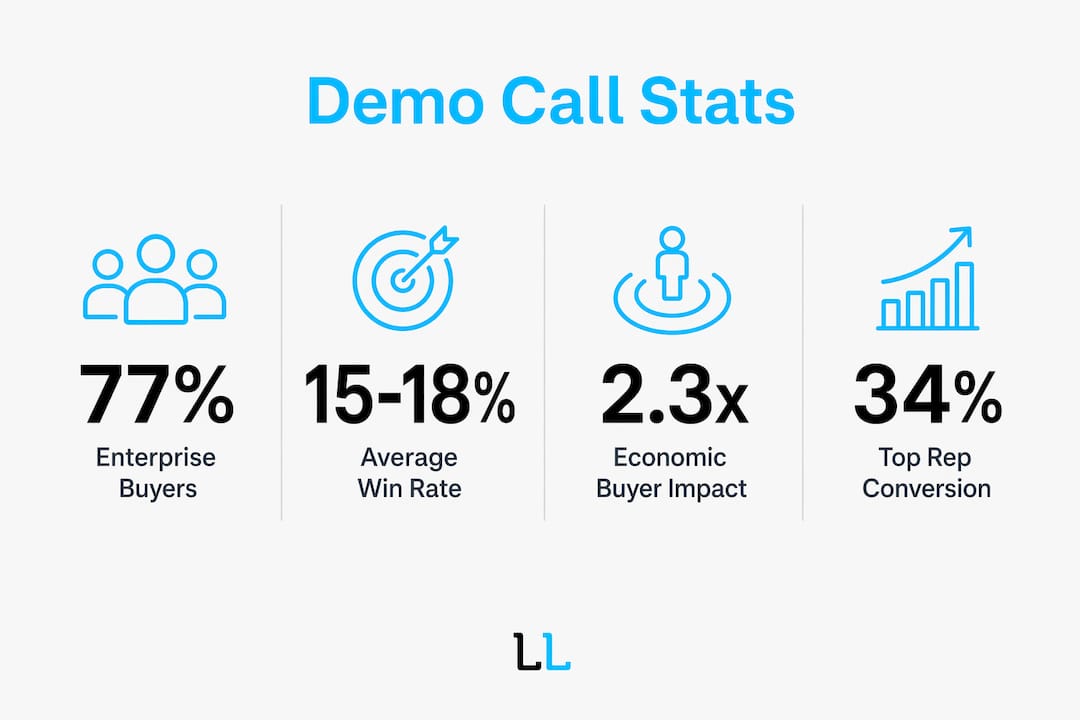
Demo calls are the primary mechanism for turning qualified interest into committed pipeline. Top-quartile reps achieve demo-to-close rates of 17–34%, while the overall market average sits at 15–18%. That gap is not explained by product quality. It is explained by how the demo is run.
Three factors drive the difference between top and bottom performers.
- Discovery quality. Top-quartile discovery-to-demo conversion rates hit 34%, while bottom-quartile reps land at 11%. The variance comes almost entirely from how well a rep qualifies the prospect before the demo begins, not from the demo content itself.
- Attendee composition. Demos with economic buyers present convert 2.3x higher than those without a decision-maker in the room. Getting the right people on the call is as important as the call itself.
- Personalization. Generic product walkthroughs underperform. Personalized demos lift conversions 40–50% over generic ones. That means tailoring the flow, the examples, and the language to the specific buyer’s role and priorities.
The demo call impact on sales is not random. It is a direct output of preparation, qualification, and customization. Reps who treat the demo as a rehearsed presentation will consistently underperform those who treat it as a structured conversation.
Pro Tip: Before every demo, confirm who will be attending and their specific role in the buying decision. If the economic buyer is not on the call, reschedule rather than proceed with a lower-probability meeting.

What do effective demo call techniques look like in 2026?
The most common demo failure is what sales coaches call “training mode.” A rep logs on, shares their screen, and walks through every feature in sequence. The buyer goes quiet. The rep talks for 25 minutes. Nothing is learned about the buyer’s actual problem, and nothing is sold.
Elite sales engineers cap live walkthroughs at 15 minutes of a 30-minute call. The rest of the time goes to discovery, dialogue, and objection handling. This is not a minor adjustment. It is a fundamental shift in how the call is structured.
Here is what effective demo call techniques look like in practice:
- Open with a discovery recap. Restate what you learned in the qualification call. Confirm the buyer’s priorities before touching the product. This signals you listened and sets the agenda on their terms.
- Cap the live walkthrough at 15 minutes. Show only what is directly relevant to the buyer’s stated problems. Skip everything else.
- Maintain a 50/50 talk-to-listen ratio. Best-performing reps check in every 1.5–2 minutes with a question or a pause. Talking past 70% of the call is a signal the demo has shifted into presentation mode.
- Handle objections in real time. Do not defer every question to the end. Addressing concerns as they arise keeps the buyer engaged and prevents objections from compounding.
- Close with a defined next step. Every demo should end with a Mutual Action Plan or a specific follow-up commitment. “I’ll send over some information” is not a next step.
Shifting from presentation mode to conversation mode is the single biggest lever most reps can pull to improve demo performance. It requires discipline, but the payoff in engagement and conversion is direct.
Pro Tip: Record your demos and review the talk-to-listen ratio. Most reps are shocked to find they speak 75–80% of the time. Aim for 50% and watch engagement scores climb.
Why do some deals skip live demos entirely?
Not every deal needs a live demo. For lower-value deals, a live 30-minute call is often the least efficient path to a close. Efficient sales teams eliminate live demos for deals under $25,000 ACV, replacing them with short recorded walkthroughs and self-serve sandboxes.
The results are significant. These asynchronous approaches accelerate conversions 2–3x and reduce friction for buyers who prefer to evaluate on their own schedule. A five-minute Loom video a buyer can watch twice at their own pace often outperforms a 30-minute live call they half-attend between other meetings.
There are clear scenarios where skipping the live demo makes sense:
- Deal value under $25,000 ACV. The time cost of scheduling, running, and following up on a live demo often exceeds the deal margin at this level.
- Buyer has already seen a competitor demo. A short, targeted recorded walkthrough focused on differentiation is more efficient than a full live session.
- Prospect is in early research mode. A self-serve sandbox lets them explore at their own pace without requiring a sales rep’s time.
- No economic buyer available. Rather than running a demo to a champion who cannot close, send an asynchronous walkthrough they can share internally.
This connects directly to the benefits of sales demos in a broader sense. The goal is not to run a demo. The goal is to advance the deal. Sometimes the most effective demo is one the buyer watches alone, pauses, rewinds, and shares with three colleagues before you ever speak again.
For prospect segmentation strategies that help route buyers to the right demo experience, the approach starts before the first outreach message is sent.
How do demo calls fit into the larger sales team structure?
A demo is not a solo performance. It is a team event, and sales must control it even when technical experts are presenting. Demo delivery requires sales reps to actively manage the flow, rescue presenters who go off track, provide summaries, and lock down next steps before the call ends.
The sales rep’s job during a demo includes four specific responsibilities:
- Presenter rescue. When a technical presenter goes too deep into a feature or loses the room, the sales rep steps in with a redirecting question or a summary statement.
- Intermediate summaries. After each major section, the rep recaps what was shown and ties it back to the buyer’s stated need. This keeps the narrative coherent.
- Objection capture. The rep tracks questions and concerns raised during the demo and addresses them before the call closes.
- Next-step commitment. The rep closes the call with a Mutual Action Plan, a specific date, and a clear owner for each action item.
Interactive leave-behind demos extend the demo’s reach beyond the call itself. These are short, clickable product experiences a champion can share with stakeholders who were not on the live call. Teams that use leave-behind demos give their internal champions a tool to sell on their behalf. The 48% of teams that send these assets after calls are not just being thorough. They are influencing buying committee members they may never speak to directly.
Effective follow-up after demos is where many deals are won or lost. A strong demo with weak follow-up loses to a mediocre demo with disciplined post-call execution.
Key Takeaways
The role of demo calls in sales is determined by discovery quality, attendee composition, and whether the call runs as a conversation rather than a presentation.
| Point | Details |
|---|---|
| Discovery drives conversion | Top-quartile reps hit 34% discovery-to-demo conversion by qualifying rigorously before the call. |
| Economic buyers change outcomes | Demos with decision-makers present convert 2.3x higher than those without them. |
| Personalization lifts close rates | Tailored demos outperform generic walkthroughs by 40–50% in conversion rate. |
| Async demos suit lower ACV deals | For deals under $25,000 ACV, recorded walkthroughs and sandboxes accelerate conversions 2–3x. |
| Sales must control the room | Reps must manage summaries, rescues, and next-step commitments even when technical experts present. |
What I’ve learned from watching demos fail in real time
Most demo problems are not product problems. They are mindset problems. The rep believes their job is to show the product. The buyer believes their job is to evaluate it. Neither person is having a conversation. Both are performing.
The demos I have seen convert at the highest rates share one trait: the rep is genuinely curious about the buyer’s situation. They ask follow-up questions that were not on any script. They skip features that are not relevant, even impressive ones. They say “that part probably isn’t relevant to what you described” and move on. That kind of discipline is rare, and buyers notice it immediately.
The other pattern I keep seeing is the failure to control the room during technical presentations. A sales engineer goes deep on an integration the buyer never asked about. The buyer goes quiet. The rep says nothing because they do not want to interrupt their colleague. The call ends without a clear next step, and the deal stalls. Sales reps must be willing to redirect, summarize, and close even when it feels awkward.
The modern demo ecosystem involving multiple stakeholders and asynchronous content is not a trend. It is the new baseline for complex B2B buying groups. Reps who still think of a demo as a single 30-minute event are operating with an outdated model.
My honest recommendation: treat every demo as a discovery call that happens to include a product. Ask more than you show. Listen more than you talk. And always, always leave with a specific next step confirmed before you hang up.
— Toby
How The Lead Lab helps you fill your demo calendar
Getting a demo call right starts with getting the right prospects into your calendar. If your pipeline is thin or your demo no-show rate is climbing, the problem often starts upstream in outreach and qualification.
The Lead Lab specializes in LinkedIn outreach campaigns built specifically for professional services firms. The team handles prospect targeting, message copywriting, response management, and campaign analytics so your sales reps spend time running demos, not chasing cold leads. If you want to see what a full pipeline of qualified, pre-screened demo appointments looks like for your firm, explore client results and case studies from firms that have already made the shift.
FAQ
What is the average demo-to-close rate in B2B sales?
Overall demo-to-close win rates sit at 15–18% in 2026. Top-quartile reps achieve 17–34% by prioritizing discovery quality and ensuring economic buyers attend the call.
How long should a sales demo call be?
A 30-minute call is standard, but the live product walkthrough should not exceed 15 minutes. The remaining time should go to discovery, dialogue, and securing a defined next step.
Why do demos with economic buyers convert higher?
Demos that include a decision-maker convert 2.3x higher because the person with authority to approve the deal can ask questions, raise objections, and commit in real time rather than relaying information secondhand.
When should you skip a live demo?
For deals under $25,000 ACV, a short recorded walkthrough or self-serve sandbox often converts faster and with less friction than a scheduled live call. Route prospects to the right demo format based on deal size and buyer readiness.
What is a leave-behind demo?
A leave-behind demo is a short, interactive product experience sent after a live call. It lets champions share the product with stakeholders who were not on the original call, extending the demo’s influence into the buying committee.