
TL;DR:
- B2B appointment setting involves scheduling confirmed meetings between qualified prospects and sales teams, occupying the middle of the sales funnel. Effective processes require clear ICP definition, precise outreach, quality handoffs, and technology tools that track and optimize performance. Success hinges on qualified meetings rather than raw booking volume, with measurable KPIs like show and conversion rates guiding continual improvement.
B2B appointment setting is the specialized process of scheduling confirmed meetings between qualified business prospects and your sales team, sitting at the top of the sales funnel where outreach converts into real pipeline. Sales Development Representatives (SDRs) and Business Development Representatives (BDRs) own this function, handling prospecting, qualification, and scheduling so that Account Executives can focus entirely on discovery and closing. Without a structured appointment setting process, even the best closers spend too much time chasing cold leads instead of converting warm ones. The result is a slower pipeline, lower conversion rates, and wasted sales capacity.
How does B2B appointment setting fit into the sales funnel?
B2B appointment setting occupies the middle layer of the sales funnel, sitting between lead generation and the discovery call. Lead generation surfaces potential buyers through content, advertising, or outbound prospecting. Appointment setting takes those raw leads and converts them into scheduled, confirmed meetings with decision-makers. The discovery call is where the Account Executive takes over to diagnose needs and present solutions.
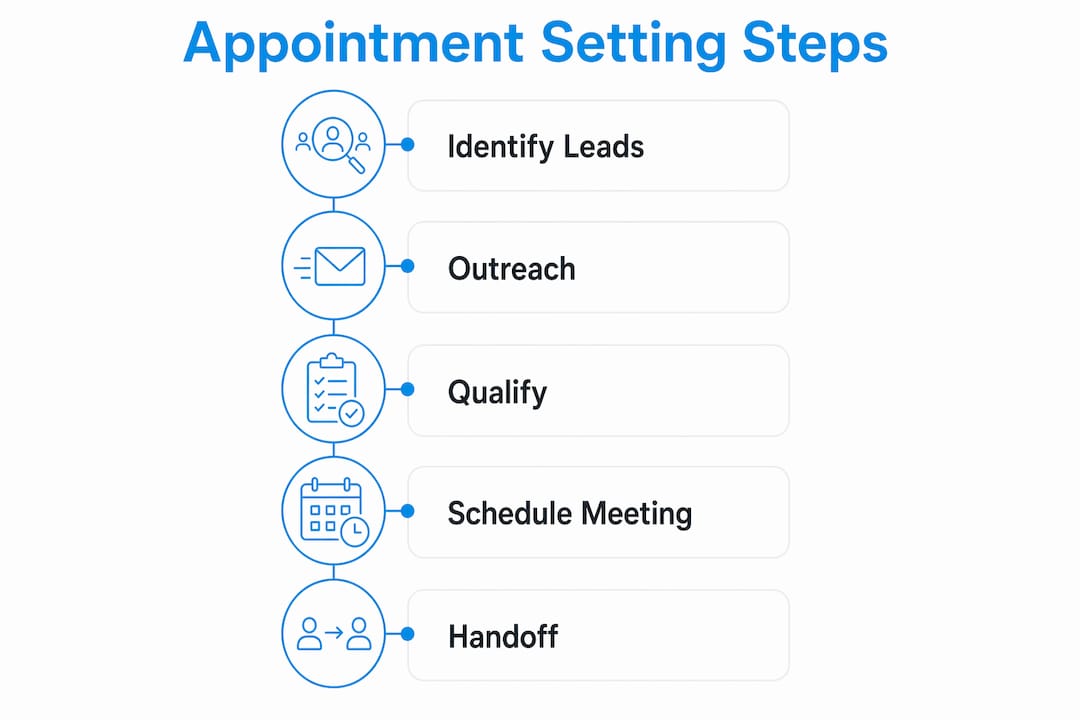

The distinction between lead generation and appointment setting matters more than most sales teams acknowledge. Lead generation produces a list. Appointment setting produces a calendar. These are fundamentally different outcomes that require different skills, tools, and success metrics.
Here is how the handoff typically flows across the funnel:
- Lead generation: Marketing or SDRs identify potential buyers through LinkedIn, paid ads, content downloads, or outbound lists.
- Prospect research: SDRs verify decision-maker identity, company fit, and contact details before outreach begins.
- Outreach and qualification: Multi-channel contact via phone, email, and LinkedIn to confirm need, authority, budget, and timing.
- Appointment scheduling: A confirmed meeting is placed on the calendar with both the prospect and the assigned Account Executive.
- Handoff: The SDR passes a detailed briefing note to the Account Executive, including pain points, conversation history, and qualification data.
- Discovery and closing: The Account Executive runs the meeting, diagnoses the problem, and advances the deal.
Specialization in appointment setting allows Account Executives to focus on complex discovery and closing activities, which directly increases overall sales efficiency. When closers spend their time closing instead of cold calling, win rates improve and sales cycles shorten. The handoff quality is where this model either succeeds or breaks down. A poor handoff forces the Account Executive to re-qualify the prospect from scratch, wasting time and creating friction that kills deals before they start.
What are the key steps and best practices in B2B appointment setting?
Effective appointment setting follows a repeatable system. Campaigns that treat it as ad hoc outreach consistently underperform against those that build structured, data-informed processes. The following steps form the foundation of any high-performing appointment setting operation.
-
Define your Ideal Customer Profile (ICP). A well-defined ICP specifies industry, company size, geography, job title, and the specific pain points your solution addresses. Without this, outreach volume is high and conversion is low.
-
Build and verify your prospect list. Use data enrichment tools to confirm contact details, job titles, and company information before any outreach begins. Outdated data wastes time and damages sender reputation.
-
Identify decision-makers. Reaching the right person matters more than reaching many people. Map the buying committee and prioritize contacts with authority over the problem your solution solves.
-
Execute multi-channel outreach. Phone, email, and LinkedIn each serve a different role in the sequence. LinkedIn builds familiarity before a cold call. Email allows detailed value propositions. Phone calls create direct human connection. Rotating channels prevents prospect fatigue and protects domain reputation.
-
Qualify using a structured framework. BANT (Budget, Authority, Need, Timing) remains the most widely used qualification framework in B2B sales. It filters out prospects who cannot buy, ensuring that booked meetings have genuine conversion potential.
-
Confirm and remind. Confirmation sequences with reminders sent 48 hours and 2 hours before the meeting reduce no-show rates from 30 to 40 percent down to under 15 percent. This single tactic has a larger impact on pipeline output than most teams realize.
-
Log everything in your CRM. Salesforce, HubSpot, and similar platforms track outreach activity, qualification notes, and meeting outcomes. Consistent CRM discipline is what separates scalable appointment setting from one-person heroics.
Pro Tip: Write your handoff notes as if the Account Executive has never heard of the prospect. Include the exact pain point the prospect mentioned, the specific trigger that made them open to a conversation, and any objections they raised. This context turns a cold discovery call into a warm one.
You can also explore LinkedIn outreach tactics that complement these steps by building prospect familiarity before the first direct contact.
How do B2B appointment setting tools and technology improve the process?
The right technology stack does not replace skilled appointment setters. It removes the manual friction that slows them down and gives managers the visibility to optimize performance. CRM and automation tools enable scalable outreach, personalized multi-channel sequences, confirmation reminders, and performance analytics in one connected system.
| Tool category | Primary function | Examples |
|---|---|---|
| CRM platforms | Pipeline tracking, contact management, activity logging | Salesforce, HubSpot |
| Email sequencing | Automated multi-step outreach with personalization | Outreach, Salesloft |
| LinkedIn automation | Scaled connection requests and message sequences | LinkedIn Sales Navigator |
| Scheduling software | Calendar booking and automated reminders | Calendly, Chili Piper |
| Data enrichment | Contact verification and company intelligence | Apollo.io, ZoomInfo |
| Analytics dashboards | KPI tracking, conversion reporting, campaign performance | Native CRM reporting |
CRM platforms like Salesforce and HubSpot sit at the center of any serious appointment setting operation. They connect outreach activity to pipeline outcomes, making it possible to see exactly which messages, channels, and prospect segments produce the most held meetings. Email sequencing tools like Outreach and Salesloft automate follow-up cadences while preserving personalization at scale. LinkedIn Sales Navigator gives SDRs the targeting filters needed to build precise prospect lists matched to a defined ICP.
Scheduling tools like Calendly and Chili Piper remove the back-and-forth of finding a meeting time. When a prospect agrees to a call, they book directly into the Account Executive’s calendar. This reduces the gap between agreement and confirmed meeting, which is when most no-shows originate. Data enrichment platforms like Apollo.io and ZoomInfo verify that contact details are current before outreach begins, protecting sender reputation and improving deliverability.
The combination of these tools creates a closed-loop system where every outreach action is tracked, every meeting outcome is recorded, and every campaign can be refined based on real performance data.
What metrics define success in B2B appointment setting?
The most important distinction in measuring appointment setting performance is the difference between meetings booked and meetings held with qualified prospects. Booked meetings are a vanity metric if the prospect does not show up or was never properly qualified. Meetings held with decision-makers who match the ICP are the only metric that drives pipeline.
The core KPIs worth tracking are:
- Show rate: The percentage of booked meetings where the prospect actually attends. A healthy show rate sits above 75 percent. Below 60 percent signals qualification or confirmation sequence problems.
- Lead-to-meeting conversion rate: Appointment setters typically convert 2 to 5 percent of outbound outreach into booked qualified meetings. This benchmark helps set realistic volume expectations for outreach activity.
- Meeting-to-opportunity rate: The percentage of held meetings that advance to a formal sales opportunity. Low rates here indicate a qualification problem, not a closing problem.
- Monthly meeting volume: Benchmarks of 20 to 40 meetings per setter per month are realistic at steady state, depending on deal complexity and outreach scale.
Timeline expectations matter as much as the metrics themselves. First booked meetings often appear within 7 to 14 days of campaign launch, but stable meeting velocity typically takes 6 to 8 weeks to achieve. Early weeks focus on ICP refinement, list building, CRM integration, and initial message testing before results stabilize. Teams that judge a campaign in week two are measuring setup, not performance.
Pro Tip: Run a monthly audit of your held meetings against your ICP definition. If more than 20 percent of held meetings fall outside your ICP, your qualification criteria need tightening before you increase outreach volume.
Campaigns that treat appointment setting as a closed-loop learning system and adjust targeting and messaging through ongoing data analysis consistently improve 30 to 50 percent in meeting volume after the initial setup and testing phase. The teams that plateau are the ones that stop refining after the first results appear.
Key takeaways
B2B appointment setting drives pipeline velocity only when meetings held with qualified prospects are prioritized over raw booking volume.
| Point | Details |
|---|---|
| Definition and function | Appointment setting schedules confirmed meetings between qualified prospects and sales closers, sitting between lead gen and discovery. |
| Role specialization | SDRs and BDRs own outreach and qualification so Account Executives can focus on closing, improving overall sales efficiency. |
| Confirmation sequences | Sending reminders 48 hours and 2 hours before a meeting reduces no-show rates from 30 to 40 percent down to under 15 percent. |
| Technology stack | CRM platforms, email sequencing tools, and scheduling software create a connected system that tracks and improves every campaign. |
| Performance timeline | Stable meeting velocity takes 6 to 8 weeks to achieve; campaigns improve 30 to 50 percent after initial setup and testing. |
Why most appointment setting programs underperform (and what actually fixes it)
The conventional advice on appointment setting focuses almost entirely on volume. More calls, more emails, more LinkedIn messages. In my experience working with professional services firms, that instinct is exactly backwards. The teams that book the most meetings are rarely the ones with the highest outreach volume. They are the ones with the tightest ICP definition and the most disciplined handoff process.
The most common failure I see is the handoff. An SDR books a meeting, logs a one-line note in the CRM, and moves on. The Account Executive walks into the discovery call knowing almost nothing about why the prospect agreed to meet. That call feels cold to the prospect, and cold calls close at a fraction of the rate of warm ones. The fix is not a new tool. It is a structured handoff template that captures pain points, conversation context, and qualification evidence every single time.
The second issue is automation overreach. Tools like Outreach and Salesloft are genuinely powerful, but teams use them to send the same generic sequence to every prospect on the list. Prospects recognize templated outreach immediately, and response rates collapse. The better approach is to use automation for timing and delivery while keeping the message itself specific to the prospect’s role, industry, and likely pain point. That combination of scale and specificity is where the real conversion gains live.
Scaling appointment setting without degrading meeting quality is possible, but it requires treating the process as a system rather than a headcount problem. Adding more SDRs to a broken process just produces more bad meetings faster. Fix the ICP, fix the handoff, and fix the messaging before you scale the team.
— Toby
How Theleadlab helps you book better B2B meetings
Theleadlab specializes in done-for-you B2B appointment setting and LinkedIn outreach campaigns built specifically for professional services firms. Every campaign starts with a precise ICP definition, moves through personalized multi-channel sequencing, and delivers qualified meetings directly into your sales team’s calendar. Response management, CRM integration, and campaign analytics are all included, so your Account Executives spend their time in discovery calls rather than chasing cold leads. If you want to see what results look like in practice, the client campaign results on the portfolio page show real meeting volumes and pipeline outcomes from firms in your sector.
FAQ
What is B2B appointment setting?
B2B appointment setting is the process of identifying qualified business prospects, contacting decision-makers through phone, email, or LinkedIn, and scheduling confirmed meetings between those prospects and a sales team. It sits between lead generation and the sales discovery call in the funnel.
How is appointment setting different from lead generation?
Lead generation identifies and surfaces potential buyers. Appointment setting qualifies those leads and converts them into confirmed calendar meetings. Lead generation produces a list; appointment setting produces a booked call with a decision-maker.
How long does it take to see results from appointment setting?
First booked meetings typically appear within 7 to 14 days of campaign launch, with stable and consistent meeting volume achieved by weeks 6 to 8 as targeting and messaging are refined.
What is a realistic conversion rate for outbound appointment setting?
Appointment setters convert roughly 2 to 5 percent of outbound outreach contacts into booked qualified meetings, with top performers reaching 20 to 40 held meetings per month depending on outreach scale and deal complexity.
What tools do B2B appointment setting teams use?
The core stack includes a CRM like Salesforce or HubSpot for pipeline tracking, an email sequencing platform like Outreach or Salesloft, LinkedIn Sales Navigator for prospect targeting, and a scheduling tool like Calendly or Chili Piper to reduce no-shows and simplify booking.
From the bottom of my heart, thank you for being a source of positivity and light in this sometimes dark and overwhelming world
Let us know in the comments which of their posts has resonated with you the most.